CZ Says Software Wallets Avoid Risks Seen in Trezor Leak
A data breach at Trezor’s shipping partner has exposed the home addresses of 13,700 customers, triggering a high-profile debate about the security trade-offs between hardware and software self-custody wallets. For institutional investors evaluating custody infrastructure, the incident underscores that physical device shipment creates distinct vulnerabilities absent from software-only solutions, even as hardware wallets retain advantages in protecting private keys from online attack.

- Trezor disclosed that ShipMonk, its logistics partner, suffered a breach exposing names, phone numbers, and home addresses of approximately 13,700 recent customers.
- Binance founder CZ argued the breach demonstrates a real security advantage of software wallets like Trust Wallet and Binance Web3 Wallet, which require no physical shipment linking identity to crypto holdings.
- Security researchers flagged that exposed customer addresses could enable targeted physical attacks, social engineering campaigns, and wrench attacks against known hardware wallet owners.
- 13,700 Recent Trezor customers affected by ShipMonk data breach exposure
- $100M+ Bitcoin stolen in separate Coldcard firmware randomness vulnerability
- Mid-July ZachXBT public criticism of all hardware wallets as unsuitable for serious use
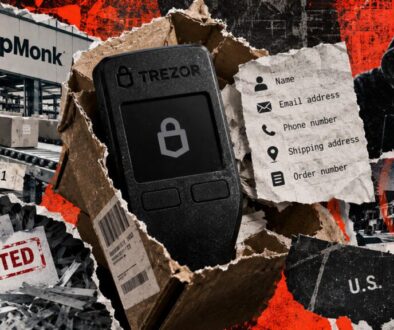
On August 13, hardware wallet manufacturer Trezor acknowledged that ShipMonk, a third-party logistics provider handling its customer shipments, had suffered an unauthorized data breach exposing the personal information of roughly 13,700 recent buyers.
The compromised dataset included names, phone numbers, and home addresses, data that ties individual customers directly to physical locations while revealing them as cryptocurrency owners. ShipMonk had notified Trezor of the incident on August 10 after detecting unauthorized system access, prompting the public disclosure three days later.
The breach created an immediate institutional quandary: how to weigh the cryptographic security advantages of hardware wallets against the operational and privacy risks introduced by physical distribution supply chains.
CZ Contrasts Hardware Shipment Risk Against Software Wallet Privacy Model
Binance founder Changpeng Zhao responded within days, using the incident to make a structural argument about custody architecture. He acknowledged that hardware wallets have earned their reputation for superior protection of private keys against online compromise, writing that the advantage is “generally true” in specific technical aspects.
However, he argued that Trezor’s breach revealed a material blind spot in the hardware wallet security model: physical shipment logistics create a paper trail linking customer identity, crypto ownership, and home address in a centralized vendor database.
CZ highlighted software self-custody solutions including Binance Web3 Wallet and Trust Wallet as alternatives that eliminate this particular attack surface.
Those products generate wallets entirely on client devices without requiring hardware manufacturing, inventory management, or shipping infrastructure, eliminating the need for any company to maintain records of who owns what cryptocurrency and where they live.
His framing avoided dismissing hardware wallets outright; instead, he positioned the two approaches as representing “different risk profiles” suited to different use cases and threat models. He also disclosed that YZiLabs, an investment vehicle he is associated with, holds stakes in multiple hardware wallet manufacturers, signaling that his critique was not ideological.
The distinction cuts to a core tension in cryptocurrency custody that institutional investors have struggled with since the earliest days of the asset class. Hardware wallets solved the problem of how to store private keys securely offline, removing them from internet-connected devices vulnerable to malware and exchange hacks.
But that solution created a new problem: someone has to manufacture, package, and ship the device to the customer, and that supply chain necessarily touches personal data in ways that pure software solutions avoid entirely.
Security Researchers Warn Exposed Addresses Enable Physical Targeting
Beyond the privacy implications, multiple security analysts flagged the concrete physical risks that the leaked address data could enable. NaoX Protocol noted that the exposed list amounts to a verified directory of cryptocurrency holders at specific residential locations, a high-value targeting list for criminals willing to pursue off-chain extortion.
Bitcoin security researcher Nick Neuman warned that the dataset could fuel targeted social engineering campaigns via email, phone calls, or postal mail, and could enable wrench attacks, where attackers use physical coercion to force victims to reveal wallet recovery phrases or sign transactions transferring funds.
Trezor’s own guidance acknowledged the elevated phishing risk, advising customers to expect more sophisticated impersonation attempts and urging them never to enter their wallet seed phrase online or disclose it to anyone.
For institutional investors, the warning underscored a hazard that custody policies and insurance products have historically underpriced: the vulnerability of individual key holders to targeted physical and social pressure when their identity and location become known to determined attackers.
A fund manager holding customer assets through Trezor devices suddenly faces a new class of liability if employees or their families become targets.
The timing and scope of these warnings gained force from the fact that they arrived amid a broader credibility crisis for the hardware wallet category itself.
Trezor Breach Joins String of Hardware Wallet Failures Within Weeks
The ShipMonk breach did not occur in isolation. In mid-July, roughly one month earlier, on-chain investigator ZachXBT had publicly declared that “all hardware wallets are complete garbage” on Telegram, citing dead batteries, forced firmware updates, interface bugs, and poor user experience as systemic problems.
While ZachXBT’s blanket condemnation lacked nuance, his complaint pointed to a real pattern of operational friction that has accumulated in the hardware wallet ecosystem and contradicted the marketing claim that these devices represent seamless, consumer-friendly security.
More significantly, Galaxy Research had linked over $100 million in stolen Bitcoin to a separate critical flaw in older Coldcard hardware wallet firmware.
The vulnerability was not a breach or supply chain attack, but rather a cryptographic defect: the firmware generated wallet seeds using weaker randomness than intended, leaving keys predictable to attackers with sufficient computational resources.
Coinkite, Coldcard’s manufacturer, patched the flaw in newer firmware releases but could not retroactively fix seeds already generated on affected devices. The company advised customers holding Mk3 through Q model Coldcards to migrate their funds to unaffected hardware immediately, a remediation that itself creates operational and custodial complexity.
That the Coldcard vulnerability involved a fundamental cryptographic failure, not mere supply chain mismanagement, meant the two incidents together illustrated the full surface area of hardware wallet risk. Devices can fail both at the point of manufacture and distribution, and the category has no monopoly on security if those foundational engineering and logistics functions break down.
Institutional Custody Decision Now Incorporates Supply Chain and Personnel Risk
For institutional investors and custodians evaluating which self-custody model to recommend or deploy, the accumulated evidence has shifted the calculus. Hardware wallets retain their advantage in isolating private keys from internet-connected systems, a benefit that remains material for defending against remote compromise and exchange hacks.
But that advantage must now be weighed against the concrete costs of supply chain vulnerability, the creation of persistent identity-address links in vendor databases, and the operational burden of device management across organizations with multiple signatories.
Software wallets eliminate the shipment and manufacturing risk entirely, but they shift the security burden onto the user’s own device security and the integrity of the software distribution channel. A compromised phone or laptop can expose keys just as thoroughly as a backdoored hardware device.
The tradeoff is not that one approach is objectively superior, but rather that they distribute risk differently: hardware wallets centralize supply chain and manufacturing risk with the vendor; software wallets distribute key security risk across individual users and devices.
The Trezor breach and the surrounding wave of hardware wallet incidents have made clear that vendors cannot simply assume their supply chain and manufacturing partners will remain trustworthy.
For custodians managing assets on behalf of institutional clients, the implication is that hardware wallet recommendations now require explicit due diligence on the manufacturer’s logistics partners, firmware update processes, and the cryptographic quality of seed generation.
The question facing institutional custody infrastructure is no longer whether hardware or software wallets are categorically more secure, but rather which combinations of hardware, software, and operational controls best match a specific fund’s threat model and risk tolerance. As additional hardware wallet manufacturers face either supply chain breaches or cryptographic vulnerabilities in coming months, a pattern that appears likely given the scrutiny now directed at the category, institutional
Original reporting: cryptopotato.com