Metaplanet raises $208M in zero-interest bonds to fund Bitcoin accumulation strategy
Metaplanet’s $208 million zero-interest bond issuance to accumulate Bitcoin exposes a fundamental leverage risk: the Tokyo-listed firm has no revenue stream to service debt if Bitcoin stalls, yet institutional demand for yield-free crypto plays remains robust, creating a test case for how far market enthusiasm can fund speculative balance-sheet engineering.
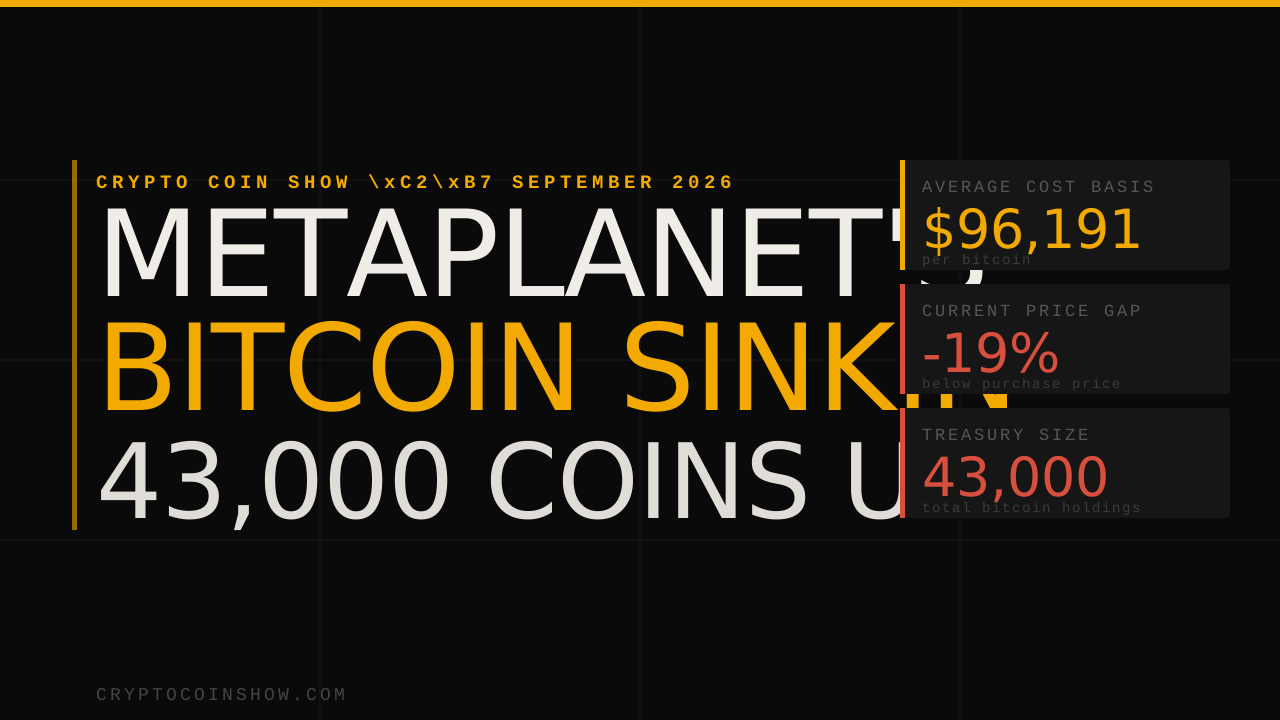
- Metaplanet issued ¥30 billion ($208 million) in 0% bonds to buy 1,005 BTC, raising total holdings to 13,350 coins valued at $1.4 billion.
- The company aims to accumulate 210,000 BTC (1% of all Bitcoin ever) by 2027 through a $5.4 billion “555 Million Plan” via bonds and capital raises.
- CEO reports 349% year-to-date yield from Bitcoin strategy, but critics warn the debt-funded model risks insolvency if Bitcoin price declines sharply.
- $208M Zero-interest bond issuance by Metaplanet in June 2025
- 13,350 Bitcoin holdings after latest purchase, up from 3,350 three months prior
- $5.4B Capital target through 2027 to reach 210,000 BTC accumulation goal
Metaplanet, a publicly traded Tokyo Stock Exchange company, issued zero-interest bonds to fund what may be the most aggressive corporate Bitcoin accumulation strategy yet attempted by a debt-financed firm. In June 2025, the company raised ¥30 billion ($208 million) through ordinary bonds carrying no interest, using the capital to purchase 1,005 additional Bitcoin at an average price of $107,601 per coin. The move, first reported by Cryptopolitan, reflects a broader shift in institutional attitudes toward crypto-backed leverage, yet it also crystallizes a structural risk that mirrors patterns seen in previous financial implosions.
EVO Fund’s entire subscription signals institutional appetite for zero-cost leverage in Japan
The entire bond offering was subscribed by EVO Fund, a private institutional investor, at 0% interest, a fact that underscores growing institutional hunger for alternative yield strategies in a Japanese market where ultra-low interest rates and yen weakness have eroded traditional savings returns.
The willingness of a major investor to deploy capital at zero carry cost on a crypto-heavy firm suggests confidence in Bitcoin’s structural value and in Metaplanet’s execution, or at minimum, a conviction that the bet is worth taking on principal appreciation alone.
Before deploying the capital toward Bitcoin, Metaplanet used a small portion of proceeds to retire ¥1.75 billion ($12 million) in bonds carrying a 0.36% annual rate. This refinancing move, swapping a positive-carry obligation for zero cost, illustrates the financial engineering at the core of the strategy. The remaining $196 million went directly into Bitcoin purchases.
Metaplanet now holds 13,350 BTC, surpassing Tesla and Galaxy Digital
The bond issuance accelerated what was already an aggressive accumulation curve: Metaplanet’s holdings quadrupled to 13,350 BTC from 3,350 BTC in the prior three months, positioning the firm as the world’s third-largest corporate Bitcoin holder after MicroStrategy and Marathon Digital.
That trajectory is set to steepen further. Metaplanet’s stated “555 Million Plan” targets $5.4 billion in capital raises through 2025 and 2026, intended to fund purchases reaching 100,000 BTC by year-end 2026 and 210,000 BTC by 2027, equivalent to 1% of all Bitcoin that will ever exist.
At current prices, that target would represent a $23 billion position, a venture that would rank Metaplanet as a top-five holder globally and redefine it from a trading company into a macro Bitcoin fund with leverage.
CEO claims 349% year-to-date return, but the balance sheet carries no income to service debt
CEO Simon Gerovich has publicly stated that Metaplanet’s Bitcoin strategy has delivered a 349% year-to-date yield, a figure that reflects the rally in Bitcoin price rather than operational revenue. This is the critical flaw in the capital structure: Bitcoin generates no cash flow, pays no dividend, and produces no intrinsic income unless sold.
Metaplanet holds debt obligations that mature at fixed dates and must be repaid in full, yet the only way to service that debt is to liquidate holdings into a volatile, uncontrolled market or to access new capital from increasingly skeptical investors.
The firm is not a productive enterprise borrowing to expand capacity or infrastructure; it is a balance-sheet levered bet that Bitcoin will appreciate enough to cover principal repayment and generate net gains.
That model works in a rising market. If Bitcoin were to decline 20% or 30%, moves that have occurred multiple times in the asset’s history, the paper losses would accelerate. Metaplanet would face pressure to liquidate holdings at depressed prices, destroying the narrative that justified the original bond raise and eroding investor confidence rapidly.
The parallel to Archegos Capital’s leverage collapse in 2021, Terra-Luna’s implosion in 2022, and earlier financial blowups is instructive: aggressive borrowing to fund non-productive assets masked fragility that only became visible when external conditions shifted.
Regulatory scrutiny and refinancing risk loom as debt obligations grow
Metaplanet’s near-term stock performance has been robust, the share price rose roughly 10% immediately after the bond announcement, suggesting that market sentiment remains bullish on Bitcoin price appreciation and on the firm’s ability to execute its accumulation plan. That confidence is real but contingent: it reflects a bet on Bitcoin, not on Metaplanet’s operational resilience.
Longer-term risks compound as the debt stack grows. Japanese financial regulators have not yet moved to restrict zero-interest leverage for crypto-heavy firms, but that tolerance may not persist if Metaplanet’s debt obligations reach multi-billion-dollar scale or if Bitcoin volatility spikes.
Capital markets could also tighten, making it harder for Metaplanet to refinance maturing bonds or to access the $5.4 billion in fresh funding it requires to reach its 210,000 BTC target by 2027.
Even small operational missteps, missed targets, regulatory warnings, or shifts in institutional appetite for zero-cost debt, could trigger a rapid reassessment of the firm’s balance sheet and a sharp reversal in equity valuation.
The CCS read. We read Metaplanet’s bet as a stress test for how much leverage institutional capital will tolerate in service of crypto narratives. The 0% bond structure works only if Bitcoin price momentum persists and refinancing windows remain open. If either condition breaks, the firm could face a liquidity crunch or forced asset sales at losses. The real question for holders: is the stock pricing Bitcoin appreciation, or is it pricing execution risk that the market has yet to price into the valuation?
Watch for Metaplanet’s Q3 and Q4 2025 bond issuances under the “555 Million Plan”, whether institutional investors continue to subscribe at 0% rates, or whether spreads begin to widen. Any shift in EVO Fund’s appetite, a regulatory warning from Japan’s FSA, or a 20%+ Bitcoin decline would signal a broader repricing of leverage-funded crypto strategies. Metaplanet’s success or failure over the next 12 months will influence how aggressively other public firms pursue similar structures.