
Bitcoin Rejection Was No Accident — Now The Battle Shifts To $93,000–$97,000 Survival Zone
Bitcoin encountered significant selling pressure at precisely the levels technical analysts had flagged as vulnerable, forcing the cryptocurrency into a critical support zone that will likely determine whether recovery is possible or further declines emerge. The pullback from resistance has established a decisive battleground in the $93,000–$97,000 range, marking a juncture where market structure and buyer conviction will be tested.
Resistance Held as Predicted, Setting Up Lower Lows
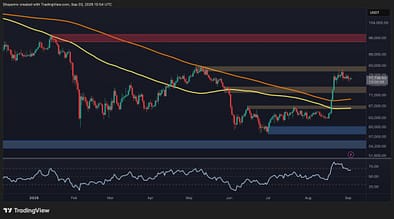
The rejection unfolded exactly as the technical setup anticipated. Bitcoin encountered a micro-resistance zone between $99,386 and $100,972 and failed to break through decisively, resulting in a clean rejection that aligned with existing market structure.
This price action generated what analysts describe as another lower low—a bearish pattern indicating that each rally attempt is failing to reach previous peaks. The move reinforced short-term selling pressure and shifted focus to the next layer of support beneath the current price action.
Bitcoin has now reached the next major support zone at the 50% retracement of the larger support box near $96,000, a crucial checkpoint that could determine whether BTC stabilizes or continues its descent.
— Technical Analysis, Crypto Market Structure
Analysts have also mapped out an extended projection zone spanning $91,322 to $82,523, derived from Elliott Wave analysis of the current price structure. While such targets remain speculative, they outline the theoretical path price could follow if selling pressure intensifies and buyers fail to establish a foothold at near-term support levels.
The $93,700–$97,500 zone represents the last meaningful support before extended downside targets. A breakdown below $91,300 would signal accelerating bearish momentum and potentially shift the broader outlook toward a prolonged correction.
$93,000–$97,000: The Demand Zone That Cannot Break
Bitcoin currently trades within a range that technical strategists are monitoring as a make-or-break level for the near-term trend. The $93,733 to $97,595 band represents the last area where buyers have historically stepped in to defend price, and its integrity will likely determine the next directional move.
A strong reaction from this zone—characterized by consolidation and the emergence of higher lows—would suggest that accumulation is finally occurring after the recent wave of liquidations and selling. Such a development would offer the first concrete signal that downside momentum is exhausting.
Conversely, failure to hold this support would open the door to the next critical level near $91,300. A breakdown at that point would amplify bearish conviction and likely accelerate selling as traders recognize the failure of a key defense line.
The $91,300 level carries outsized importance because it marks the boundary between near-term correction and an extended bearish phase. A sustained breakdown below it would signal that the current retracement has transformed into something more structural.
Industry Context and Market Implications
Bitcoin’s current price vulnerability reflects broader dynamics within the cryptocurrency market and traditional financial conditions. The digital asset class has matured significantly since its early days, with institutional adoption now creating new layers of complexity around price discovery and volatility management.
The institutional cryptocurrency market has grown substantially over the past decade, with major asset managers, corporations, and financial institutions now holding Bitcoin as part of diversified portfolios. This maturation has paradoxically increased the asset’s sensitivity to macroeconomic conditions, particularly interest rate expectations and inflation data. When traditional markets experience stress, institutional holders often liquidate positions to meet margin requirements or rebalance portfolios, creating cascading selling pressure.
The current pullback must be understood within this broader context. Bitcoin’s inability to sustain levels above $100,000 suggests that despite long-term bullish narratives around digital scarcity and monetary policy concerns, near-term demand destruction is occurring. This pattern is consistent with historical cycles where initial enthusiasm gives way to profit-taking and position adjustment among sophisticated market participants.
For the broader cryptocurrency ecosystem, Bitcoin’s price action functions as a primary driver of sentiment and capital flows. Altcoins and smaller digital assets typically move in tandem with Bitcoin during periods of uncertainty, meaning any extended weakness in the leading cryptocurrency could trigger significant selling pressure across the industry. Conversely, a decisive recovery above $100,500 would likely unlock a rotation back into higher-risk cryptocurrency assets.
The Road to Recovery Requires a Clear Break
For bulls to establish legitimate control and reverse the prevailing bearish structure, Bitcoin must accomplish one thing: break above and hold $100,500. Until that occurs, price action within the $93,000–$97,000 zone should be interpreted as a short-term bounce rather than the beginning of a sustained recovery.
This threshold is significant because it sits above the micro-resistance zone that initially rejected price. Breaking through it would signal that buyers have overcome the structural selling pressure that manifested at $99,386–$100,972 and possess sufficient strength to reclaim higher levels.
A legitimate sign of a local bottom will only emerge once Bitcoin breaks and holds above $100,500 again. Anything below that threshold keeps the overall structure firmly bearish.
— Market Structure Analysis
Until that reclamation occurs, even bounces within the current support zone should be approached with caution. The broader Bitcoin price structure remains vulnerable, and temporary relief rallies can mask underlying weakness.
Breaking above $100,500 is non-negotiable for establishing a legitimate shift in market momentum. Without this level being reclaimed, any strength in the $93,000–$97,000 zone remains a tactical bounce within a bearish framework.
Market Implications for Risk Assets
Bitcoin’s current positioning has ripple effects throughout digital assets and risk-on markets more broadly. The cryptocurrency space remains highly correlated with technology equities and other growth-oriented asset classes, particularly during periods of volatility. When Bitcoin enters a defensive posture—characterized by lower lows and failed rallies—it often signals broader risk-off sentiment that can accelerate selling in traditional markets as well.
The failure to break above $100,500 represents a technical rejection that carries significant psychological weight. Round numbers and major resistance levels function as focal points for large market participants to establish positions. When price fails to break decisively above such levels, it confirms that supply from sellers exceeds demand from buyers at that price, a critical signal for directional traders and systematic trading algorithms.
Cryptocurrency exchange data showing capital flows and liquidation patterns provide additional context for understanding the current market structure. Large liquidations at specific price levels indicate that leveraged traders are being forced out of positions, adding to selling pressure and reinforcing bearish momentum. The $93,000–$97,000 zone likely contains multiple layers of stops and liquidation orders that could either accelerate a breakdown or trigger a violent reversal if buyers step in decisively.
What Traders Should Monitor
The near-term trading landscape has narrowed into a series of critical inflection points. Each support level will provide real-time information about the health of buyer demand and the conviction behind any recovery attempts.
- Watch for volume patterns when price approaches $96,000—high volume reversals would suggest legitimate accumulation
- Monitor whether Bitcoin can hold $93,700 if it tests that level; a breakdown opens $91,300
- Observe price action at $100,500; a failed attempt here reinforces bearish structure
- Track whether lower lows continue forming; a halt in this pattern would indicate stabilization is beginning
- Analyze exchange flows for signs of institutional accumulation or continued distribution
- Monitor implied volatility and options positioning for clues about market participant expectations
Technical structure currently favors the bears, with each failed rally creating a lower high. The burden of proof now rests with bulls to demonstrate that exhaustion is setting in and accumulation is underway.
The broader cryptocurrency market pricing will likely remain sensitive to how Bitcoin navigates this zone. A decisive breakdown could accelerate selling across altcoins, while a strong hold and recovery above $100,500 would unlock renewed upside momentum.
Conclusion: The Inflection Point Approaching
Bitcoin stands at a critical juncture where technical structure and market sentiment align to create a definitive outcome in the coming weeks. The $93,000–$97,000 support zone represents the last meaningful area where buyers have established persistent demand. A failure here would mark a structural breakdown with consequences extending beyond Bitcoin to the broader digital asset ecosystem and correlated risk markets.
For now, the $93,000–$97,000 range represents the front line in the battle between supply and demand. Market participants should treat this zone with the seriousness it deserves, as the outcome will shape Bitcoin’s trajectory for weeks ahead. Whether this becomes a launching point for recovery or a final capitulation point before extended weakness remains the market’s central question.
Get weekly blockchain insights via the CCS Insider newsletter.