
Stablecoins after GENIUS: what 29 founder interviews say changed between 2025 and 2026
Onchain market data and a hand-screened read of every stablecoin conversation on Crypto Coin Show since January 2025 show supply stalling while usage grows, and founders moving from DeFi plumbing to payments, with the GENIUS Act as the enterprise unlock and yield as the fault line.
Key findings
- Stablecoin conversations doubled as a share of the show, from 13% of CCS interviews in 2025 to 25% in 2026, and stablecoins went from the main subject of one episode to seven.
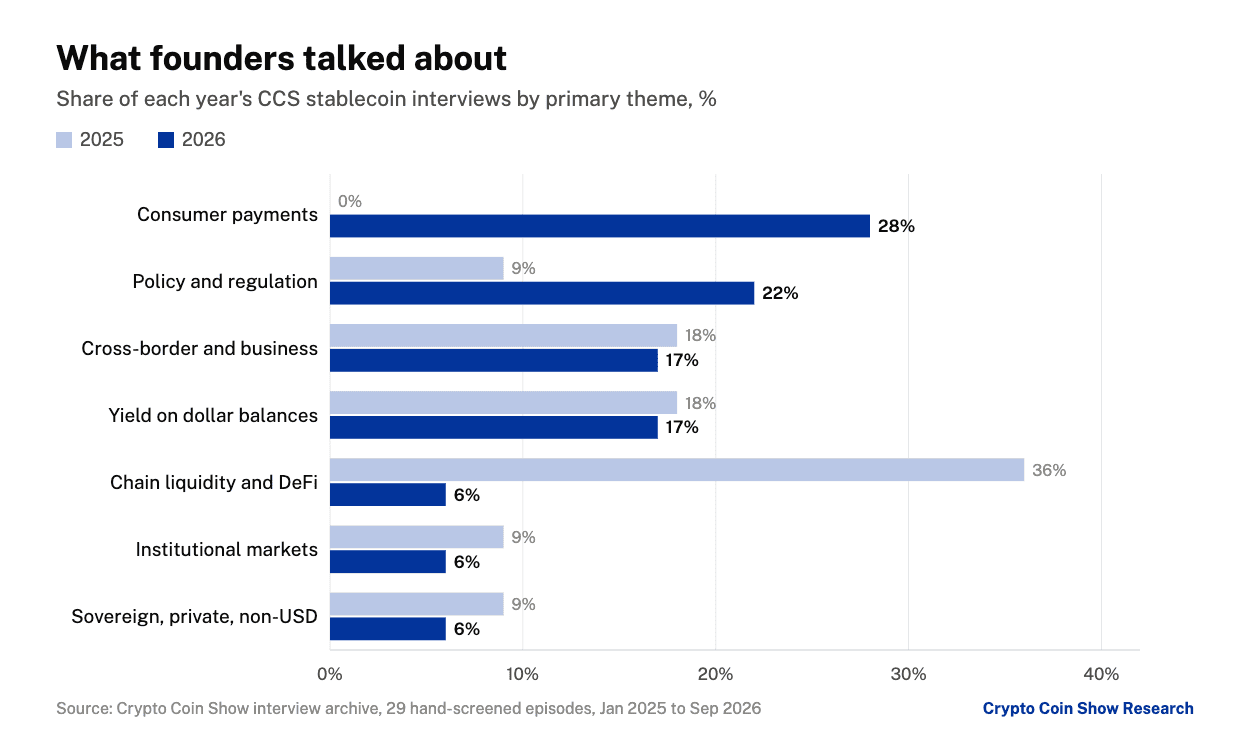
- The conversation moved from DeFi plumbing to payments: chain liquidity fell from 36% of stablecoin episodes to 6%, while business and consumer payments rose from 18% to 44%.
- Consumer payments appeared as a new theme in 2026 at 28% of stablecoin episodes, with wallets, cards and neobanks built for people who do not think of themselves as crypto users.
- The GENIUS Act came up in 1 of 11 stablecoin conversations in 2025 and 10 of 18 in 2026, as guests described it as the permission enterprises needed.
- Yield is the fault line: 2026 guests described the distributor rewards window that banks and the OCC are now trying to close, and the Clarity Act failed 49 to 50 on September 15.
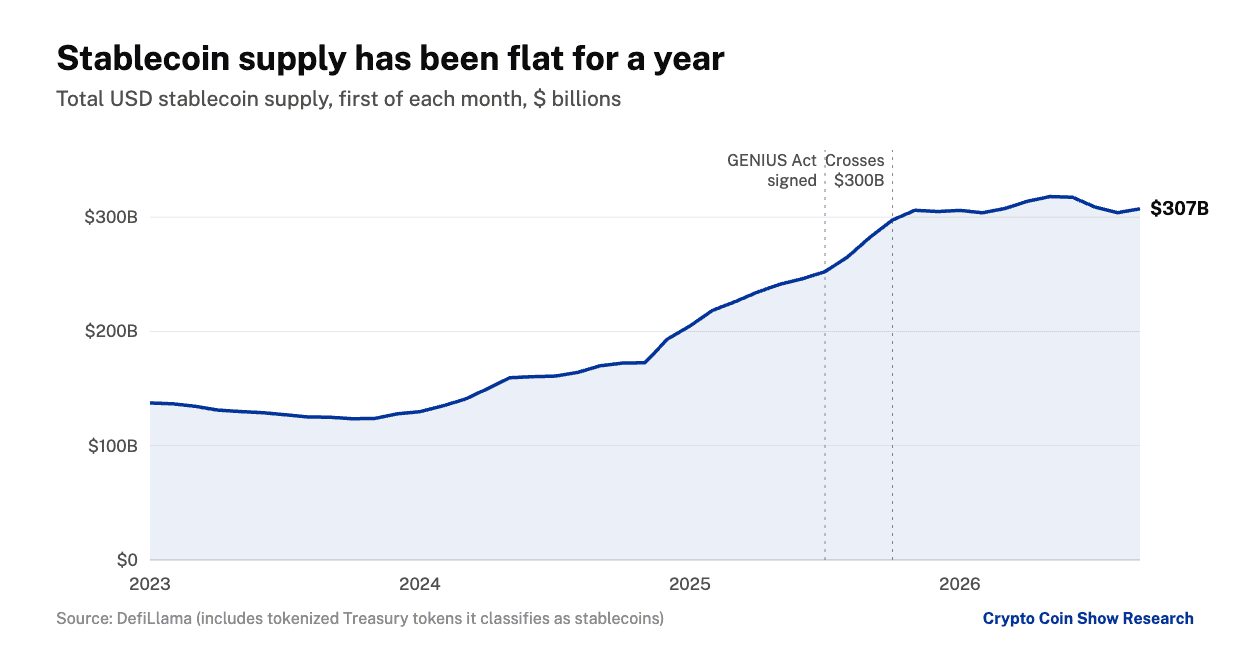
- Demand is coming from emerging markets and the bottleneck is fiat ramps and banking partners, not blockchains; total supply has been flat near $300 billion while payment volumes set records.
Crypto Coin Show published 161 founder and executive interviews between January 1, 2025 and September 29, 2026. This report combines two sources: onchain market data on the stablecoin market, and a hand-screened read of every one of those interviews for what the people building on dollar tokens were actually working on, and how that changed after the GENIUS Act became law in July 2025.
The short answer is that stablecoins stopped being crypto plumbing and became a product. Supply has barely grown in a year, but usage has, and the founders on the show moved with it: in 2025 the typical stablecoin guest was a chain or DeFi protocol talking about USDC liquidity; in 2026 it was a payments company, a fintech or a yield provider using stablecoins to move or pay dollars for people who never think of themselves as crypto users.
Key metrics
| Measure | Value |
|---|---|
| Total USD stablecoin supply | $310.7 billion (September 30, 2026) |
| Supply growth, September to September | +66% (2024 to 2025) vs +9% (2025 to 2026) |
| USDT / USDC supply | $183.8 billion / $74.6 billion (83% of the market combined) |
| Adjusted stablecoin payment volume, H1 2026 | $8.82 trillion (Visa) |
| USDC share of adjusted payment volume | About 70% |
| Largest chains by stablecoin supply | Ethereum $146 billion, Tron $94 billion, Solana $16 billion |
| GENIUS Act in force | By January 18, 2027 at the latest |
| CCS stablecoin episodes, 2025 / 2026 | 11 of 88 / 18 of 73 |
Primer: what counts as a stablecoin
A stablecoin is a token designed to hold a fixed value, almost always one US dollar. They differ mainly in what backs them:
- Fiat-backed coins such as USDT, USDC, PYUSD and RLUSD hold cash and short-dated Treasury bills and let approved customers redeem one token for one dollar. The issuer earns the interest on those reserves.
- Crypto-backed coins such as DAI and USDS are overcollateralized by crypto held in smart contracts.
- Synthetic or delta-neutral coins such as Ethena’s USDe and Aegis’s YUSD hold crypto and hedge its price with short futures, paying out the funding income as yield.
- Yield-bearing Treasury tokens such as BlackRock’s BUIDL and Ondo’s USDY pass interest through to holders. Some trackers, including DefiLlama, count them as stablecoins; they are securities in most jurisdictions and are covered in our tokenization report.
The GENIUS Act creates a US licence for “payment stablecoins” backed one to one by high-quality liquid assets, and bars issuers from paying interest to holders. That single rule, who gets the reserve yield, runs through almost every argument in this report.
Market data
Supply stalled for a year
Total supply grew 66 percent in the year to September 2025, crossing $300 billion in October. In the twelve months since, it has grown 9 percent and has moved sideways between roughly $304 billion and $318 billion, including the first monthly declines in four years this summer.
Two issuers still hold most of the market
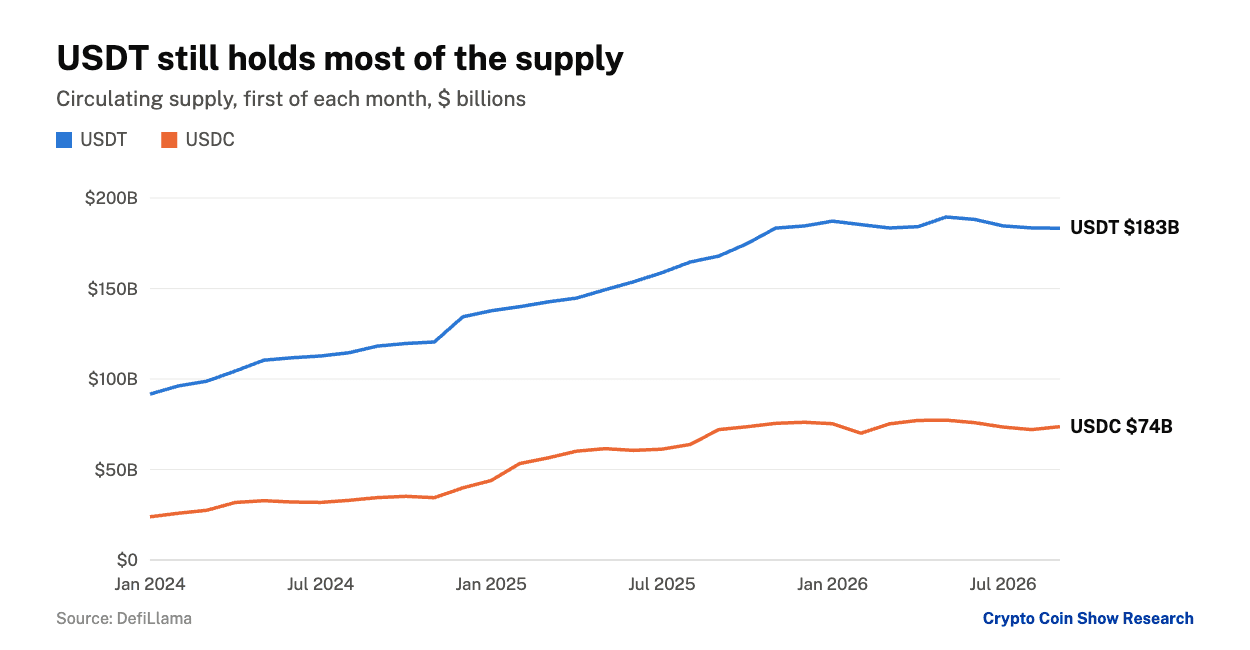
USDT and USDC together hold 83 percent of supply. USDT’s lead widened through 2025 and it has held about $183 billion to $189 billion all year; USDC more than tripled from early 2024 to early 2026 and has since traded in a $70 billion to $77 billion range.
Supply and usage tell different stories
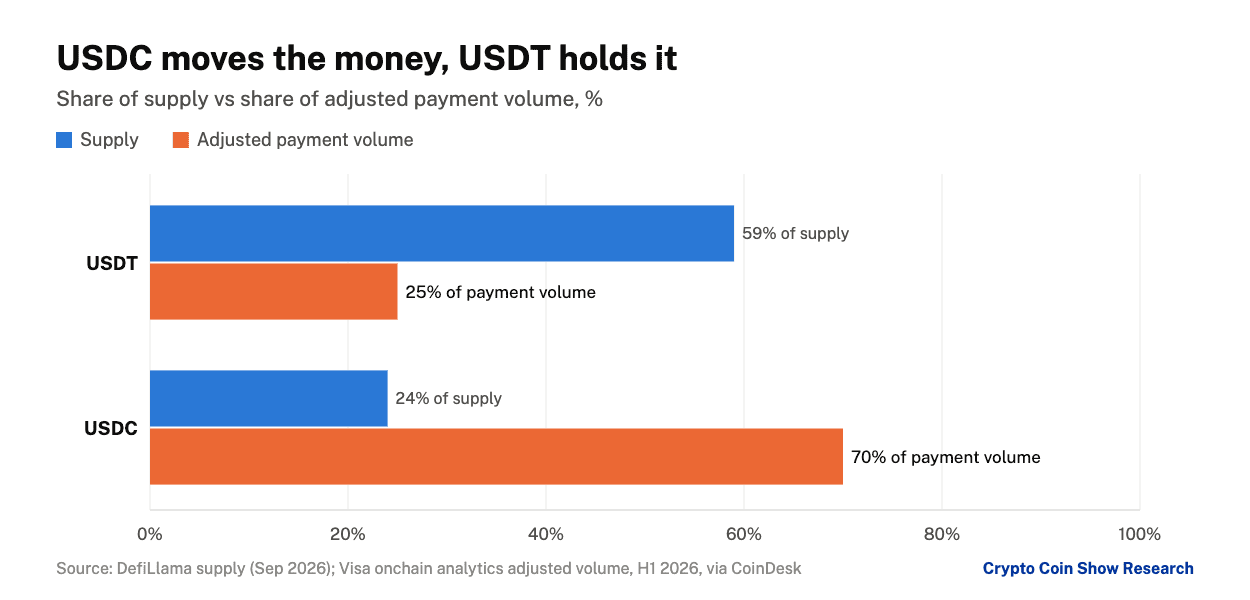
Measured by adjusted payments, which strip out bots and exchange shuffling, the order flips. USDC carries about 70 percent of volume on a quarter of supply, while USDT carries about a quarter of volume on three-fifths of supply. Adjusted volume reached a record $1.79 trillion in June 2026, up 125 percent year over year. Fewer idle dollars sit in stablecoins, and the ones that remain move faster.
Where stablecoins live
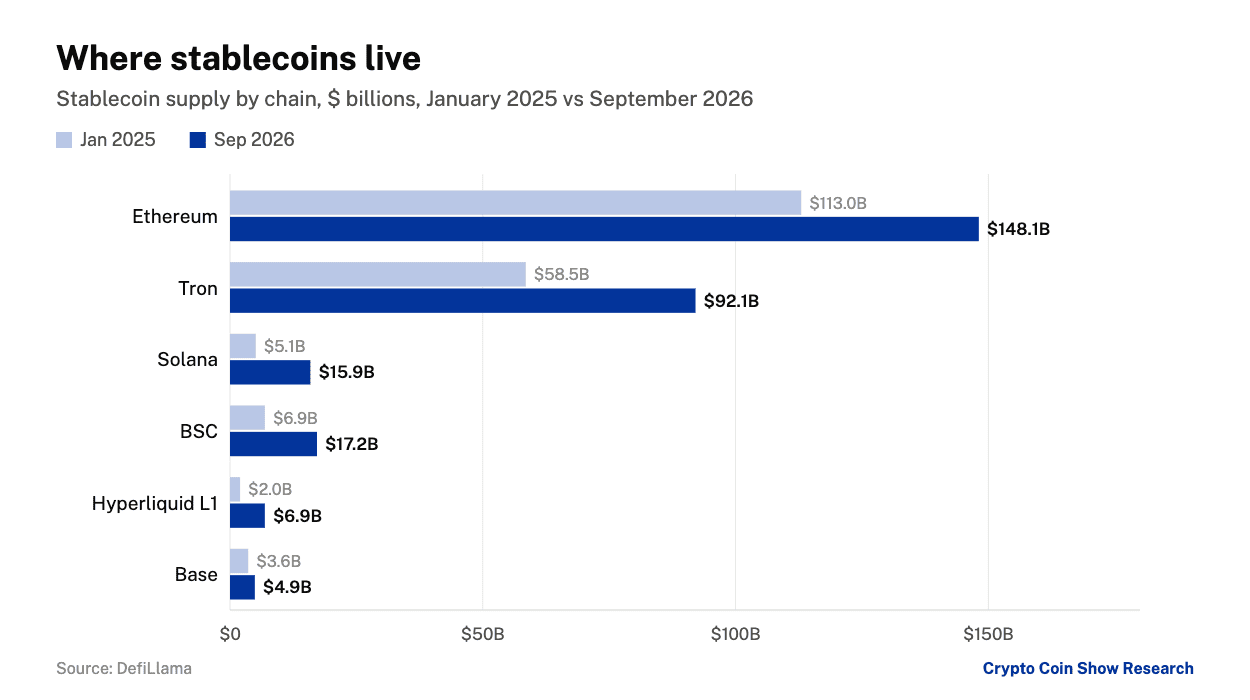
Ethereum and Tron still hold the bulk of supply, but the fastest growth since January 2025 was elsewhere: Solana roughly tripled to $16 billion, BNB Chain grew about 2.5 times to $17 billion and Hyperliquid’s L1 more than tripled to $7 billion. Robinhood Chain, which only launched in July 2026, already holds about $1 billion. New chains are winning stablecoin balances by giving them something to do, which is the same point the founders in this dataset made.
The challengers are still small
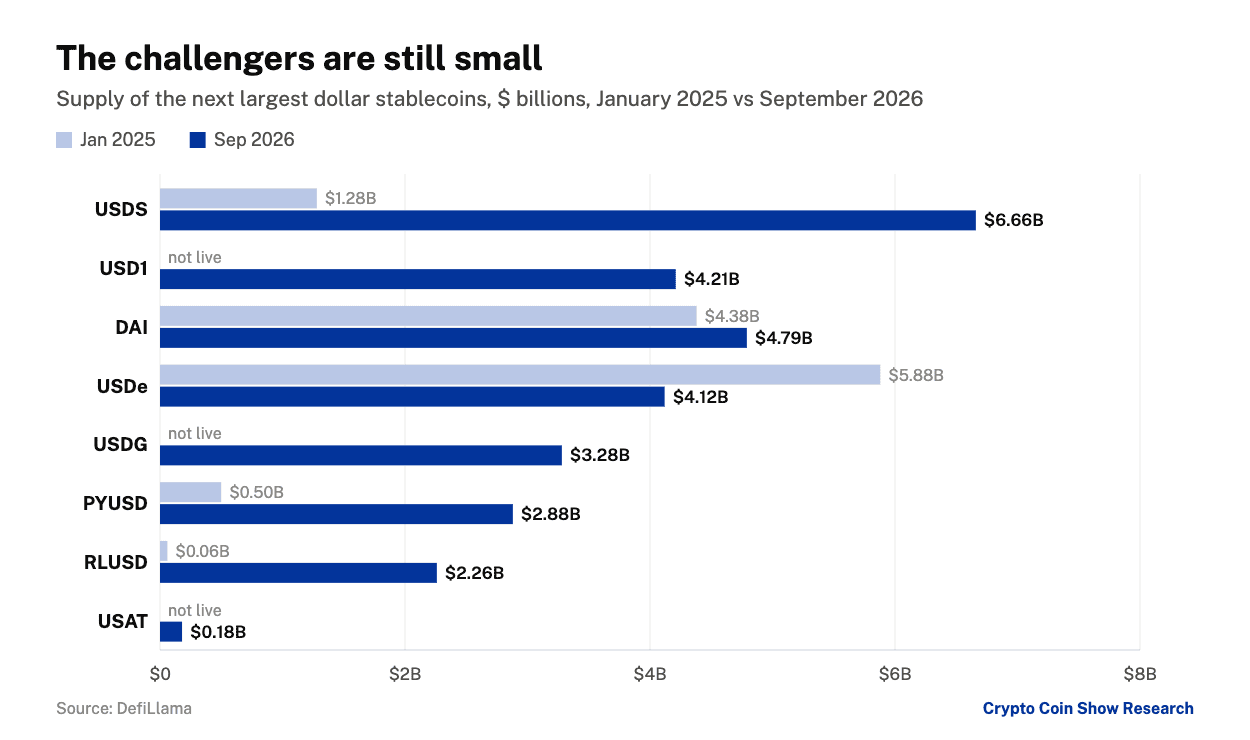
Plenty of new dollar tokens launched, but none has broken $7 billion. World Liberty Financial’s USD1, Paxos’s Global Dollar and Ripple’s RLUSD grew from nothing or near nothing, PayPal’s PYUSD grew about sixfold, and Sky’s USDS grew about fivefold. Ethena’s USDe is smaller than it was in January 2025, having shrunk from its 2025 peak. Tether’s US-regulated USAT, launched in January 2026 through Anchorage Digital Bank, holds about $180 million.
Landscape
| Stablecoin | Issuer | Backing | Supply (Sep 30, 2026) | 30-day change | Chains |
|---|---|---|---|---|---|
| USDT | Tether | Fiat reserves | $183.78B | +0.2% | 130 |
| USDC | Circle | Fiat reserves | $74.56B | +0.7% | 157 |
| USDS | Sky | Crypto collateral | $6.89B | +3.5% | 7 |
| USDe | Ethena Labs | Delta-neutral crypto | $4.90B | +20.1% | 31 |
| DAI | Sky (formerly MakerDAO) | Crypto collateral | $4.79B | +0.0% | 49 |
| USD1 | World Liberty Financial | Fiat reserves | $4.43B | +5.5% | 8 |
| USDG | Paxos (Global Dollar Network) | Fiat reserves | $3.09B | -5.2% | 6 |
| PYUSD | PayPal (issued by Paxos) | Fiat reserves | $2.73B | -1.8% | 19 |
| RLUSD | Ripple | Fiat reserves | $2.52B | +6.3% | 2 |
What the founders say
The dataset
The desk screened all 161 episodes by hand, starting from the archive’s Stablecoins & Payments tag (32 episodes) and a keyword search of every episode’s show notes, key takeaways and transcript. An episode is counted when stablecoins are its main subject or a significant part of the product being discussed. Episodes that mention stablecoins only in passing are excluded, as are payment episodes that do not involve stablecoins, such as Bitcoin merchant payments and crypto debit cards. That leaves 29 episodes: 11 from 2025 and 18 from 2026.
Measured against the whole show, stablecoin conversations made up 13 percent of episodes in 2025 and 25 percent in 2026 to date. The CCS Interview Index counted Stablecoins & Payments at 22 percent in 2026 using the automatic tag alone; the difference comes from hand screening, which removed tagged episodes that were not about stablecoins and added untagged ones that were.
| Measure | 2025 | 2026 |
|---|---|---|
| Episodes published | 88 | 73 |
| Stablecoin episodes | 11 | 18 |
| Share of all episodes | 13% | 25% |
| Stablecoins as the main subject | 1 | 7 |
| GENIUS Act discussed in the conversation | 1 of 11 | 10 of 18 |
Six findings
1. Stablecoins went from a side topic to a main subject
The share of the show about stablecoins roughly doubled, from 13 to 25 percent, but the bigger change is depth. In 2025 only Aegis, which issues a Bitcoin-backed, delta-neutral stablecoin, was built around one. In 2026 seven episodes were: OpenTrade, CMT Digital, OpenPayd, Buck, Higlobe, Ramp Network and Ground. Several of those guests run companies that exist only because stablecoins do.
2. The conversation moved from DeFi liquidity to payments
In 2025 the largest theme, at 36 percent of stablecoin episodes, was stablecoins as liquidity for a chain or protocol. Sonic cited more than $500 million in bridged USDC and native issuance with Circle; Nibiru, Injective and Centrifuge discussed stablecoins as the collateral and settlement asset of their ecosystems. In 2026 that theme fell to 6 percent, a single episode.
Payments took its place. Episodes about moving money, for businesses or consumers, rose from 18 percent of stablecoin conversations to 44 percent. Consumer payments did not exist as a theme in 2025 and made up 28 percent in 2026: Ramp Network launched a wallet it described as a global Venmo on stablecoin rails, Veera said 35 to 40 percent of crypto-sector employees are now paid in tokens and stablecoins, Virgo named stablecoin payments as one of two pillars of mass adoption, and Brave, in two episodes, positioned stablecoins as the on-ramp for its roughly 120 million mostly non-crypto users, including a GENIUS Act-compliant card and x402 payments for AI agents.
| Primary theme | 2025 | 2026 | Change |
|---|---|---|---|
| Consumer payments and onboarding | 0% | 28% | +28 pts |
| Policy and regulation | 9% | 22% | +13 pts |
| Cross-border and business payments | 18% | 17% | -1 pt |
| Yield on dollar balances | 18% | 17% | -1 pt |
| Chain liquidity and DeFi collateral | 36% | 6% | -30 pts |
| Institutional capital markets | 9% | 6% | -3 pts |
| Sovereign, private and non-USD designs | 9% | 6% | -3 pts |
3. The GENIUS Act became the reference point for enterprise adoption
The GENIUS Act came up in one of the 11 stablecoin conversations in 2025 and in ten of the 18 in 2026. Guests described it less as a rulebook than as permission. Lux Thiagarajah of OpenPayd called enterprise use of stablecoins the biggest shift he had seen since the Act, noting that before it the only non-crypto clients using them were startups. Sam Hallene of CMT Digital said the Act gave institutions “the rules of the road” to issue a compliant stablecoin and that large technology companies were now working on their own. Staci Warden of the Algorand Foundation called it the industry’s biggest unlock.
The guests were also clear that the law is not finished. Chris O’Brien of Venable pointed out that implementing rules were still being written. The Act takes effect on the earlier of January 18, 2027 or 120 days after final rules, according to Chapman and Cutler’s rulemaking tracker, and the OCC, FDIC, Federal Reserve, NCUA and Treasury have all opened proposals.
4. Yield is the fault line, and the guests saw it coming
Yield held steady at 17 to 18 percent of stablecoin episodes, but the 2026 conversations named the fight that now dominates Washington. The GENIUS Act bars issuers from paying interest to holders. Reid Cuming of Ground, which sells an API that embeds onchain yield into neobanks and exchanges, described the “aperture” that remains for distributors such as exchanges and custodians to pass rewards on, and said Ground was designed to work whether that window stays open or closes. Jeff Handler of OpenTrade said tens of millions of users, mostly in Latin America, already earn interest on dollar accounts powered by OpenTrade without knowing it. Hallene went furthest: if yield sharing is allowed, he said, it will change the banking model and pull deposits into fintech apps.
That is exactly the ground regulators and banks are contesting. The OCC’s February 2026 proposal would create a rebuttable presumption against yield paid through affiliates or related third parties, and eight banking groups pushed the Senate to tighten the Clarity Act’s rewards language before its September 15 vote. That vote failed 49 to 50, over ethics provisions and election-year politics rather than yield, which leaves the rewards question with the regulators for now.
5. The demand is outside the United States
Six of the 18 stablecoin guests in 2026 located their growth in emerging markets. Teymour Farman-Farmaian of Higlobe described “infinite demand” from a billion-person middle class in the global south that wants to save and send in dollars, against traditional transfers that cost about 6 percent and take five days. OpenTrade said its fastest growth came from Latin American companies offering dollar accounts. VALR described an explosion of cross-border stablecoin activity across Africa, where remittances cost 7 to 8 percent. Ramp Network reported strong recent growth in Latin America, Veera targets gig workers in Southeast Asia, Latin America and Africa, and Hallene credited Tether with capturing global-south demand for dollars from people who do not necessarily trust US institutions.
6. The bottleneck is ramps and banks, not blockchains
No guest in 2026 said blockchains were too slow or too expensive for stablecoin payments. Five of them said the hard part is the connection to the banking system. Higlobe called local on- and off-ramps the primary barrier in emerging markets, built country by country. Przemek Kowalczyk of Ramp said users drop off at payment rejection and KYC, not technical complexity. OpenPayd cited fragmented regulation, licensing costs and the difficulty of securing banking partners. VALR and Veera both described banking relationships and fiat ramps as the point where the experience breaks. The infrastructure problem the show heard about in 2026 is regulatory and commercial, not technical.
Company snapshots
The eight guests for whom stablecoins were the main subject of the conversation. Figures are as reported by each guest.
| Company | Guest | What it does | Episode |
|---|---|---|---|
| Aegis | Ermin Sharich, CEO | Issues YUSD, a Bitcoin-backed, delta-neutral stablecoin that pays holders the funding income from its hedge. | May 2025 |
| OpenTrade | Jeff Handler, COO and co-founder | Lets fintechs and neobanks pay RWA-backed yield on stablecoin balances; says its fastest growth is in Latin America. | Feb 2026 |
| CMT Digital | Sam Hallene | Crypto venture investor whose 2026 thesis treats stablecoins as the marginal buyer of US Treasuries. | Mar 2026 |
| OpenPayd | Lux Thiagarajah, CCO | Multi-currency accounts in 38 currencies through one API, with USDC and USDT settlement alongside bank rails. | Mar 2026 |
| Buck | Dan Hillery, Head of Treasury | A savings token backed by Strategy’s STRC preferred stock, targeting 10 percent a year. | Apr 2026 |
| Higlobe | Teymour Farman-Farmaian, CEO | Dollar accounts for the global south using a bank-stablecoin-bank “sandwich” that settles in under 60 seconds. | Apr 2026 |
| Ramp Network | Przemek Kowalczyk, CEO | Fiat on- and off-ramps in 150+ countries; launched a multichain wallet pitched as a global Venmo on stablecoin rails. | May 2026 |
| Ground | Reid Cuming, CEO and co-founder | An API that embeds onchain yield into neobanks and exchanges, built to work whether stablecoin rewards are restricted or not. | Jun 2026 |
Policy timeline
| Date | Event |
|---|---|
| Jul 18, 2025 | GENIUS Act signed into law, creating a federal licence for payment stablecoins |
| Oct 2025 | Stablecoin supply crosses $300 billion |
| Jan 2026 | Tether launches USAT, a US-regulated stablecoin issued through Anchorage Digital Bank |
| Feb 25, 2026 | OCC proposes GENIUS rules, including a presumption against yield paid through affiliates or related third parties |
| Apr 10, 2026 | FDIC proposes GENIUS rules for the issuers and banks it supervises |
| Jul 2026 | Federal Reserve, NCUA and Treasury proposals open alongside the OCC and FDIC |
| Sep 14, 2026 | Eight banking groups urge the Senate to tighten stablecoin rewards in the Clarity Act |
| Sep 15, 2026 | Clarity Act fails a Senate cloture vote, 49 to 50 |
| Jan 18, 2027 | Latest date the GENIUS Act takes effect |
Where the guests disagree
What should back a stablecoin. Aegis argued that fiat-backed coins carry banking-system risk, citing the 2023 scare when part of Circle’s reserves were caught at Silicon Valley Bank, and backs its coin with hedged Bitcoin instead. OpenTrade’s Handler argued the opposite: a digital dollar only works if people trust there are real dollars behind it, and regulation is one part of earning that trust.
Who should keep the yield. Ground and OpenTrade want yield passed to the end user through platforms. Nexus Labs launched its own Treasury-backed stablecoin, USDX, so the chain itself captures the reserve income and uses it to fund its ecosystem. Buck sidesteps the stablecoin rules altogether with a savings token backed by Strategy’s STRC preferred stock, targeting 10 percent.
One dollar or many. Hallene expects an oligopoly: under GENIUS there is little an issuer can do with its collateral to stand out, so distribution decides the winners. Sign’s Xin Yan expects many stablecoins, not all of them dollars, with governments bridging their own CBDCs into onchain stablecoins.
How fast it grows. In October 2025 Lee Bratcher of the Texas Blockchain Council cited projections of $3 trillion in stablecoins by 2030. Supply has been flat at about $300 billion in the year since. If the volume data is the better guide, the growth is showing up in how often each dollar moves rather than in how many dollars are issued.
What to watch into 2027
If the 2026 pattern holds, the next year of stablecoin conversations on the show will be about distribution and the plumbing around it: final GENIUS rules before the January 2027 deadline, whether the OCC’s limits on third-party yield survive, and whether the Clarity Act returns after the midterms. On the product side, the 2026 guests point to three things: dollar accounts for the global south, stablecoin cards and wallets aimed at people who do not use crypto, and payments made by AI agents rather than people, a theme covered in our Crypto x AI report. Competition among issuers is also shifting inside the United States, where Tether now offers USAT, a GENIUS-oriented coin issued through Anchorage Digital Bank, alongside USDC.
Methodology
Interviews: all 161 long-form interviews published on cryptocoinshow.com between January 1, 2025 and September 29, 2026. Each episode was screened from its published show notes, chapter list, key takeaways and auto-generated transcript. The 29 episodes counted were each assigned one primary theme and marked as either stablecoins as the primary subject or a significant topic by the CCS editorial desk. GENIUS Act counts reflect whether the Act was discussed in the transcript, by either the host or the guest. Figures quoted for companies (users, volumes, costs, yields) are as reported by the guests and were not independently verified. Transcripts are machine-generated and quotes were checked against context.
Market data: supply, issuer and chain figures are from DefiLlama, taken on September 30, 2026, using first-of-month readings for time series. DefiLlama counts some yield-bearing Treasury tokens as stablecoins, so its total runs a few billion dollars above trackers that exclude them; the landscape table excludes them. Chain totals include bridged supply and do not sum to the market total. Payment volumes are Visa’s adjusted onchain figures as reported by CoinDesk and Forbes.
Disclosures: the archive reflects who was booked on the show, not the market as a whole. Some interviews are produced as part of paid distribution packages. No company in the dataset had input into this report. This report is for information only and is not investment advice.
Appendix: the 29 episodes
| Date | Guest | Company | Theme | Stablecoin role |
|---|---|---|---|---|
| 2025-02-05 | Mirza Uddin | Injective Labs | Chain liquidity and DeFi collateral | Significant topic |
| 2025-03-19 | Bentzi Rabi | Utila | Cross-border and business payments | Significant topic |
| 2025-04-09 | Jeroen Offerijns | Centrifuge | Chain liquidity and DeFi collateral | Significant topic |
| 2025-04-30 | Michael Kong | Sonic Labs | Chain liquidity and DeFi collateral | Significant topic |
| 2025-05-13 | Ermin Sharich | Aegis | Yield on dollar balances | Primary subject |
| 2025-05-26 | Unique Divine | Nibiru | Chain liquidity and DeFi collateral | Significant topic |
| 2025-06-16 | Sam Dorrer | Echo | Yield on dollar balances | Significant topic |
| 2025-10-06 | Lee Bratcher | Texas Blockchain Council | Policy and regulation | Significant topic |
| 2025-10-17 | Xin Yan | Sign | Sovereign, private and non-USD designs | Significant topic |
| 2025-10-24 | Ali Beikverdi | HollaEx | Cross-border and business payments | Significant topic |
| 2025-11-19 | Charles Allen, Roshan Robert, Sidney Powell | BTCS, OKX US, Maple Finance | Institutional capital markets | Significant topic |
| 2026-01-13 | Erik Balsbaugh | Open Frontier | Policy and regulation | Significant topic |
| 2026-02-10 | Jeff Handler | OpenTrade | Yield on dollar balances | Primary subject |
| 2026-02-20 | Daniel Marin | Nexus Labs | Chain liquidity and DeFi collateral | Significant topic |
| 2026-02-27 | Sukhdeep Bhogal | Veera | Consumer payments and onboarding | Significant topic |
| 2026-03-05 | Staci Warden | Algorand Foundation | Policy and regulation | Significant topic |
| 2026-03-19 | Guy Itzhaki | Fhenix | Sovereign, private and non-USD designs | Significant topic |
| 2026-03-27 | Sam Hallene | CMT Digital | Institutional capital markets | Primary subject |
| 2026-03-30 | Lux Thiagarajah | OpenPayd | Cross-border and business payments | Primary subject |
| 2026-04-08 | Dan Hillery | Buck | Yield on dollar balances | Primary subject |
| 2026-04-16 | Teymour Farman-Farmaian | Higlobe | Cross-border and business payments | Primary subject |
| 2026-04-27 | Chris O’Brien | Venable LLP | Policy and regulation | Significant topic |
| 2026-05-01 | Przemek Kowalczyk | Ramp Network | Consumer payments and onboarding | Primary subject |
| 2026-05-14 | Adam Cai | Virgo | Consumer payments and onboarding | Significant topic |
| 2026-05-28 | Neil Steinhardt | Nexo US | Policy and regulation | Significant topic |
| 2026-06-30 | Reid Cuming | Ground | Yield on dollar balances | Primary subject |
| 2026-07-08 | Farzam Ehsani | VALR | Cross-border and business payments | Significant topic |
| 2026-09-18 | Luke Mulks | Brave | Consumer payments and onboarding | Significant topic |
| 2026-09-27 | Drew Potter | Brave | Consumer payments and onboarding | Significant topic |
Crypto Coin Show Research publishes original analysis built from CCS's own archive and public data. Figures are as stated at publication and are not investment advice. Reuse with attribution and a link.