XRP At Risk Of A Drop To $0.80? Analyst Makes The Case
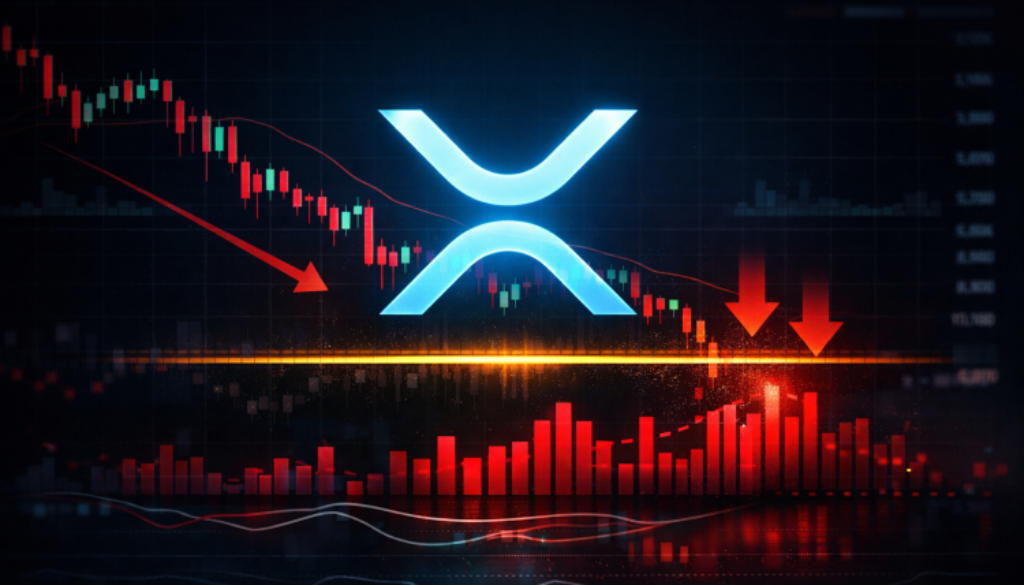
Ripple’s XRP token is signaling potential weakness, with technical analysts mapping out a possible decline toward $0.80 as multiple on-chain metrics deteriorate. A combination of shrinking network activity, concentrated institutional selling, and historical price distribution data has created what some market observers view as a confluence of bearish signals for the cryptocurrency.
Network Engagement Deteriorating
On-chain fundamentals for XRP are showing measurable signs of strain. Daily active addresses on the network have compressed to approximately 38,500, according to recent analysis—a contraction that typically indicates waning user participation rather than healthy ecosystem growth.
This metric matters because it tracks genuine transaction activity across the blockchain. When active addresses decline, it often suggests investors are moving from accumulation to caution, or simply reducing their interaction with the network. A shrinking addressable user base can precede broader price weakness if the trend persists.
Daily active addresses on the XRP blockchain have contracted to approximately 38,500, a notable compression that typically signals fading interest among the broader user base.
— On-Chain Analysis Data
The distinction between speculative positioning and genuine network use is critical. When active address counts fall, it suggests the latter is declining, which poses questions about the long-term utility and demand for the asset.
For context, Ripple’s XRP was designed to facilitate cross-border payments and serve as a bridge currency for financial institutions. The network’s health—measured through active participants and transaction volume—directly reflects whether the asset is fulfilling its core purpose. When engagement metrics contract, it raises fundamental questions about whether institutional adoption is materializing as envisioned or whether early enthusiasm has stalled.
Whale Liquidation Pressure
Institutional and high-net-worth investors—commonly referred to as whales in cryptocurrency markets—have begun reducing their XRP holdings at a notable pace. Recent data indicates these major stakeholders have liquidated approximately 40 million tokens.
This activity carries outsized significance. Whale movements often signal shifts in institutional confidence before they become apparent to retail participants. When large holders actively sell rather than accumulate, it typically reflects a reassessment of near-term or medium-term prospects for the asset.
Whale sellers have liquidated roughly 40 million XRP tokens recently, suggesting institutional confidence may be eroding at higher price levels.
The cumulative effect of sustained whale selling can create technical pressure on price charts. These investors possess both capital and information advantages, making their behavior a meaningful signal for other market participants to monitor.
It is particularly noteworthy that this liquidation is occurring despite Ripple’s continued efforts to establish partnerships with financial institutions and expand XRP’s use cases. The divergence between company-level developments and investor behavior suggests the market may be pricing in skepticism about execution timelines or regulatory headwinds that could impact adoption velocity.
Historical Price Distribution Creates Resistance
Technical analysts examining XRP’s price history have identified a significant cluster of investor cost basis near the $1.77 level. The UTXO Realized Price Distribution metric maps where circulating supply entered investor portfolios across historical price points, effectively creating psychological and technical resistance zones.
When an asset attempts to retrace toward previous highs where substantial volume accumulated, holders who purchased at those levels often become sellers. This dynamic creates natural resistance as break-even sellers re-enter the market. The $1.77 zone represents such a concentration point for XRP.
Below current levels, support becomes thinner, which is why analysts are flagging $0.80 as a potential target if key technical support fails. This type of analysis relies on the principle that historical price levels where investors held significant positions tend to influence future price action.
The $0.80 level itself carries historical significance as a major support zone from previous market cycles. If XRP were to break through current technical floors, this lower level would represent both a technical support floor and a psychologically meaningful price point where patient long-term accumulation began in prior cycles.
Industry and Market Implications
The XRP weakness signal arrives amid a broader period of cryptocurrency market maturation and increased regulatory scrutiny. Ripple has faced persistent legal challenges regarding XRP’s classification as a security, which has created uncertainty around the token’s long-term use case and regulatory acceptance in major markets.
Unlike decentralized protocols such as Bitcoin or Ethereum, Ripple maintains significant control over XRP distribution and development direction. This centralized governance structure, while efficient in some respects, has attracted regulatory skepticism that directly impacts investor confidence. Market participants are increasingly pricing in the possibility that regulatory resolution may be slower or less favorable than previously anticipated.
The broader cryptocurrency industry is simultaneously experiencing maturation in institutional adoption, competing digital asset development, and technological advancement in payment infrastructure. XRP faces competitive pressure not only from established cryptocurrencies but also from central bank digital currencies (CBDCs) and blockchain solutions developed by traditional financial institutions that don’t require external tokens to function.
Ripple’s business model depends partly on XRP adoption as a bridge asset. If institutional partners can achieve similar functionality through alternative technologies or through Ripple’s own non-XRP solutions, the fundamental value proposition of the token becomes questionable. This competitive reality is likely factoring into both whale selling behavior and deteriorating network engagement metrics.
What This Means for XRP Holders
The convergence of multiple bearish signals does not guarantee a move to $0.80, but it does warrant attention from XRP holders. Cryptocurrency price movements remain volatile and subject to sudden reversals based on news, regulatory developments, or broader market sentiment shifts.
For investors holding XRP, the current environment suggests several considerations. Risk management becomes more important when on-chain metrics are deteriorating. Position sizing and stop-loss discipline may protect against worst-case scenarios if the bearish case develops further.
The interplay between current pricing and this historical cost-basis distribution suggests downside vulnerability if technical support levels fail to hold.
— Technical Analysis Framework
It is also worth noting that cryptocurrency markets move in cycles. Periods of weakness often precede recovery phases. Understanding where you stand in that cycle relative to your own investment thesis is more important than trying to time short-term movements.
Holders should also monitor whether network fundamentals stabilize. If active addresses begin recovering or whale selling slows, it could suggest the bearish case is losing steam. These metrics are worth tracking on a weekly basis for anyone exposed to XRP.
For broader context on how XRP compares to other digital assets, understanding bitcoin and ethereum price movements can help contextualize where risk appetite sits across the entire crypto market. Weakness in XRP often correlates with broader market stress, though correlation is not guaranteed.
Additionally, investors should remain alert to any regulatory announcements or settlement discussions regarding Ripple’s legal status. Clarity on whether XRP will be classified as a security or commodity could dramatically shift market sentiment. Positive regulatory resolution could reverse current bearish positioning, while adverse rulings could accelerate the downside scenario outlined by technical analysts.
On-chain metrics suggest caution, but technical analysis remains probabilistic. No single metric predicts price movement with certainty. Diversification and risk management are essential for navigating volatile assets.
The cryptocurrency market has proven repeatedly that fundamental deterioration can be offset by regulatory clarity, adoption announcements, or macroeconomic shifts. XRP’s situation should be monitored but not treated as a predetermined outcome.
Conclusion and Forward Outlook
XRP currently faces a significant technical and fundamental challenge. The combination of deteriorating on-chain engagement, institutional liquidation pressure, and unfavorable price distribution creates a legitimate case for caution among current holders. The $0.80 target identified by technical analysts would represent roughly a 40% decline from current levels, a material drawdown that underscores the significance of current warning signals.
However, this bearish case is neither inevitable nor permanent. Ripple’s underlying mission—improving cross-border payment efficiency—remains valid, and institutional interest in blockchain-based financial infrastructure continues to grow. The path forward likely depends on Ripple’s ability to demonstrate meaningful commercial traction, achieve regulatory clarity, and stabilize investor confidence through either technology breakthroughs or strategic partnerships.
For market observers, the XRP situation serves as a useful reminder that cryptocurrency valuations remain tied to both fundamental adoption metrics and sentiment dynamics. Tokens can decline sharply even when technology improves, and conversely, can appreciate amid mediocre fundamentals if sentiment shifts positive. Current conditions suggest caution is warranted, but opportunities may emerge if and when the bearish case is fully priced in.
Staying informed on XRP developments and broader cryptocurrency news remains essential for anyone with exposure. Market conditions shift, and early warnings from on-chain data can provide valuable lead time for decision-making.
Get weekly blockchain insights via the CCS Insider newsletter.