
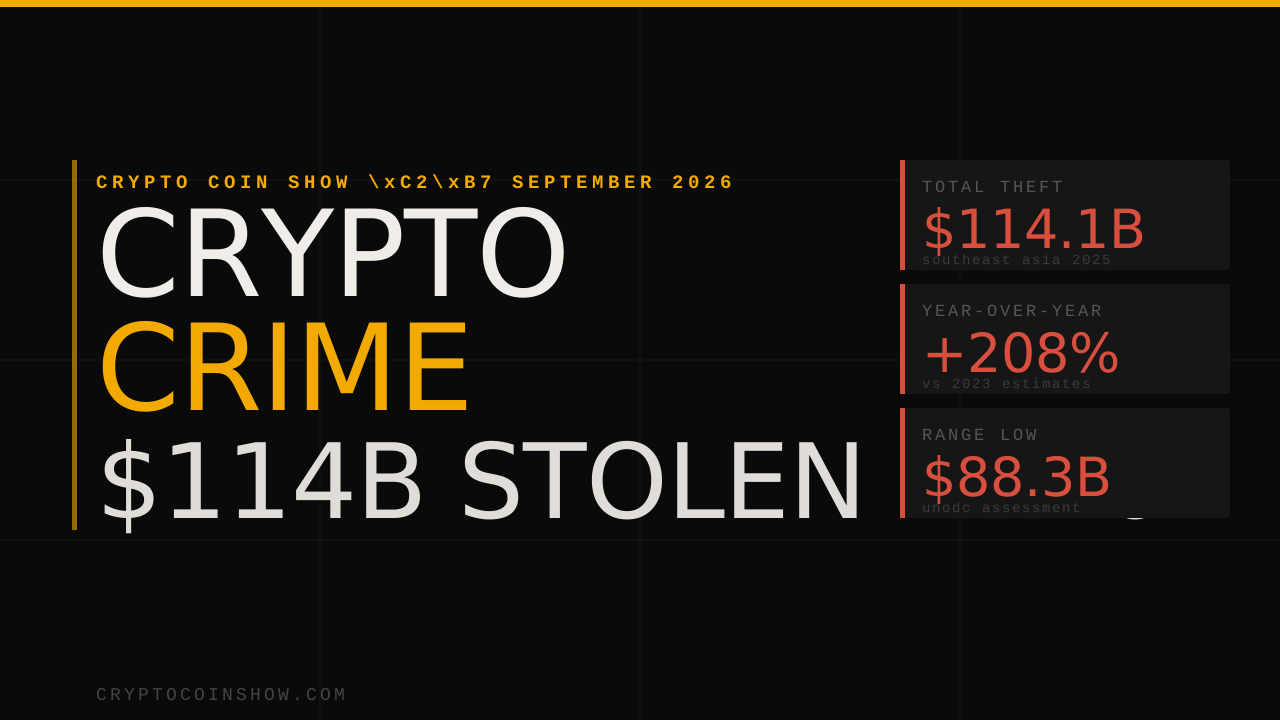
UNODC says Southeast Asia crime networks stole $114 billion via crypto in 2025
Southeast Asia-based crime syndicates stole between $88.3 billion and $114.1 billion from victims across the Asia-Pacific region in 2025 using integrated networks that now function like corporate franchises, according to a UN Office on Drugs and Crime threat assessment released this week. The scale of cryptocurrency’s role in laundering these proceeds, combined with law enforcement’s repeated failure to disrupt operations even after high-profile arrests, signals a structural enforcement gap that institutional investors and compliance officers must now treat as systemic market infrastructure risk.
- Southeast Asia crime networks stole $88.3 billion to $114.1 billion in 2025, more than triple the $18 billion to $37 billion estimated for 2023.
- UNODC describes syndicates as integrated “corporate franchises” selling services to each other on shared infrastructure for money laundering, fraud, and human trafficking.
- Operations continue despite arrests of kingpins and extraditions to China, signaling that law enforcement raids alone cannot disrupt the criminal economy’s underlying architecture.
- $114.1B Peak 2025 losses from Southeast Asia crime networks versus $37 billion in 2023
- 80+ Countries and territories with nationals identified in Mekong region compounds
- 3x Estimated growth in criminal economy scale between 2023 and 2025
The United Nations Office on Drugs and Crime released a comprehensive threat assessment this week documenting the explosive growth and structural consolidation of transnational criminal networks operating across Southeast Asia.
The headline finding cuts across institutional investor due diligence and compliance frameworks: between $88.3 billion and $114.1 billion was stolen from victims in the Asia-Pacific region during 2025 alone, representing at least a threefold increase from the $18 billion to $37 billion the UN estimated for 2023.
A significant portion of these proceeds moved through cryptocurrency networks, making digital asset infrastructure a primary conduit for the largest regional money-laundering operation documented in recent years.
The geographical scale amplifies the institutional risk. The stolen sum exceeds the GDP of several countries in the Southeast Asian region. China, South Korea, and Taiwan each reported losses in the billions, with the past two years marking their most severe period of victimization.
The criminals behind these schemes have systematized their operations across borders, language groups, and specializations in ways that prior law enforcement models were designed to disrupt, yet persistently fail to.
Scam syndicates merge into unified criminal franchise with cryptocurrency at its core
What distinguishes the 2025 picture from earlier years is not simply the scale but the architecture. According to the UNODC assessment, regional syndicates have abandoned territorial and specialty-based organization in favor of an integrated corporate model. Groups now sell services, money laundering, fraud, human trafficking, data harvesting, to each other on shared technical infrastructure.
Delphine Schantz, UNODC’s regional representative for Southeast Asia and the Pacific, described the setup explicitly as “corporate franchising,” a characterization that reframes the threat from a law enforcement problem into a platform or supply-chain problem.
The stolen losses “outstrip the GDP of several countries in the region.”
UNODC threat assessment
Cryptocurrency functions in this ecosystem not merely as a payment method but as the primary infrastructure binding the franchise together.
The mechanics are now understood in institutional detail. Romance and crypto investment scams, commonly termed “pig butchering”, run from fortified compounds in Cambodia and Myanmar.
Victims are lured by fake investment opportunities and relationship schemes, often aided by AI-powered translation tools that allow recruiters to pitch non-Mandarin-speaking audiences in English, German, Polish, Dutch, Spanish, Italian, French, Swedish, and Norwegian.
Stolen funds are then washed on the blockchain, integrated with methamphetamine trafficking proceeds, proceeds from child sexual exploitation, and investment flows, all routed through established trade channels and concealed behind cryptocurrency transactions. The result is a system where digital assets serve as the connective tissue between otherwise discrete criminal verticals.
Law enforcement arrests fail to disrupt operations as kingpins are replaced within running networks
The UNODC report delivers a stark assessment of enforcement effectiveness: raids and arrests of individual kingpins do not materially disrupt the underlying criminal economy. Over the past year, several alleged network bosses have been arrested and extradited from Cambodia to China following pressure from Washington and London, which imposed sanctions on firms and individuals linked to the trade.
Yet the compounds continue operating. Operations restart under new management. The criminal franchise’s structural redundancy, its deliberate compartmentalization and distributed decision-making, ensures that removing individual operators does not collapse the system.
This persistence despite high-profile arrests signals a fundamental mismatch between law enforcement capacity and the integrated nature of the criminal platform.
The UNODC characterizes the problem in blunt terms: police efforts are outpaced by the industry’s scaling. Traditional enforcement approaches assume that disrupting leadership will cascade downward through an organization; they assume territorial control and supply-chain bottlenecks that no longer exist. The criminal franchises have engineered out those vulnerabilities.
They have built redundancy into every critical function. They have adopted the very playbook that modern legitimate businesses use to scale globally, distributed operations, outsourced services, shared infrastructure, specialization by function rather than geography.
Cryptocurrency’s role in laundering proceeds positions digital asset chains as critical enforcement gap
For institutional investors in cryptocurrency infrastructure, exchanges, and blockchain analytics, the UNODC assessment underscores a regulatory and operational reality that has remained largely implicit: digital asset systems are now processing criminal proceeds at scale that rivals traditional financial crime.
The $88.3 billion to $114.1 billion estimate for 2025 represents a realized value that moved, at least in part, through blockchain networks and cryptocurrency exchanges.
That trafficking occurs across 80 or more countries and territories, meaning the compliance and AML burden falls not on a single jurisdiction but on hundreds of exchanges, wallet providers, staking platforms, and DeFi protocols operating across divergent regulatory frameworks.
The UNODC does not recommend specific cryptocurrency regulation in its threat assessment. It does, however, situate digital assets as foundational to the criminal economy’s resilience. Compounds are raided; operations move.
Bank accounts are frozen; funds are rerouted to crypto addresses. Kingpins are arrested; successors take over. The one constant is the use of blockchain infrastructure to obscure fund flows and move value across borders faster than traditional correspondent banking allows.
This places institutional custody providers, exchange operators, and blockchain forensics firms in a position of asymmetric information and enforcement burden: they are expected to identify and block criminal proceeds in real time, yet the criminal networks they are working to disrupt have designed themselves explicitly to exploit the speed and opacity advantages that cryptocurrency provides.
The scale documented by the UN suggests that current AML compliance frameworks may be calibrated to historical volumes of criminal crypto use, not the $100+ billion annual flows now evident in Southeast Asian networks.
Recruitment continues across Western languages as criminal networks widen target geography
A secondary but significant shift documented in the UNODC report is the geographic and linguistic expansion of recruitment. Syndicates previously focused recruitment on Mandarin speakers, concentrating their targeting on victims and workers from China, Taiwan, and ethnic Chinese communities across the region.
Active recruitment notices now appear in English, German, Polish, Dutch, Spanish, Italian, French, Swedish, and Norwegian, signals of an intentional pivot toward Western labor markets and Western victims.
AI translation tools are cited as enabling this widening, a direct reminder that the criminal franchises are adopting consumer AI capabilities as quickly as legitimate businesses, translating materials, training content, and pitch scripts at scale.
This expansion matters for institutional investors because it suggests that the criminal ecosystem’s growth trajectory has not yet plateaued. If syndicates are only now beginning systematic recruitment outside Mandarin-speaking communities, and only now deploying AI translation infrastructure to lower the friction of that expansion, then the 2025 figures likely represent an inflection point rather than a ceiling. The jump from $37 billion (2023) to $114 billion (2025) is itself evidence of rapid scaling; active recruitment in nine additional languages suggests that 2026 and beyond may see further acceleration