
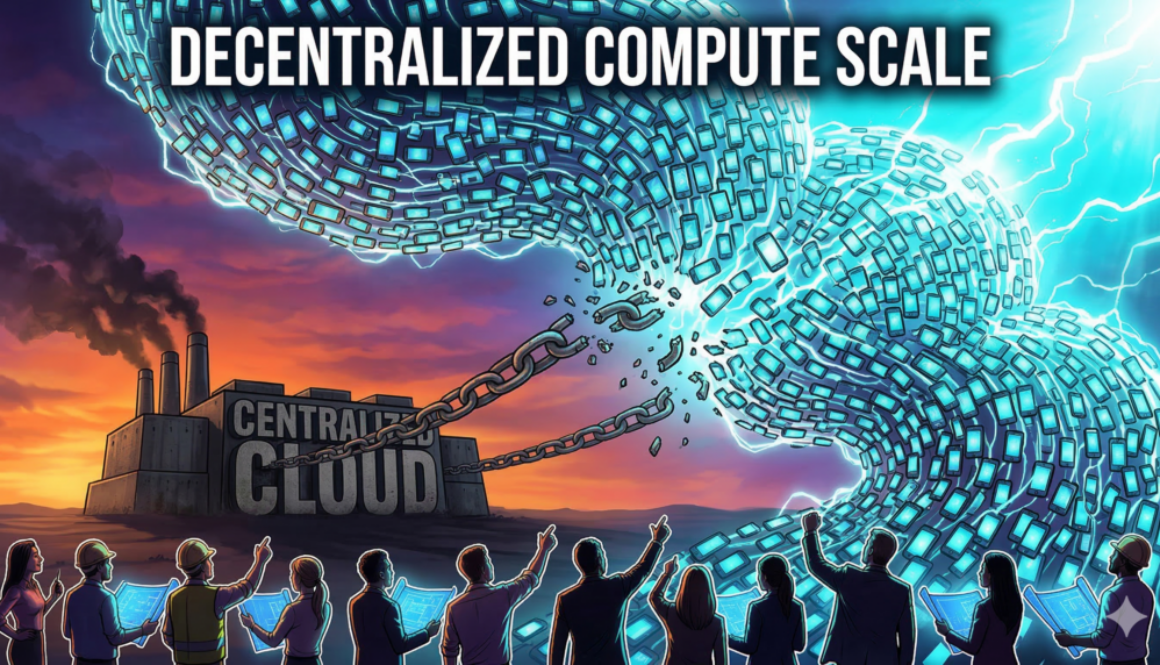
Your Phone Is A Data Center – Acurast Compute Network
Your Phone Is A Data Center
Acurast founder Alessandro De Carli on how smartphones’ trusted execution environments are becoming the backbone of confidential, decentralized compute — and why big tech cloud infrastructure may have finally met its match.
// Full Interview
Ashton Addison interviews Alessandro De Carli, Founder of Acurast · Blockchain Interviews
Most people use their smartphones to scroll social media, take photos, and stream video. Alessandro De Carli sees something else entirely: a distributed supercomputer that no hyperscaler can replicate — one that already exists in the pockets of billions of people.
De Carli is the founder of Acurast, a decentralized compute network that turns everyday mobile devices into verified, privacy-preserving compute nodes. The project has already onboarded more than 200,000 compute units from around the globe, and its architecture is built on a hardware capability that every modern smartphone already ships with: the Trusted Execution Environment (TEE).
What Is a Trusted Execution Environment?
Every modern smartphone contains a secure element — the same piece of hardware that makes Apple Pay and Google Pay possible. Nested inside is the TEE, a hardware-isolated subsystem capable of running code that cannot be tampered with or inspected, even by the device owner.
For Acurast, this was the foundational insight. If a network rewards users for contributing compute, bad actors will inevitably try to fake that compute. The TEE closes that loophole entirely: only attested devices — those that produce a cryptographic proof of genuine hardware — can participate in the network.
People should be able to onboard devices and provide compute without even noticing that what they’re actually working with is a blockchain and a crypto system.
— Alessandro De Carli, Founder, AcurastConfidential Compute: The Missing Piece
Beyond anti-cheat, the TEE enables something more profound: confidential compute. When you offload a workload to an Acurast node, the device owner processing that task cannot read your data, inspect your code, or alter the execution — cryptographic guarantees enforced in hardware.
De Carli argues this is the core reason previous decentralized compute networks failed to achieve mainstream adoption. “You will not hand over your personal data to perfect strangers,” he told Addison. Without confidentiality, decentralized networks were limited to workloads involving data nobody actually cared about protecting.
- Web scraping and resilience testing at scale
- Confidential AI agent execution — secrets stay private
- Multi-chain workload deployment paid in USDT, ETH, BTC, or native ACU
- Crowdsourced compute spread across thousands of global households
Why Phones Beat Servers
It sounds counterintuitive, but the benchmarks bear it out. Mobile chips — Apple’s A-series in particular — are optimized relentlessly for single-core performance. Apple alone spends $33 billion annually on R&D, with over half its revenue coming from the iPhone. The result, De Carli notes, is “not a consumer device but the most and best-engineered piece of hardware out there in terms of compute per unit.”
Server chips, by contrast, optimize for multi-threading and throughput — spreading performance across many cores — while consuming dramatically more power. For the specific workloads Acurast targets, the mobile advantage is real. Independent benchmarks on sites like CPUBenchmark.net confirm that per-core performance on mobile often outpaces traditional server hardware.
Beyond raw performance, the laptop and desktop market simply lacks the secure element that makes verifiable, confidential compute possible. Mobile was the only viable starting point.
The Cloud Rebellion
The timing feels deliberate. Recent missile strikes on data centers in the Middle East caused cascading outages across cloud-dependent services, a stark reminder that centralized infrastructure is geographically and politically fragile. De Carli sees the pendulum swinging back toward distributed architectures — not because of ideology, but necessity.
“With Acurast, your data center is spread across thousands, if not millions, of households,” he explained. Resilience becomes structural, not something you pay extra for in an SLA that may or may not hold during a genuine crisis.
These companies notoriously don’t have your best interest in mind. This can quickly turn into bigger things — being denied health insurance because the whole system knows you very well and risk data is being shared.
— Alessandro De Carli, Founder, AcurastAI Agents and What’s Coming Next
As AI agents become more capable — and as users hand them API keys, credentials, and access to sensitive systems — the question of where that compute runs becomes urgent. Addison put it plainly: “Who owns the server? Who else might have access? Nobody really thinks about that with these centralized AIs.”
Acurast’s answer is container support, launching imminently. The new environment provides a full Linux runtime — all packages, all dependencies, running entirely inside the confidential compute boundary. That includes tools like OpenClaw, the popular self-hosted AI agent, which could soon run on Acurast without ever exposing its secrets to the compute provider.
- Container Support — Full Linux environments inside confidential compute, enabling OpenClaw and custom AI agents
- Compute Clusters — Coordinated multi-device workloads for heavier compute demands
- App Store Layer — Developers publish deployments; others — humans or agents — can discover and utilize them permissionlessly
How to Get Involved
Participating as a compute provider is as simple as installing the Acurast app from the iOS App Store or Google Play. After a brief onboarding, your device begins contributing compute to the network. The app must run in the foreground — Acurast chose this deliberately to leverage maximum single-core performance rather than throttled background processes.
For an everyday device, that means contributing during charging cycles or idle time. For a spare phone or tablet gathering dust, it can run continuously. Rewards accrue in ACU, which can be acquired or paid using USDT, ETH, or BTC through the network’s multi-chain payment system.
For those with technical questions — bulk device onboarding, workload deployment, or developer integration — the Acurast Discord community is active, and the weekly newsletter at acurast.com provides summarized updates on protocol developments.
Download the Acurast App & Start Earning
Install the app on any iOS or Android device — including spare phones and tablets — and begin contributing compute to the network. Use our exclusive bonus code at registration.
Watch More Blockchain Interviews
CCS publishes one founder interview per week — syndicated on Reuters/Refinitiv TV and distributed across 10+ podcast networks.