
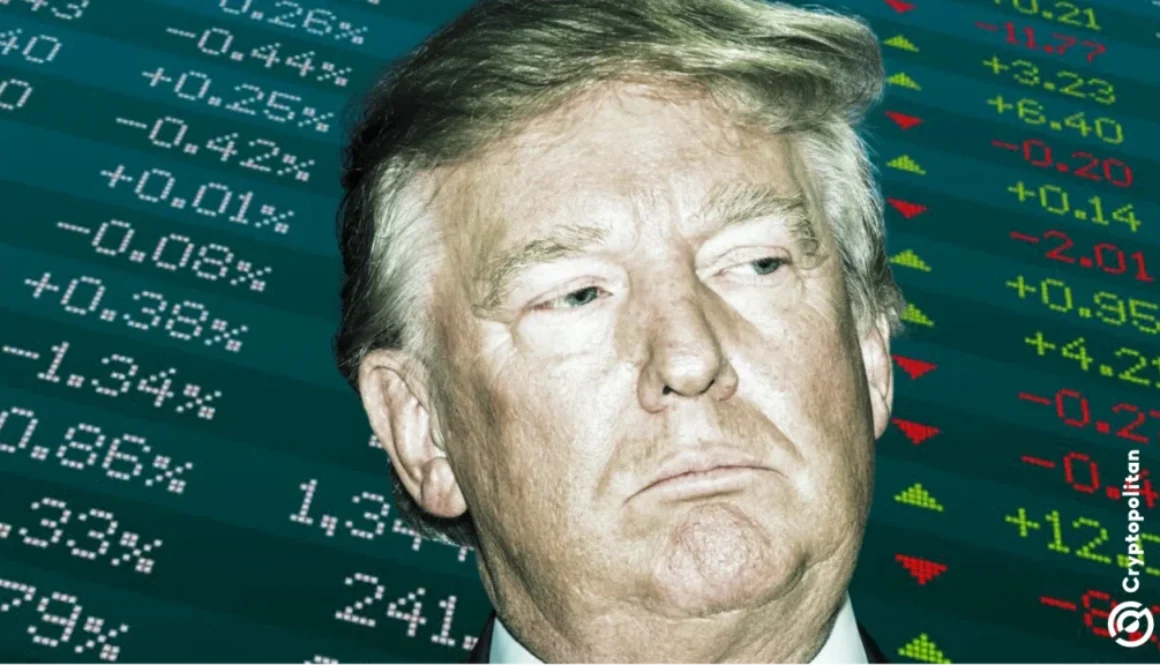
Trump’s 15% tariff shock rocks stocks but crypto keeps calm
President Trump has escalated his trade policy stance, raising the global tariff rate to 15% from 10% through executive order, marking a significant shift in US economic strategy. The cryptocurrency market, which historically reacts sharply to major policy announcements, showed surprising resilience following the tariff announcement, with Bitcoin holding near $68,000 and Ethereum remaining stable. The move, justified as addressing long-standing trade imbalances, has triggered immediate pushback from international trade partners and raised questions about broader economic consequences.
The Tariff Announcement and Market Response
Trump formalized the increase through executive action backed by Congress, implementing what he described as a “fully allowed and legally tested level” of tariff escalation. The President stated his intention to announce additional tariffs in coming months, signaling this represents an opening phase of a broader trade recalibration. Unlike previous major policy shifts, the crypto market did not experience the substantial sell-off typically observed during periods of macroeconomic uncertainty.
As President of the United States, I am raising the 10% global tariff on countries that have been taking advantage of the US for many years, without any consequences until my administration came along.
— President Trump, Truth Social statement
The 5-percentage-point increase represents a meaningful escalation in tariff pressure on US trading partners. Analysts are scrutinizing whether the crypto market’s muted response reflects changing investor psychology around tariffs or suggests broader economic concerns have already been priced into digital assets. Bitcoin’s stability near $68,000 during the announcement period contrasts sharply with equity market volatility, pointing to divergent risk assessments across asset classes.
The tariff increase follows a Supreme Court ruling that restricted the President’s ability to impose tariffs under the International Emergency Economic Powers Act (IEEPA), prompting the administration to pursue congressional authorization instead.
Industry Context and Supply Chain Disruptions
The manufacturing and technology sectors face particularly acute challenges from the expanded tariff regime. Industries heavily reliant on imported components—including semiconductors, automotive, pharmaceuticals, and consumer electronics—stand to experience significant cost pressures. The 15% tariff effectively increases input costs across supply chains, forcing manufacturers to choose between absorbing costs, raising consumer prices, or relocating production facilities.
Global supply chains have spent decades optimizing for efficiency and cost reduction, establishing intricate networks of component suppliers across multiple countries. The tariff escalation threatens to reverse this consolidation by making localized production economically competitive again. However, reshoring production requires substantial capital investment and workforce development, timelines measured in years rather than months. Companies face immediate tariff costs while waiting for long-term restructuring benefits to materialize.
The semiconductor industry, already navigating supply constraints and geopolitical risk, faces particular vulnerability. Tariffs on imported chips and manufacturing equipment threaten to compound existing supply-chain fragility and push technology product costs higher. This dynamic could affect cryptocurrency mining operations, data center infrastructure, and blockchain-related technology development that depends on cutting-edge computing hardware.
International Concerns and Trade Tensions
Britain’s business community has responded swiftly and critically to the tariff escalation. The British Chambers of Commerce, representing the UK’s largest business interests, warned that the policy threatens bilateral trade relationships and contradicts promises of favorable treatment through existing trade agreements.
William Bain, head of Trade Policy at the BCC, highlighted a crucial disparity in the tariff structure. According to Bain’s assessment, many UK exports face the full 5% additional tariff increase, with only goods covered under the existing Economic Prosperity Deal exempted from the new burden. This selective application creates uncertainty for British exporters and complicates trade planning.
This means an additional 5% increase in tariffs on many UK goods exported to the US, except those included in the Economic Prosperity Deal. Tariff hikes are a misguided approach that will negatively affect trade and international economic growth.
— William Bain, Head of Trade Policy, British Chambers of Commerce
British officials have stressed the need for transparent, stable trade conditions that provide certainty for businesses operating across the Atlantic. The tariff escalation threatens to undermine investment confidence and complicates supply chain planning for firms with transatlantic operations. Recent policy developments suggest trade tensions will remain elevated through the coming months.
The European Union, Canada, Mexico, and other major trading partners are similarly evaluating retaliatory measures. Historical precedent suggests that tariff escalations frequently trigger tit-for-tat responses, expanding economic friction across multiple fronts. Such escalation dynamics could create cascading effects through global trade networks, potentially affecting cryptocurrency market volatility indirectly through broader macroeconomic deterioration.
Market Implications and Asset Class Reactions
Traditional equity markets have demonstrated measurable concern about tariff escalation, with industrials and technology shares showing heightened volatility. The divergent response between equities and cryptocurrency reflects different investor bases and risk assessments. Institutional investors in traditional markets face immediate margin pressure from higher input costs, while cryptocurrency investors may view digital assets as disconnected from traditional supply chain dynamics.
Currency markets have reacted more significantly, with the dollar strengthening against major trading partners’ currencies. Strong dollar dynamics typically support cryptocurrency valuations by making dollar-denominated assets more attractive relative to alternatives, potentially explaining part of crypto’s resilience. However, this advantage reverses if tariff-induced economic weakness subsequently weakens the dollar.
Bond markets have priced in expectations of slower growth from tariff disruption, with longer-dated Treasury yields declining despite inflation concerns. This dynamic suggests investors anticipate the Federal Reserve may face pressure to cut rates sooner than previously expected if tariff-driven growth headwinds materialize. Lower interest rates typically support risk asset valuations, including cryptocurrency, by reducing opportunity costs of holding non-yielding assets.
Broader Economic Implications
The tariff increase carries consequences extending beyond bilateral trade relationships. Economists warn that broad-based tariff escalation typically results in higher consumer prices, reduced international trade volumes, and slower economic growth across multiple regions. The cumulative effect of these tariffs could dampen global economic momentum and create headwinds for growth-sensitive assets.
Tariff-driven price increases typically filter through supply chains, raising costs for consumers and businesses. The lag between tariff implementation and economic impact means effects may not be immediately visible in market data but will likely accumulate over subsequent quarters.
Policy analysts have questioned whether tariff-based strategies effectively address underlying trade imbalances or instead disrupt established supply chains and reduce overall economic efficiency. The administration has signaled that additional targeted tariffs will follow, suggesting the current 15% rate represents a baseline rather than a final position. This ongoing uncertainty may eventually pressure financial markets and commodity prices.
Inflation pressures represent a critical concern. While tariffs increase import costs immediately, broader economic slowdown may eventually suppress demand and moderate price growth. The net inflation effect depends on the magnitude of growth dampening versus import cost increases. Central banks face policy dilemmas if tariffs create “stagflation” scenarios combining higher prices with slower growth, historically among the most economically damaging conditions.
Cryptocurrency’s Unusual Stability
The crypto market’s muted response to significant geopolitical and economic news represents a notable shift from historical patterns. Typically, major policy announcements trigger rapid repricing of risk assets as investors reassess economic scenarios. The stability in Bitcoin and Ethereum prices during the tariff announcement period suggests either strong buyer support at current levels or investor indifference to tariff policy specifically.
Several factors may explain this divergence from historical behavior. Digital asset investors may view tariff policy as primarily affecting traditional equities and currency markets rather than cryptocurrency valuations. Alternatively, the market may have already incorporated expectations of elevated tariff regimes into current pricing. The coming weeks will clarify whether this stability reflects genuine decoupling from traditional macroeconomic factors or represents a temporary phenomenon.
The administration’s stated intention to implement additional tariffs in coming months suggests economic uncertainty will persist, potentially creating volatility triggers for broader financial markets. Investors should monitor how traditional equities and commodity markets respond to tariff implementation, as such reactions may eventually influence cryptocurrency valuations through indirect channels affecting risk appetite and capital allocation decisions.
Forward Outlook and Investment Considerations
The tariff escalation establishes a new baseline for policy uncertainty that will shape market behavior through the coming year. Businesses must rapidly evaluate supply chain resilience, geographic diversification strategies, and pricing power. Financial markets will likely experience periodic volatility as tariff implementation schedules are announced and economic data reveals real-world impacts.
Cryptocurrency investors should recognize that while digital assets have demonstrated stability during this initial tariff announcement, broader macroeconomic deterioration would eventually pressure all risk assets. The relationship between cryptocurrency valuations and traditional macroeconomic conditions remains imperfect but meaningful over extended timeframes. Diversification across asset classes becomes increasingly important in uncertain policy environments characterized by potential trade war escalation.
The tariff policy represents a fundamental shift toward economic nationalism and domestic-focused strategy, reversing decades of trade liberalization. Whether this approach generates net benefits or costs remains contested, but the transition period will undoubtedly create market opportunities and risks for investors positioned to navigate heightened uncertainty. The cryptocurrency market’s emerging role as a macroeconomic hedge will continue developing as these trade tensions unfold.
Get weekly blockchain insights via the CCS Insider newsletter.