
Bridgeless DeFi Is Here: Why Wrapped Tokens Are Dead
Bridgeless DeFi Is Here: Why Wrapped Tokens Are Dead
Toby Gilbert, Co-Founder & CEO of PACT SWAP, on building the world’s first truly unified, bridgeless liquidity layer — enabling native $BTC, $ETH, and $SOL swaps without bridges, wrapped assets, or custodial middlemen.
Bridges. Wrapped tokens. Cross-chain risk. These are the structural flaws that have quietly undermined DeFi for years — and according to Toby Gilbert, Co-Founder & CEO of PACT SWAP, the industry is finally ready to leave them behind for good.
In this exclusive Crypto Coin Show interview, Ashton Addison sits down with Toby to explore how PACT SWAP is building what it calls the world’s first truly unified, bridgeless liquidity layer — a protocol that eliminates the risks of intermediary-based swaps while unlocking native BTC liquidity at scale.
Cross-chain infrastructure has long depended on a patchwork of bridges and wrapped token equivalents — mechanisms that introduce counterparty risk, smart contract vulnerabilities, and custody concerns at every step. High-profile bridge exploits have drained billions from the ecosystem, and the trust assumptions required by wrapped tokens run counter to the permissionless ethos DeFi was built on.
PACT SWAP’s thesis is direct: if DeFi is going to scale to institutional adoption in 2026 and beyond, the infrastructure beneath it needs to be rebuilt from the ground up — not patched.
“Bridges. Wrapped tokens. Cross-chain risk. Stuff DeFi doesn’t need.”
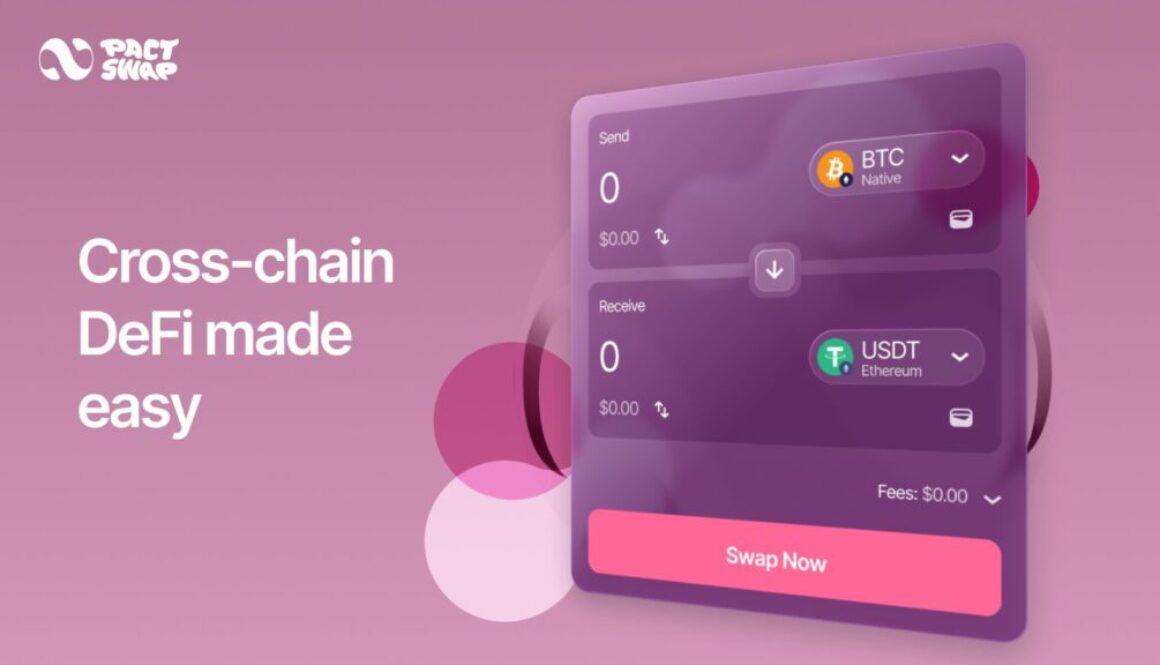
— Toby Gilbert, Co-Founder & CEO, PACT SWAPRather than locking assets in a bridge contract and minting a synthetic equivalent on another chain, PACT SWAP uses reactive smart contracts and collateralized accountability to execute swaps natively across chains. The result is a system where users can swap real $BTC for real $ETH — not wBTC, not a bridged equivalent — with full on-chain verifiability and no custodial middleman.
- Why existing bridge architecture is a structural liability, not a feature
- How PACT SWAP’s reactive smart contracts eliminate wrapped token risk
- What collateralized accountability means for permissionless cross-chain swaps
- Native $BTC, $ETH, and $SOL swaps — without custodians or synthetics
- The institutional DeFi opportunity in 2026 and how PACT SWAP is positioned
- What bridgeless liquidity means for global users in hubs like Austin and Dubai
With institutions actively preparing for the next wave of crypto adoption, demand for clean, auditable, bridge-free infrastructure has never been higher. PACT SWAP is positioning itself at exactly that intersection — a protocol that meets institutional-grade security requirements while remaining fully permissionless and decentralized.
Toby walks through the mechanics of how PACT SWAP eliminates liquidity silos across chains, and what a truly unified liquidity layer could mean for traders, institutions, and the everyday user who simply wants things to work — powerful infrastructure running silently beneath seamless financial experiences.
Interview
Covering blockchain’s intersection with real-world infrastructure since 2014. Syndicated on Refinitiv TV / London Stock Exchange, reaching 600,000+ institutional subscribers. 1,500+ interviews. 150K+ YouTube subscribers.
cryptocoinshow.com · @pact_swap · @tobycoinweb