
SEC considers removing two-year restriction connected to advisers’ political contributions
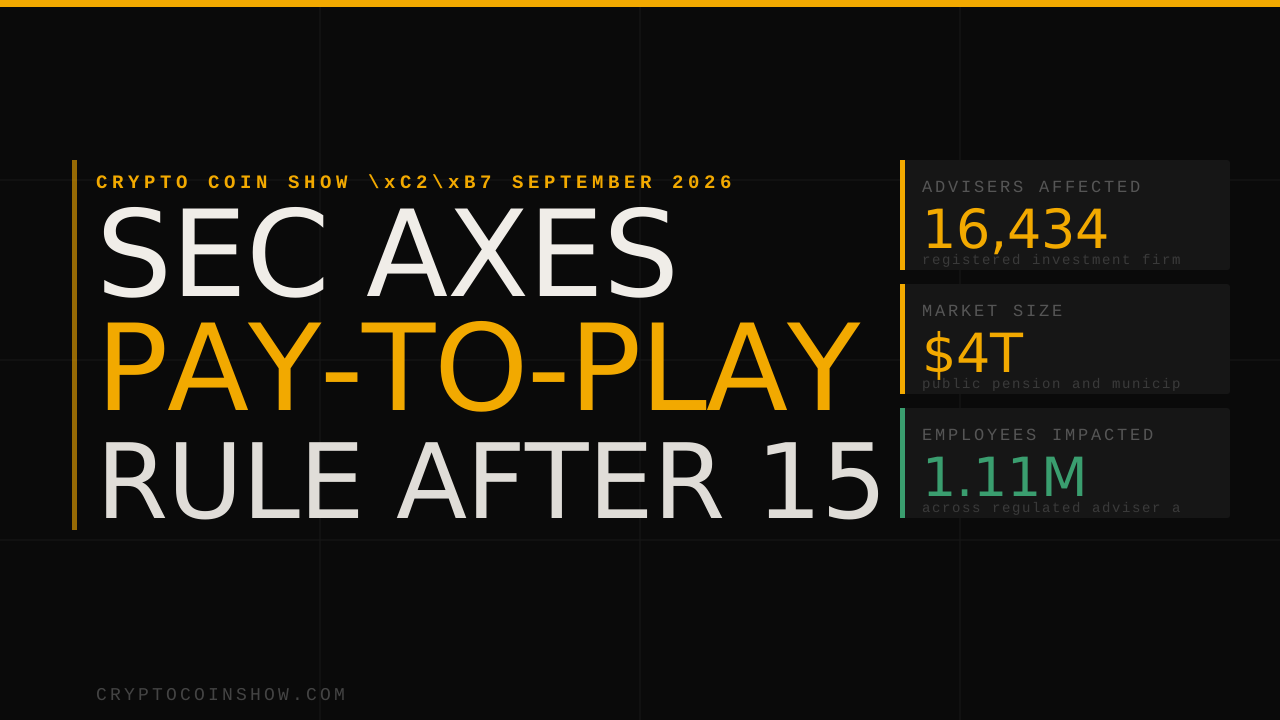
The SEC is moving to eliminate a 15-year-old “pay-to-play” rule that bars investment advisers from managing government money for two years after making political contributions to officials who influence adviser selection. The repeal would affect 16,434 registered advisers and 1.11 million employees, fundamentally reshaping how the $4 trillion public pension and municipal fund market awards contracts.
- SEC proposes repealing Rule 206(4)-5, eliminating the two-year compensation ban for advisers making political contributions to government officials.
- 16,434 investment advisers managing accounts for 1.11 million employees would no longer face restrictions on political activity and government client fees.
- The proposal eliminates political-contribution recordkeeping but retains anti-fraud, fiduciary duties, and existing federal and state anti-corruption laws as backstops.
- 15 years Duration of the “pay-to-play” rule since its original adoption by the SEC.
- 16,434 Registered investment advisers currently subject to the political contribution restriction rule.
- $4T+ Approximate scale of public pension and municipal fund assets at stake in adviser selection decisions.
On September 3, the Securities and Exchange Commission published a proposal to repeal Rule 206(4)-5, the agency’s signature “pay-to-play” regulation that has prohibited investment advisers from collecting fees from government clients for two years following any political contribution by the adviser, its employees, or partners to officials with power to award advisory contracts.
The rule, enacted in 2010 during the post-financial-crisis regulatory surge, currently restricts roughly 16,434 registered investment advisers and their 1.11 million employees from making contributions to candidates or officials at the federal, state, or local level who could influence selection of the adviser.
The proposal marks a sharp reversal of the agency’s earlier stance and aligns with broader deregulatory priorities announced by SEC Chairman Paul Atkins in 2024.
SEC Labels Rule Complex and Unclear After 15 Years of Application
The SEC’s characterization of Rule 206(4)-5 as a “trap for the unwary” and a “de facto strict liability standard” underpins its rationale for repeal.
The agency argues the rule is so complex and unclear that many investment firms have responded by implementing blanket internal bans on all political contributions rather than risk inadvertent violation, even where contributions would pose no genuine conflict.
WilmerHale’s analysis of the rule highlighted that the two-year lockout can apply to contributions “relatively small in size” with no demonstrated improper intent, creating compliance friction disproportionate to the actual risk.
The rule’s lookback provisions compound the confusion. Contributions made before an employee is formally designated as a “covered associate” can still trigger the two-year bar retroactively.
The prohibition extends even to donations made to federal campaign candidates if that candidate later holds a covered position in state or local government, effectively creating an unpredictable scope that extends beyond the original transaction. The SEC’s statement suggests this architecture has made compliance almost impossible to guarantee without eliminating political activity entirely.
For large advisory firms managing billions across multiple jurisdictions, the operational burden has been substantial. Compliance teams must track covered associates across all entities, monitor political contribution databases in real time, and audit contributions at the state and local level, many of which lack centralized public records.
The cumulative compliance cost for the industry, the SEC implies, exceeds the conflict-of-interest reduction the rule actually delivers.
Government Pension Assets Worth Trillions Remain Unprotected Under New Proposal
Public pension funds, state retirement systems, and public university endowments collectively manage trillions in assets and award some of the largest and most lucrative advisory mandates in the United States. These institutions were the target beneficiaries of Rule 206(4)-5.
By severing the link between political contributions and adviser selection, the proposal exposes these funds to the precise conflict it was designed to prevent: the risk that adviser hiring decisions would be influenced by campaign contributions rather than merit.
The SEC acknowledges this exposure but argues that other safeguards will remain in place. Anti-fraud provisions, fiduciary obligations, state and local procurement laws, and federal anti-corruption statutes will continue to apply. However, these existing guardrails operate after the fact, through litigation or enforcement action, rather than prophylactically.
The two-year bar operated as a structural prophylactic: it prevented the conflict from arising in the first place by making the transaction economically irrational for the adviser. Removing it shifts the burden of monitoring and prevention to the fund itself and to the political and legal system.
The proposal does eliminate the political-contribution-specific recordkeeping requirements embedded in the rule, removing one operational compliance layer.
Repeal Signals Broader Shift in SEC’s Regulatory Philosophy Under Atkins
The proposal reflects a deliberate deregulatory agenda. In April 2024, SEC Chairman Paul Atkins stated publicly that the agency was identifying and scrapping unnecessary regulations.
The repeal of Rule 206(4)-5 represents one of the first significant reversals of post-2008 financial regulation and signals openness to revisiting other rules that have been criticized as overly prescriptive or burdensome. For institutional investors and fund sponsors, this shift carries implications for how regulatory risk is priced and how fiduciary monitoring must be structured going forward.
The timing also matters. The proposal comes as the crypto and blockchain industry has faced persistent SEC scrutiny on disclosure, custody, and market manipulation. A simultaneous move to deregulate traditional securities-based adviser conduct could be read as either inconsistent or part of a broader “deregulation where possible” posture.
For institutional crypto investors evaluating whether to allocate capital through cryptocurrency fund managers, the SEC’s demonstrated willingness to relax traditional adviser rules may reduce confidence in the agency’s willingness to enforce other conduct standards.
The proposal does not yet carry the force of law. The SEC typically allows a 60-day public comment period following the publication of a proposed rule change. Opposition from state pension funds, municipal finance officers, and government procurement officials is expected, as those constituencies are the primary beneficiaries of the existing rule.
The question remains whether that opposition will be sufficient to slow or block the repeal, or whether the SEC’s deregulatory mandate will prevail.
The SEC has not announced a formal comment deadline or timetable for a final rule vote. Institutional investors and fund sponsors should monitor comment submissions from CalPERS, CalSTRS, and other large public pension systems over the coming weeks, as their positions will likely shape whether the agency faces sufficient political pressure to modify or withdraw the proposal. The next concrete step is the close of the public comment period, expected within 60 days of the September 3 publication date.