Peter Schiff warns Bitcoin could reverse as silver’s historic rally accelerates
Veteran market commentator Peter Schiff has renewed his long-standing critique of Bitcoin, warning that the cryptocurrency could face a sharp reversal as silver reaches historic price levels. The cautionary statement emerged as silver surged to an unprecedented $79 per ounce, marking a milestone moment for the precious metal and reigniting debate about the relationship between traditional assets and digital currencies.
Silver’s Historic Breakout
Silver experienced a remarkable rally recently, jumping more than 10 percent in roughly 90 minutes as it climbed from $78 to approximately $79 per ounce. This move represented the first time the metal has reached this price level in recorded history, drawing widespread attention from institutional and retail investors alike.
Technical analysis underscored the significance of the breakout. The metal’s monthly Relative Strength Index reached an all-time high not seen in 45 years, according to charting data reviewed by analysts. This reading suggested strong upward momentum but also raised questions about whether the rally could sustain its current trajectory.
Silver’s recent price action has prompted analysts to debate whether the surge reflects genuine institutional demand or temporary speculative fervor.
— Market Analysts
The broader metal ecosystem has benefited from renewed investor interest. Tokenized commodity assets backed by blockchain technology have grown to approximately $4 billion in total value, suggesting a meaningful shift toward alternative assets among a segment of the investment community.
Silver reached $79 per ounce for the first time in history, with the metal’s 45-year monthly RSI reaching all-time highs.
Schiff’s Bitcoin Warning
Peter Schiff, a long-time cryptocurrency skeptic and Bitcoin critic, used the occasion of silver’s rally to issue fresh warnings about digital assets. His thesis holds that as traditional precious metals appreciate, cryptocurrencies may experience corresponding downward pressure rather than benefit from the same tailwinds.
Schiff’s argument rests on the assumption that investor capital moving into commodities represents a rotation away from riskier alternatives. Market downturns, he contends, can accelerate rapidly once momentum reverses, potentially catching leveraged positions off guard.
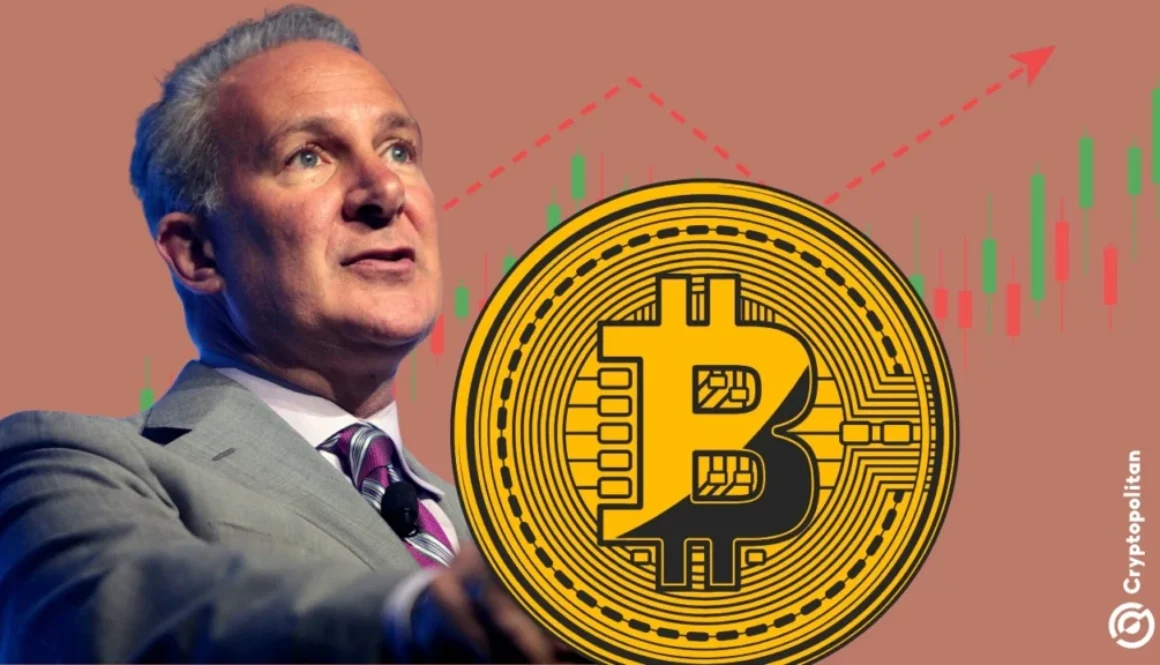
At the time of Schiff’s statement, Bitcoin was trading near $87,000, showing minimal movement over a 24-hour period. Major cryptocurrencies across the board posted only modest daily gains, with crypto prices largely treading water compared to silver’s explosive momentum.
Bitcoin remained near $87,000 with minimal 24-hour volatility as precious metals accelerated higher.
Industry Context and Market Implications
The precious metals industry has experienced significant structural changes over the past decade. Silver, historically viewed primarily as an industrial commodity and monetary backstop, has increasingly attracted attention from macroeconomic investors concerned about currency debasement and inflation. The industrial demand for silver—particularly in solar technology, electronics, and medical applications—has created a fundamental floor beneath prices, distinguishing silver from purely speculative assets.
The cryptocurrency market, by contrast, has matured into a multi-trillion-dollar ecosystem with institutional participation from major asset managers, family offices, and sovereign wealth funds. This institutional adoption has lent legitimacy to digital assets while simultaneously introducing new volatility vectors tied to regulatory developments and macroeconomic policy shifts.
Schiff’s commentary represents a traditional finance perspective that has grown increasingly vocal as alternative assets gain mainstream acceptance. His warnings specifically target the leverage and sentiment-driven nature of cryptocurrency markets, which can experience rapid reversals when momentum shifts. The precious metals complex, while volatile, has centuries of historical precedent as a store of value during currency crises and geopolitical instability.
Market data suggests that both asset classes have attracted capital flows during the current period of monetary uncertainty. Central bank policies across developed nations have maintained accommodative stances, creating environments where alternative assets—whether mined commodities or digitally native currencies—benefit from reduced opportunity costs relative to fiat-denominated savings accounts and traditional bonds.
Diverging Narratives in Markets
The contrasting performance of silver versus Bitcoin has intensified an ongoing debate within financial markets about which assets represent genuine value stores. Schiff represents one school of thought that favors traditional commodities over decentralized digital currencies.
However, the rapid growth of tokenized commodities indicates that some investors see no inherent conflict between the two asset classes. The $4 billion total value in blockchain-based commodity tokens suggests a hybrid approach is gaining traction, where exposure to both traditional and emerging asset types appeals to a sophisticated investor base.
Silver’s recent performance has also narrowed the valuation gap with major technology stocks, drawing fresh institutional attention to the metals complex. Analysts point to increasing evidence that commodities may be entering a structural bull phase independent of cryptocurrency movements.
The question facing investors is whether silver’s breakout and Bitcoin’s consolidation reflect genuine market divergence or temporary tactical misalignment.
— Industry Observers
Entity Background: Peter Schiff and His Market Influence
Peter Schiff has maintained a prominent position in financial commentary for over two decades, known for contrarian perspectives on monetary policy, currency markets, and asset valuations. As chief economist of Euro Pacific Capital, Schiff has consistently advocated for commodity-based investments and warned against excessive leverage in financial systems.
His warnings about cryptocurrencies have remained consistent despite Bitcoin’s significant appreciation over the past decade. Rather than moderating his stance, Schiff has intensified his criticism, arguing that the lack of intrinsic value and yield-generating capacity makes cryptocurrencies inherently speculative. His recent commentary on silver’s rally represents a continuation of this thesis, suggesting that genuine portfolio protection comes from physical assets with industrial utility and historical monetary recognition.
Schiff’s influence extends across multiple platforms including traditional media appearances, his own investment advisory firm, and significant social media following. His warnings carry weight with investors concerned about systemic risks, even as cryptocurrency advocates dismiss his perspective as outdated and resistant to technological innovation.
What’s Next for Both Assets
Schiff’s warning highlights the tension between two competing narratives. Traditional market observers view precious metals as genuine inflation hedges backed by millennia of monetary history. Digital asset advocates counter that cryptocurrencies offer superior portability, divisibility, and independence from government control.
The 45-year high in silver’s monthly RSI presents a genuine technical question: can the rally extend further, or have late-stage buyers entered near the peak? Similarly, Bitcoin‘s subdued trading action contrasts sharply with silver’s explosive move, raising questions about relative strength across asset classes.
Looking forward, several scenarios could unfold. A continuation of silver’s rally might validate Schiff’s thesis if Bitcoin simultaneously experiences downward pressure, suggesting genuine capital rotation. Alternatively, both assets could appreciate together if the underlying driver represents broad institutional flight from currency-denominated assets rather than a zero-sum competition between alternative stores of value.
Investors monitoring both markets should recognize that correlation patterns can shift. Asset classes that historically moved together may diverge significantly during periods of rapid monetary or geopolitical change. The current market environment—characterized by economic uncertainty and currency concerns—may favor both commodities and cryptocurrencies simultaneously, contradicting Schiff’s zero-sum assumption.
The tokenization of commodities adds another layer of complexity to this analysis. As blockchain technology enables fractional ownership of physical assets, the traditional separation between digital and traditional markets blurs. This trend suggests that future portfolio construction may increasingly blend both approaches, potentially creating opportunities for sophisticated investors who recognize complementary rather than competing characteristics.
Market participants should track several key indicators moving forward: whether silver sustains above $79, the technical behavior of Bitcoin near $87,000, institutional capital flows into tokenized commodity vehicles, and central bank policy announcements that might shift risk appetite. These data points will help determine whether Schiff’s warning holds merit or if both assets can thrive during a broader flight toward alternative stores of value. The resolution of this debate may ultimately depend less on the inherent properties of these assets and more on macroeconomic developments and policy choices that remain uncertain.
Get weekly blockchain insights via the CCS Insider newsletter.