
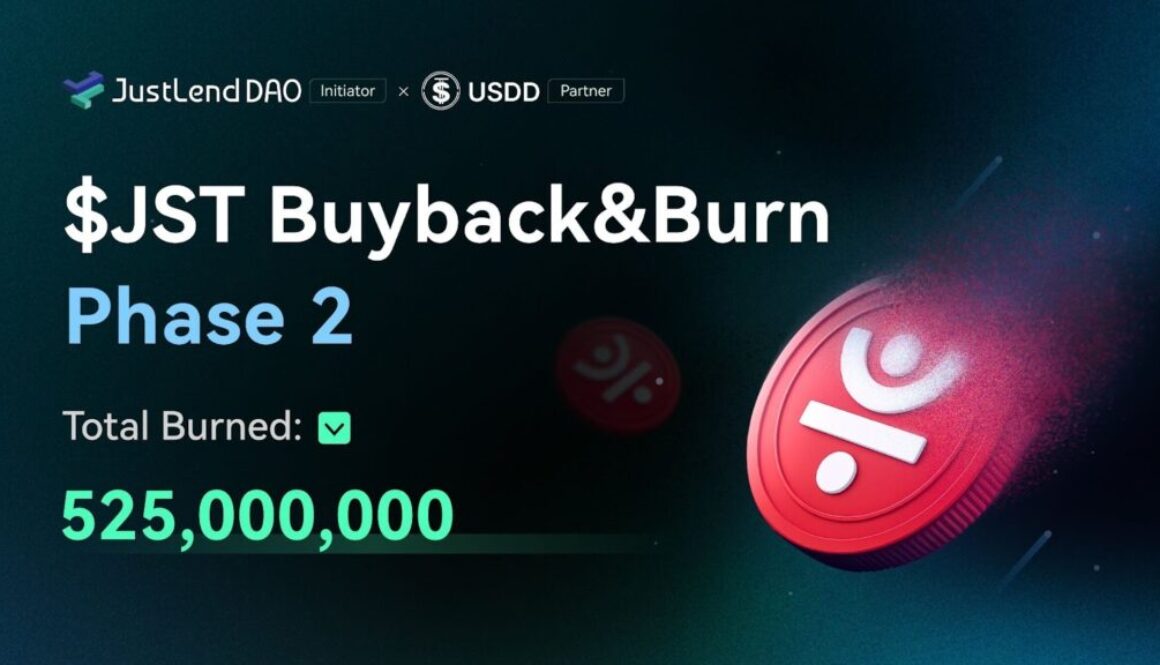
JustLend DAO Completes Second JST Buyback and Burn, Removing Nearly 11% of Total Supply
JustLend DAO has completed its second major token reduction initiative, removing 525 million JST tokens from circulation through a buyback and burn mechanism. The move, valued at approximately $21 million, represents part of a broader deflationary strategy that has eliminated roughly 11% of total JST supply in under three months, demonstrating how decentralized lending protocols are using token economics to manage inflationary pressures.
Cumulative Supply Reduction Accelerates
The protocol has now permanently removed 1.08 billion JST tokens across two consecutive burn events. This dual-phase approach underscores a strategic shift in how decentralized finance projects approach tokenomics—moving beyond passive distribution models toward active, programmatic supply management.
What distinguishes this initiative is its self-sustaining structure. The buyback mechanism operates using USDT reserves generated from the initial burn, creating a closed-loop system that theoretically can continue without requiring new capital injections. This design eliminates dependency on treasury allocations or governance proposals for each subsequent reduction.
The buyback mechanism draws from USDT reserves generated during the initial burn, creating a self-sustaining model that can support future supply reductions without requiring external capital infusions.
— JustLend DAO Protocol Analysis
Ecosystem activity, particularly strength in the SBM market, provided the economic foundation for this burn. When a DeFi protocol generates sufficient fee revenue and user engagement, it creates the financial runway needed for genuine token reduction—distinguishing this from cosmetic burns that lack underlying fundamentals.
TVL Growth and Competitive Standing
JustLend DAO currently secures more than $7.08 billion in total value locked, positioning it among the three largest decentralized lending markets globally. This metric matters because TVL correlates directly with protocol revenue, user trust, and the sustainability of deflationary initiatives.
For context on competitive dynamics, understanding how Ethereum-based lending protocols and TRON’s ecosystem compare reveals important market structure shifts. TRON’s lower transaction costs have historically attracted users seeking alternatives to higher-fee networks. The decentralized lending market has grown substantially, with total sector TVL exceeding $40 billion across all blockchains as of early 2025. Within this competitive environment, TRON-based protocols have captured meaningful market share by offering cost advantages that prove particularly valuable for users executing frequent transactions or managing smaller position sizes.
JustLend DAO’s $7.08 billion TVL represents significant concentration of liquidity on a single blockchain, reflecting both the protocol’s operational strength and TRON’s growing relevance in DeFi infrastructure. The protocol’s ability to maintain this position while implementing supply reduction demonstrates that user retention remains strong despite deflationary pressures on token holders.
JustLend DAO’s $7.08 billion TVL positions it among the three largest decentralized lending markets, enabling sustainable token reduction strategies through ecosystem-generated revenue.
The protocol’s market position demonstrates that lending activity—not speculative trading—drives the revenue streams enabling token burns. This distinction matters for assessing whether supply reduction initiatives represent genuine value-creation or temporary price support measures. Real lending generates sustainable fee income; speculative enthusiasm creates temporary conditions that cannot support prolonged token reduction initiatives.
Supporting Infrastructure and Ecosystem Integration
Beyond tokenomics, JustLend DAO has expanded its product ecosystem with several infrastructure components. The sTRX staking product has attracted over 9.3 billion tokens, allowing users to earn yield while maintaining exposure to other DeFi applications. This dual-utility approach—combining security interest income with DeFi accessibility—has proven particularly effective at driving capital retention within the ecosystem.
The Energy Rental feature, which reduced fees from 15% to 8% in September 2025, continues driving on-chain adoption. Fee reductions signal confidence in volume growth and represent a deliberate trade-off: lower margins on individual transactions justified by increased transaction frequency. This pricing strategy acknowledges that in competitive DeFi markets, user acquisition costs often justify short-term margin compression.
The GasFree Smart Wallet has processed $46 billion in cumulative transaction volume. By allowing users to pay network fees directly from transferred assets like USDT, the wallet removes friction points that typically discourage retail participation in blockchain applications. Individual transfer costs have been subsidized to approximately 1 USDT. This innovation addresses a critical adoption barrier: the need to maintain separate reserves of native tokens specifically for transaction fees. By consolidating fee payments into primary assets, JustLend reduces cognitive and operational friction.
The GasFree Smart Wallet has processed $46 billion in transaction volume by enabling users to pay network fees directly from transferred assets, with subsidies bringing individual transfer costs down to roughly 1 USDT.
— JustLend DAO Infrastructure Report
These infrastructure innovations matter because sustainable token economics require sustained user engagement. Fee structures, staking mechanics, and wallet functionality directly influence whether protocol activity persists or declines. Infrastructure improvements that reduce user friction tend to correlate with higher retention rates, which in turn generate more consistent revenue for supporting deflationary mechanisms.
The USDD stablecoin has expanded beyond its native TRON blockchain onto Ethereum and BNB Chain. Multi-chain presence addresses a fundamental constraint: stablecoins derive utility from acceptance and liquidity across multiple venues. A stablecoin confined to a single blockchain encounters natural demand limitations. By extending across multiple blockchains, USDD positions itself as a general-purpose settlement asset rather than a niche ecosystem token.
The expansion strategy reflects broader market trends in stablecoin adoption. Traditional finance institutions increasingly recognize stablecoins as essential infrastructure for blockchain-based settlement. Protocols offering stablecoins that function across multiple chains position themselves favorably within this emerging financial structure. USDD’s multi-chain presence makes it available to users regardless of their primary blockchain ecosystem, expanding potential adoption.
USDD’s total value locked surpassed $1 billion by mid-January 2025, more than doubling within two months. This expansion strengthens connections between stablecoin adoption and broader ecosystem engagement.
The stablecoin’s multi-chain deployment creates important interconnections within the TRON ecosystem. USDD adoption on Ethereum and BNB Chain increases points of contact between external users and TRON-native protocols like JustLend DAO. Higher stablecoin circulation can indirectly support token demand through cross-chain arbitrage and DeFi composability. Users accessing USDD through Ethereum or BNB Chain may subsequently discover TRON-based opportunities, creating new acquisition channels for the main ecosystem.
Understanding broader cryptocurrency market trends and stablecoin adoption provides context for why protocols are prioritizing multi-chain presence. Fragmented blockchain ecosystems require stablecoins that function across boundaries. Protocols that fail to achieve multi-chain reach risk becoming confined to single-chain relevance as users increasingly expect interoperability.
Industry Context and Market Implications
The decentralized lending sector has matured significantly from its early experimental phase. Protocols now face intensifying competition on multiple dimensions: yield competitiveness, user experience, security assurance, and economic sustainability. Token reduction initiatives must be understood within this competitive context—they represent one tool among many that protocols use to maintain user interest and demonstrate competent management.
The broader DeFi market has also witnessed increased institutional participation, which generally favors protocols demonstrating disciplined capital management. Institutional investors tend to evaluate DeFi protocols using frameworks more similar to traditional finance scrutiny: revenue sustainability, expense discipline, capital efficiency. Token burns funded through actual protocol revenue align more closely with institutional expectations than speculative supply manipulations lacking underlying economics.
JustLend DAO’s approach—combining revenue-funded token reduction with infrastructure innovation and multi-chain expansion—represents a more sophisticated strategy than simple supply-side interventions. This multi-pronged approach acknowledges that sustainable competitive advantage in DeFi requires simultaneous attention to technology, user experience, and economic incentives.
Sustainability Questions and Forward Outlook
The fundamental question surrounding token reduction initiatives is whether they reflect structural improvements or temporary dynamics. JustLend DAO’s approach—burning tokens generated from actual ecosystem fees—appears more grounded than speculative supply reductions lacking underlying revenue.
However, sustained deflationary pressure depends on maintaining protocol activity levels. If user engagement declines, fee revenue shrinks, and the mechanism supporting future burns loses fuel. The protocol must balance revenue generation with user acquisition and retention.
The staking products, wallet innovations, and stablecoin expansion suggest management is pursuing genuine ecosystem development rather than relying solely on token economics to drive adoption. Whether these efforts generate sufficient long-term engagement will determine whether the deflationary strategy becomes a sustainable feature or a temporary market phenomenon.
For investors and participants evaluating TRON-based DeFi opportunities, the relevant questions extend beyond current burn rates. Tracking ecosystem activity, fee generation, and user growth metrics provides better insight into protocol health than token supply reductions alone. Observing whether infrastructure improvements translate into increased transaction volume, whether stablecoin expansion attracts new users, and whether staking products retain capital during market downturns—these metrics ultimately determine whether JustLend DAO’s broader strategy succeeds.
The competitive landscape for decentralized lending continues evolving as protocols across multiple blockchains experiment with different economic models. JustLend DAO’s combination of supply reduction, infrastructure innovation, and cross-chain expansion represents one approach to building sustainable DeFi products. As the sector matures, protocols that demonstrate both technical excellence and economic discipline will likely emerge as the lasting winners. Time will reveal whether this strategy generates lasting competitive advantages or remains effective only during favorable market conditions.
Get weekly blockchain insights via the CCS Insider newsletter.