
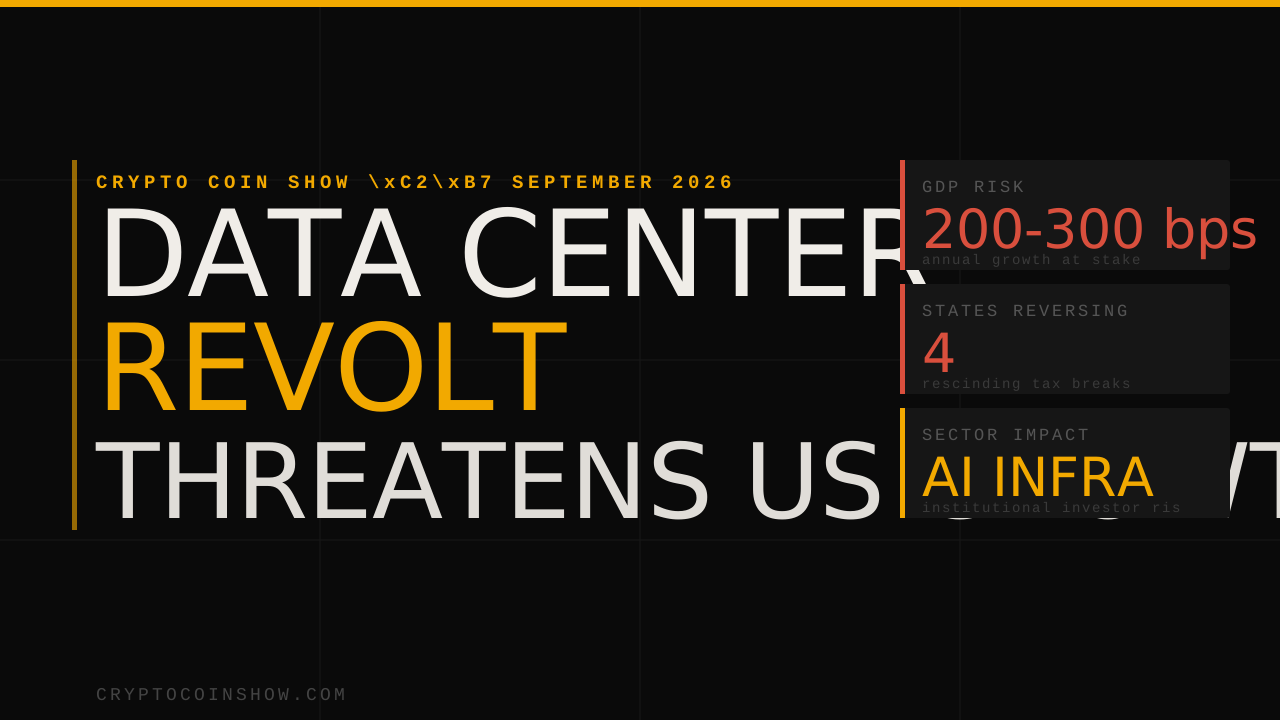
Chamath Palihapitiya warns data center revolt could dent US GDP
Silicon Valley venture capitalist Chamath Palihapitiya has warned that escalating state-level conflicts over AI data center siting could cost the US economy 200 to 300 basis points of annual GDP growth if political resistance continues to spread. The alarm signals mounting tension between industry expansion and voter backlash over electricity costs, creating a critical risk for institutional investors positioned in AI infrastructure and energy sectors.
- Palihapitiya called state-level data center disputes a “powder keg” that could metastasize into a national economic crisis if unresolved.
- Governors in Pennsylvania, Texas, Ohio, and New York have reversed course, rescinding tax breaks and imposing new restrictions on data center projects.
- The Department of Energy projects data centers could consume 15.3% of US power supply by 2030, driving household electricity cost concerns.
- 200-300 bps Estimated annual US GDP loss if data center disputes continue spreading unchecked
- 15.3% Share of US power supply projected for data centers by 2030 versus current demand baseline
- 1 in 6 US households currently struggling to pay utility bills amid rising energy costs
In a stark reversal of enthusiasm for AI infrastructure investment, governors across multiple states have begun dismantling incentive packages and imposing fresh regulatory barriers on data center construction.
The shift reflects a deepening political crisis that threatens the buildout of computational capacity required for US AI dominance, and represents an emerging macroeconomic headwind that institutional investors have largely overlooked.
Palihapitiya’s August 20 warning on X framed the phenomenon as an existential threat to GDP growth, estimating losses between 200 and 300 basis points annually if the conflict spreads beyond Texas, Ohio, and Pennsylvania.
The core issue centers on electricity costs. Data centers consume enormous volumes of power to run processors and cooling systems, and new construction drives demand for generation capacity that can push up rates for households already stretched by inflation.
Approximately one in six American households struggle to pay utility bills, according to current data, creating a potent political constituency opposed to projects that threaten further rate increases.
The Department of Energy has projected that data centers alone could account for 15.3 percent of total US power consumption by 2030, a jump from roughly 8 percent today, making the tension between AI infrastructure and household economics increasingly acute.
Pennsylvania Governor Reverses Data Center Support Over Rate and Community Concerns
Josh Shapiro, Pennsylvania’s governor, exemplifies the policy reversal. He previously promoted data center development as an economic opportunity, offering tax breaks and priority permitting to accelerate projects. This week, he announced a dramatic pivot: rescinding those incentives and imposing what he termed “the strictest guardrails in the nation” on any future facilities.
Shapiro also attacked what he called “predatory developers” attempting to coerce local officials into approving projects without adequate community protections.
His move is not isolated. Texas Governor Greg Abbott has paused new data center projects and pledged to rescind tax breaks worth more than one billion dollars to existing or planned facilities. New York imposed a one-year moratorium on large-scale data center construction.
In Ohio, the political machinery is moving even faster: both the Republican and Democratic gubernatorial nominees, Vivek Ramaswamy and Amy Acton, have pledged to tighten regulatory standards if elected, while Senate Republicans have warned that losing control of the state legislature could trigger outright data center bans.
The geographic concentration of resistance in major manufacturing and energy-producing states suggests the issue is spreading beyond isolated local grievances into sustained political organizing.
Electricity Cost Projections Expose the Structural Tension Between Growth and Affordability
The economics underlying the revolt are straightforward. Building new data centers requires either new generation capacity or redirecting power from existing users. Both scenarios create upward pressure on electricity prices.
Palihapitiya specifically highlighted the problem of moving large industrial users off the grid to make room for data centers, arguing that such reassignments inevitably spike rates for everyone else by concentrating demand on remaining supplies.
The Department of Energy’s projection that data centers will consume 15.3 percent of US power supply by 2030 translates into a fundamental reallocation of national energy resources. The Energy Information Administration has identified approximately 250 operating data centers nationwide today; that number will expand significantly if AI infrastructure investment continues at its current trajectory.
Each facility requires either dedicated power generation, often nuclear or natural gas plants built specifically for the purpose, or contractual access to grid capacity that would otherwise serve residential and small business consumers.
For households already burdened by inflation and wage stagnation, a visible link between AI data center expansion and monthly utility bills creates direct political opposition.
Governors respond to constituent pressure, meaning the conflict is not primarily ideological or anti-technology but rooted in a genuine distributional problem: the costs of AI infrastructure development are externalized to electricity consumers while the benefits accrue to technology investors and corporate data center operators.
Palihapitiya’s GDP Warning Frames Data Center Siting as a Macroeconomic Multiplier Risk
Palihapitiya’s claim that unresolved data center disputes could cost 200 to 300 basis points of annual GDP growth warrants careful parsing. A 200 basis point reduction would represent a drop from roughly 2.5 percent nominal growth to 0.5 percent, pushing the economy toward stagnation. Three hundred basis points would imply contraction.
Those figures assume data center construction delays metastasize into broader capital underinvestment, technology sector slowdown, and downstream job losses across industries dependent on AI applications.
The warning presumes that current state-level resistance will prevent the deployment of computational capacity required to maintain US AI leadership relative to China and other competitors.
If states continue tightening restrictions, data center operators and their investors face a choice: negotiate with governors to raise electricity supply through new generation or transmission, relocate facilities to states with friendlier regulatory environments, or pause expansion entirely. The first option demands capital investment and time.
The second fragments US data center capacity across multiple jurisdictions, raising operational costs. The third creates a capacity shortage that forces computational workloads overseas or simply prevents them from happening at all. Each scenario represents a drag on economic growth, but the magnitude depends on how many states follow Pennsylvania’s model.
The Unresolved Question of Whether Nuclear Investment Can Decouple Data Centers From Grid Conflict
Palihapitiya has previously asked what nuclear power plants would operate if not data centers, implying that dedicated nuclear capacity built to serve data centers could solve the electricity cost problem entirely. Nuclear generation produces carbon-free, reliable baseload power at a scale sufficient to support large computational facilities without raising residential rates.
However, building nuclear capacity requires regulatory approval, substantial capital investment, and 5-10 years of construction time, a timeline that exceeds the runway of most current data center development plans.
The nuclear solution also depends on political will at both the state and federal levels. States currently imposing data center restrictions have not announced plans to fast-track nuclear licensing or to partner with operators on dedicated reactors.
Federal policy could theoretically accelerate nuclear permitting through legislation, but such measures remain contentious and have not materialized despite bipartisan acknowledgment of AI’s importance to US competitiveness. The result is a gap between Palihapitiya’s conceptual solution and the actual policy environment in which data center siting disputes are unfolding.
Without rapid nuclear deployment or equivalent generation capacity, governors retain leverage to restrict data center projects regardless of industry pressure or federal incentives.
Institutional Investors Face Exposure Across Multiple Risk Vectors
For institutional investors, the data center siting crisis creates exposure on multiple fronts. Energy stocks and utilities benefit if electricity demand rises and rates climb, but face regulatory risk if states impose rate caps or restrict large industrial users.
AI infrastructure investments and cloud computing operators depend on unimpeded data center expansion; state-level restrictions directly threaten returns.
Separately, investors positioned in electric utilities and power generation should monitor whether state pressure forces utilities to invest in new generation capacity, creating either capital-intensive stranded assets or long-term revenue growth depending on regulatory treatment.
The conflict also signals a broader governance risk: policy reversals based
