
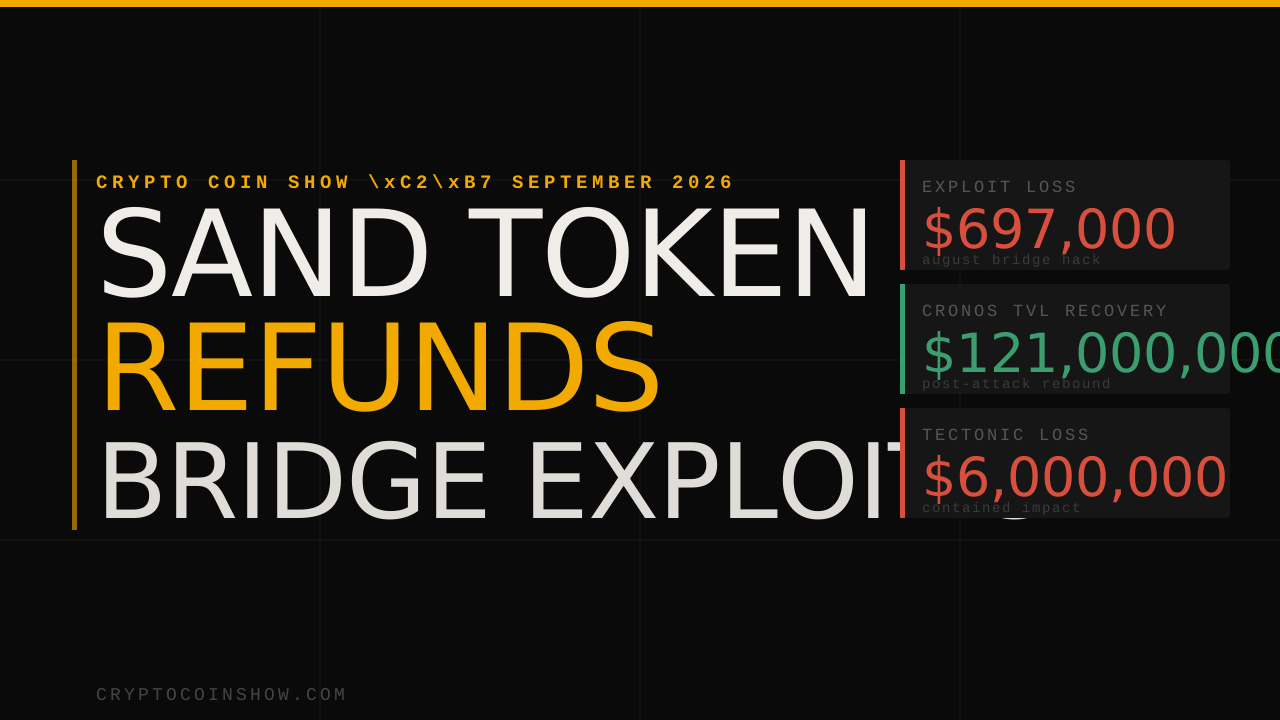
SAND token holders receiving full refunds after $697,000 August bridge exploit
The Sandbox and Cronos are compensating users after separate August exploits, even as Ledger and Trezor warn that AI-accelerated vulnerability discovery is outpacing the industry’s ability to patch, raising pressure on researchers to adopt responsible disclosure practices before flaws go public.
- The Sandbox is issuing 1:1 refunds in SAND on Ethereum for the $697,000 lost in its August 22 bridge exploit across Base and BNB Smart Chain.
- Cronos contained an August attack on its Tectonic lending market to $6 million in actual loss, with TVL recovering from $3 million back to $121 million.
- Ledger and Trezor are calling for mandatory 90-day private disclosure windows before public vulnerability reports, citing AI’s role in accelerating exploit discovery.
- $697,000 in SAND tokens lost in The Sandbox bridge exploit on August 22
- $6 million of $75 million exposed on Cronos contained before chain halt took effect
- 90 days standard private disclosure window Ledger recommends before public vulnerability reporting
The Sandbox began accepting compensation claims on September 8 for users who held bridged SAND on Base or BNB Smart Chain before the August 22 exploit, offering full refunds paid in SAND on Ethereum. Individual wallet holders must submit claims through the project’s portal, while exchange users require no action. The attack, first reported by Cryptopolitan, drained approximately $697,000 from a poorly secured bridge configuration, though forensic analysis suggests total economic damage reached $1.49 million. The Sandbox has ruled out reopening the bridge, citing permanent contestability of the compromised contracts.
Attackers Exploited Token Contract Dual Use as Bridge Authority
The bridge vulnerability stemmed from a design choice to register SAND token contracts on Base and BNB Smart Chain as the bridge’s application layer, allowing users to bypass additional transaction steps. This configuration treated any instruction from those contracts as a direct order from The Sandbox itself.
Attackers registered their own address as administrator, modified approval settings to require only self-authorization for bridge messages, then minted SAND against deposits that never occurred.
The attackers reverse-bridged 14,742,341.84 SAND tokens out of the Ethereum vault before The Sandbox shut the bridge across all three chains on August 22.
Cronos Limited Tectonic Damage to $6 Million in Real Losses
Cronos responded more swiftly to an August attack on Tectonic, its largest lending market. An attacker inflated the thinly traded TONIC token roughly 100 times within 20 minutes, then borrowed real assets against the inflated collateral.
The chain halted block production on August 30, containing losses to approximately $6 million of the roughly $75 million at risk before attackers could transfer funds to Ethereum.
Security firm PeckShield confirmed the rapid response prevented further damage. Cronos has since resumed normal operations, and Tectonic’s total value locked has recovered to $121 million from a low of $3 million, suggesting user confidence has largely stabilized. Crypto.com CEO Kris Marszalek stated the exchange and app were never compromised in the incident.
Ledger and Trezor Push Researchers to Delay Public Disclosure
As platforms move to compensate victims, two of the industry’s largest cold wallet makers are raising alarms about vulnerability reporting practices. Charles Guillemet, chief technology officer at Ledger, stated that AI has made vulnerabilities cheap to find while stripping defenders of their former advantage. He specifically criticized researchers who publish findings before fixes exist, calling it “attention farming with someone else’s risk.”
Guillemet urged researchers to report issues privately and commit to a fixed timeline, citing 90 days as a common baseline that can flex upward based on severity. Trezor voiced support for responsible disclosure, with head of security Jan Komarek emphasizing that the 90-day window represents a vendor commitment, not merely a researcher preference. Komarek added that researchers may publish if the vendor misses the deadline.
The push for stricter disclosure protocols follows Coldcard hardware wallet thefts exceeding $100 million and a breach at Trezor’s shipping provider that exposed tens of thousands of customer records.
The industry faces an open tension: researchers and security auditors have little incentive to honor lengthy private disclosure windows when public attention and reputation drive their business model, yet vendors cannot patch exploits faster than AI-assisted discovery now produces them. Whether wallets, exchanges, and protocol teams can enforce meaningful 90-day windows, and whether such timelines remain realistic as vulnerability discovery accelerates, will shape how the industry responds to the next wave of attacks.