
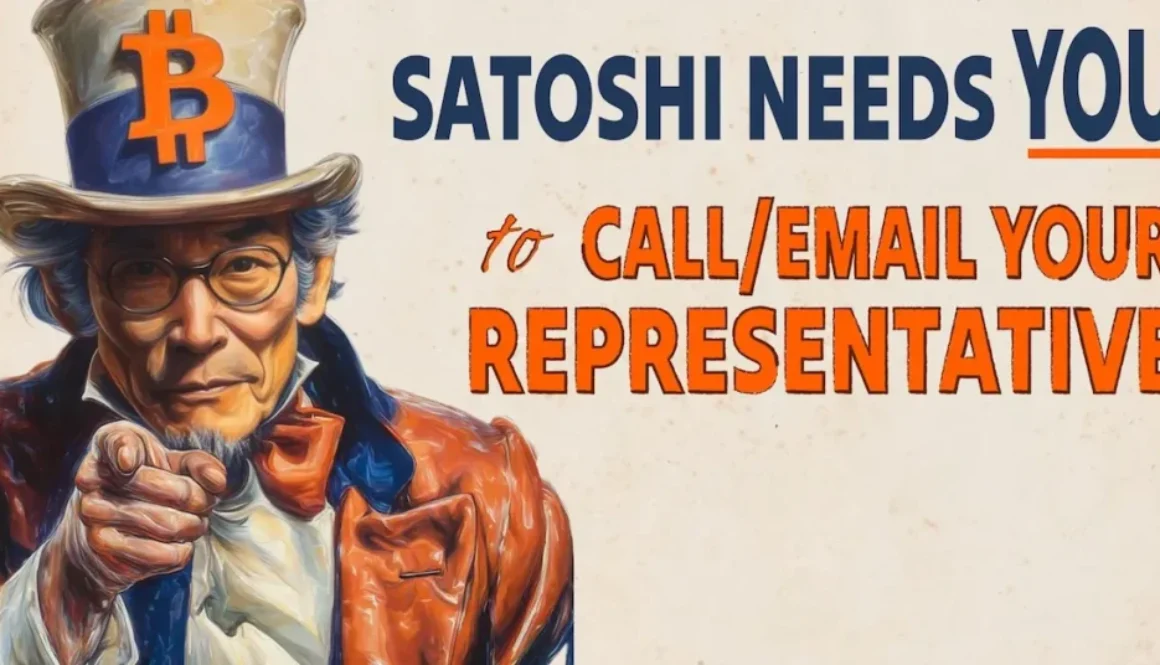
Satoshi Needs You: Bitcoin Advocates Issue Call to Action to Protect Peer-to-Peer Rights
A coalition of prominent Bitcoin organizations is mobilizing the cryptocurrency community to defend peer-to-peer transaction rights through legislative action. The push comes after recent legal developments that have raised concerns about the future of noncustodial software and user privacy in the digital asset space.
A Coordinated Campaign for P2P Protection
The Bitcoin Policy Institute, Save Our Wallets, Coin Center, the Bitcoin Design Foundation, and regional Bitcoin advocacy groups have launched “Satoshi Needs You!” — a decentralized campaign designed to encourage individual Bitcoin users to contact their elected representatives. The initiative aims to build grassroots pressure for congressional support of specific legislative protections.
The campaign targets provisions within the Blockchain Regulatory Certainty Act (BRCA), which were incorporated into the Senate’s version of the CLARITY Act. These provisions would establish legal safeguards for developers who create noncustodial technology and for users who employ such tools for Bitcoin transactions.
We can’t take anything for granted until our fundamental rights to economic liberty in the digital realm have been codified into law.
— Kyle Olney, Co-founder, Save Our Wallets
What’s at Stake
The backdrop for this campaign includes recent high-profile legal cases involving privacy-focused cryptocurrency tools. The outcomes of these trials have underscored what advocates view as regulatory uncertainty surrounding noncustodial software development.
Without legislative clarity, the Bitcoin community argues that developers face potential legal exposure for building peer-to-peer applications. Users, meanwhile, could face restrictions on their ability to transact freely without intermediaries — a core principle underlying Bitcoin’s original design.
Advocates warn that without explicit legal protections, the fundamental right to conduct peer-to-peer transactions could be compromised, and developers of noncustodial tools may increasingly face legal action.
Industry Context and Regulatory Uncertainty
The Bitcoin and broader cryptocurrency industry has experienced explosive growth over the past decade, with the total market capitalization fluctuating between hundreds of billions and over three trillion dollars. However, this growth has occurred largely in a regulatory gray area, where federal agencies have struggled to establish clear frameworks governing digital assets, noncustodial wallets, and peer-to-peer transaction protocols.
The Financial Crimes Enforcement Network (FinCEN), the Securities and Exchange Commission (SEC), and the Commodity Futures Trading Commission (CFTC) have all asserted varying degrees of authority over cryptocurrency activities. This fragmented regulatory approach has created uncertainty for developers and users alike. Noncustodial wallet developers—those creating software that allows individuals to control their own private keys without relying on third-party custodians—face particular ambiguity about their regulatory obligations and potential liability.
Recent enforcement actions and legal proceedings have intensified this uncertainty. High-profile cases involving cryptocurrency mixing services and privacy-enhanced transaction protocols have exposed developers to criminal and civil liability, even when they argue their tools serve legitimate privacy purposes. This legal chilling effect threatens to drive noncustodial development offshore or to discourage innovation entirely within the United States.
The coalition behind “Satoshi Needs You!” argues that legislative action is necessary precisely because the regulatory landscape remains fragmented and unpredictable. Without clear statutory protections, even developers acting in good faith may face prosecution under broad interpretations of existing anti-money laundering (AML) and know-your-customer (KYC) laws.
The Legislative Path Forward
The campaign directs participants to SaveOurWallets.org, where supporters can identify their U.S. Senators and send direct communications urging support for the CLARITY Act. The website provides a straightforward interface for citizens to locate contact information and draft messages to their representatives.
The focal point of the advocacy effort is Section 109 of the Senate’s current CLARITY Act draft, which contains the specific protections developers and users seek. Advocates emphasize that grassroots engagement is essential to move the legislation forward.
The CLARITY Act itself represents a significant policy shift in how Congress might address cryptocurrency regulation. Rather than imposing blanket restrictions, the proposed legislation aims to create clarity by defining categories of activity, establishing standards for different types of market participants, and explicitly protecting certain conduct from regulatory overreach. Section 109 specifically addresses noncustodial software by establishing that individuals and developers cannot be held liable for transactions conducted through peer-to-peer tools, provided those tools are not deliberately designed to facilitate illegal activity.
Kyle Olney’s statement captured the urgency advocates feel: the window for establishing legal protections requires action now, with ongoing emphasis that digital economic freedom cannot be assumed or taken for granted.
Interested supporters can visit SaveOurWallets.org to: identify their Senators, understand the CLARITY Act’s provisions, and submit contact requests urging support for Section 109 and related protections.
Market Implications and Competitive Positioning
The outcome of this legislative effort carries significant market implications for the cryptocurrency industry. Jurisdictions that provide clear legal protections for noncustodial technology are likely to attract cryptocurrency developers and innovation. Conversely, jurisdictions perceived as hostile to noncustodial tools risk losing talent and development activity to more permissive regulatory environments.
Several countries and regions have already positioned themselves as cryptocurrency-friendly jurisdictions. El Salvador’s adoption of Bitcoin as legal tender, Switzerland’s “Crypto Valley” in Zug, and Singapore’s regulated approach to digital assets have all attracted capital and talent. The United States, as the world’s largest economy and historically a center of financial innovation, faces a competitive risk if it becomes perceived as overly restrictive toward noncustodial technology.
Additionally, the bifurcation of the cryptocurrency market between custodial and noncustodial services creates different risk profiles for users and regulators. Custodial platforms like exchanges and wallets that hold user funds are subject to existing financial services regulations and can be effectively supervised. Noncustodial tools, by contrast, place control entirely with users, eliminating counterparty risk but also reducing regulators’ ability to monitor or intervene. The legislative question thus becomes how to maintain consumer protections and AML/KYC compliance while preserving the right to noncustodial access.
Market analysts note that the price and adoption of Bitcoin often correlates with regulatory developments. Clarity around noncustodial rights could remove a significant source of uncertainty that has historically dampened institutional and retail adoption in the United States.
Broader Implications for Cryptocurrency
The campaign reflects a broader tension between regulatory oversight and technological freedom in the cryptocurrency space. As government agencies worldwide develop regulatory frameworks, questions about how to balance legitimate compliance concerns with user privacy and developer freedoms remain unresolved.
Bitcoin’s foundational design prioritizes peer-to-peer transactions without intermediaries. Advocates contend that protecting noncustodial tools is essential to preserving Bitcoin’s original vision and ensuring it remains accessible to individuals regardless of geography or regulatory jurisdiction.
The coalition bringing attention to this issue represents a diverse range of stakeholders — from policy organizations to design-focused foundations to grassroots advocacy groups. Their unified message signals that protecting peer-to-peer rights has become a priority across different segments of the Bitcoin community.
For the broader cryptocurrency ecosystem, the outcome of this legislative effort could set precedents for how developers operate, how users access tools, and how governments regulate digital assets. If the CLARITY Act’s protections pass, other jurisdictions may follow suit, establishing a global standard for noncustodial software. Conversely, if legislative efforts fail, expect increased regulatory pressure on noncustodial development and accelerated migration of such projects to jurisdictions with more favorable regulatory conditions.
The “Satoshi Needs You!” campaign underscores that legislative protection for noncustodial technology requires sustained public engagement. Without organized constituent pressure on elected officials, advocates argue that protections for peer-to-peer rights may not materialize during this congressional session.
Conclusion: A Watershed Moment for Digital Financial Freedom
The mobilization around the CLARITY Act represents a critical juncture for the future of noncustodial technology and peer-to-peer financial systems in the United States. The outcome will likely reverberate across the global cryptocurrency industry, influencing regulatory approaches in other jurisdictions and shaping the trajectory of Bitcoin adoption and innovation.
For Bitcoin users and developers, the stakes could hardly be higher. Legislative success would provide the certainty necessary for continued development and widespread adoption of noncustodial tools. Failure would leave the landscape uncertain, potentially driving innovation offshore and limiting American participation in what proponents view as a fundamental shift in financial technology.
The grassroots engagement strategy employed by “Satoshi Needs You!” reflects a maturation of the cryptocurrency community’s political engagement. Rather than relying solely on industry lobbying or think tank advocacy, the coalition is mobilizing individual citizens to express their preferences to elected representatives—a traditional but often-overlooked mechanism of democratic influence.
Whether this legislative push succeeds will depend on the sustained engagement of the cryptocurrency community, the receptiveness of policymakers, and the broader political and regulatory environment in which these discussions occur. For now, the initiative represents the Bitcoin community’s determination to ensure that fundamental rights to economic liberty and financial privacy are preserved in the digital age.
Get weekly blockchain insights via the CCS Insider newsletter.