
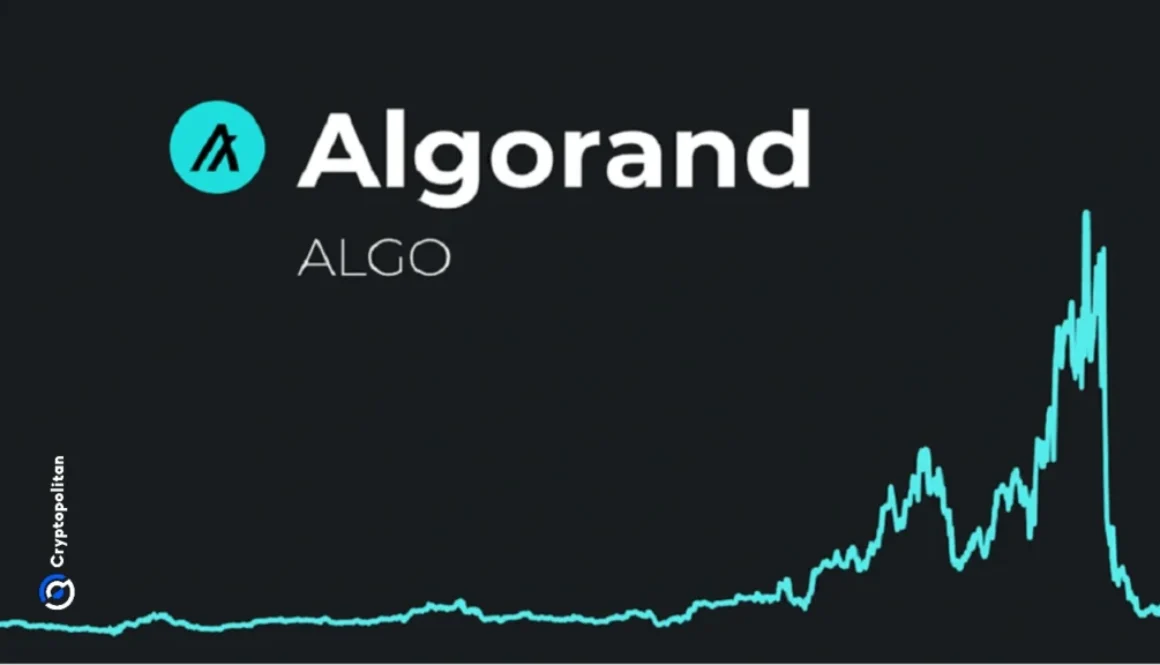
Algorand price prediction 2025-2031: Is a resurgence possible?
Algorand faces a critical juncture as traders assess whether the layer-1 blockchain can sustain momentum beyond near-term resistance levels. Recent price action and technical signals suggest a consolidation phase, with the cryptocurrency struggling to break decisively above the $0.30 mark after a strong recovery through July. Understanding where ALGO might head requires examining both current technical conditions and the broader context of blockchain adoption trends.
Current Market Position and Recent Price Movement
Algorand was trading around $0.2261 at the time of this analysis, down from recent highs near $0.34 reached in mid-July. The asset recorded a 23% recovery over the preceding 30 days but surrendered some gains with a 4.57% pullback over the previous 24 hours.
Trading volume contracted significantly, declining 26.43% in a single day to approximately $96.5 million. This drop signals diminishing retail and institutional interest at current price levels, a pattern typically observed when momentum exhausts itself following rapid rallies.
Market cap: $1.96 billion | Circulating supply: 8.69 billion ALGO | 24-hour volatility: 18.25% | All-time high: $3.28 (June 2019)
Total value locked in Algorand protocols slipped 3.27% to $72.29 million, reflecting reduced developer and user activity on the network. This metric often precedes price weakness, as declining ecosystem engagement typically correlates with lower demand for the native token.
Industry Context and Competitive Landscape
Algorand operates within an increasingly crowded layer-1 blockchain ecosystem. Competitors including Solana, Polkadot, Cosmos, and emerging platforms like Sui and Aptos have attracted significant developer attention and venture capital funding. The 2024 market environment has favored platforms demonstrating measurable transaction volume, staking participation, and real-world application development.
Founded in 2017 by MIT computer scientist Silvio Micali, Algorand introduced a proof-of-stake consensus mechanism designed to achieve finality without sacrificing scalability or decentralization. The network can theoretically process thousands of transactions per second while maintaining energy efficiency superior to proof-of-work systems. However, theoretical capabilities must translate into developer adoption and user engagement—areas where Algorand has underperformed relative to its technical specifications.
The Algorand Foundation’s strategic initiatives throughout 2024 have focused on expanding institutional partnerships and improving developer tooling. These efforts represent recognition that technology alone cannot drive adoption; ecosystem maturity and business incentives prove equally critical. The foundation’s annual grants program and venture arm have attempted to accelerate decentralized finance (DeFi) and real-world asset tokenization projects, yet market traction remains below initial expectations.
Technical Analysis: Resistance and Consolidation Patterns
The daily chart reveals a textbook rejection scenario at the $0.30 level, a price point that coincides with the 23.6% Fibonacci retracement from earlier highs. This is not a coincidence—major technical traders recognize these levels, and concentrated selling often emerges at such confluences.
The MACD histogram points to rising negative momentum, suggesting that the earlier uptrend has lost its driving force.
— Technical Analysis Data
The four-hour timeframe paints a picture of indecision. Candlestick patterns have compressed, with wicks extending both upward and downward—a classic sign that buyers and sellers remain deadlocked. Volatility has expanded, but bearish momentum dominates the shorter-term outlook.
Moving averages send mixed signals. Shorter-period simple moving averages (3, 50, and 200-day) suggest buy conditions, while intermediate periods (10, 21, and 100-day) flash sell signals. This disagreement reflects the transitional nature of the market—neither bulls nor bears have established clear control.
50-day SMA: $0.2209 | 200-day SMA: $0.1856 | Current price above both long-term averages, indicating structural support remains in place despite recent volatility.
Sentiment and Market Psychology
The Fear and Greed Index registered at 55, classified as greed territory. This reading suggests that despite near-term weakness, market participants retain optimistic expectations. However, this sentiment often represents a contrarian signal—peak greed frequently precedes corrections.
Over the previous 30-day period, ALGO traded higher on 17 of 30 days, a 57% win rate that indicates a slight bullish bias. Yet this advantage has eroded as the current session’s losses chip away at earlier gains. Sentiment can shift quickly when momentum falters.
The neutral technical designation reflects this ambiguity. Algorand is neither oversold nor overbought in absolute terms, but the rejection at $0.30 suggests that attempted rallies now face systematic selling pressure.
Market Implications and Macroeconomic Considerations
Algorand’s performance occurs against the backdrop of broader cryptocurrency market dynamics influenced by Federal Reserve policy, geopolitical tensions, and institutional capital allocation decisions. The cryptocurrency sector’s correlation with technology stocks and risk-sensitive assets has increased significantly since 2022, meaning that macroeconomic headwinds directly impact layer-1 blockchain valuations regardless of fundamental developments.
Regulatory clarity regarding cryptocurrency securities and staking mechanics remains inconsistent across jurisdictions. Algorand’s proof-of-stake model generates rewards distributed to token holders, creating potential classification concerns under securities laws in various countries. Such regulatory uncertainty creates friction for institutional adoption and may suppress medium-term price appreciation until frameworks stabilize.
The emergence of central bank digital currencies (CBDCs) and enterprise blockchain solutions presents both threats and opportunities. If financial institutions increasingly utilize private or consortium-based blockchains for settlement purposes, demand for public layer-1 networks could decline. Conversely, interoperability between CBDC systems and public blockchains could create new use cases for platforms like Algorand.
Price Predictions and Longer-Term Outlook
Analysis of Algorand’s medium-term prospects suggests a high of approximately $0.3313 for 2025, implying limited upside from current levels in the near term. For 2026, price estimates cluster between $0.5404 and $0.6531, with a midpoint of $0.5558—a recovery that would require sustained positive catalyst events.
By 2030, projections widen considerably, suggesting a trading range between $2.21 and $2.73. Such multiyear forecasts carry substantial uncertainty, as they depend on regulatory clarity, broader blockchain adoption trends, and Algorand’s competitive positioning against rival smart contract platforms.
Algorand’s capabilities in smart contracts and blockchain interoperability position it as an interesting prospect for developers, yet market adoption remains below that of established competitors.
— Ecosystem Assessment
Whether ALGO can reach $10 remains speculative and would require an approximate 44-fold increase from current levels. While cryptocurrency markets have witnessed such rallies in previous cycles, such an outcome would demand extraordinary improvements in developer adoption, enterprise partnerships, and mainstream integration.
Reaching $10 would imply a market capitalization of $86.9 billion, assuming circulating supply remains stable. For context, this would position Algorand among the largest cryptocurrencies by market valuation, a status it has not approached even during peak bull markets.
What Comes Next for ALGO Traders
The immediate technical picture demands close monitoring of the $0.30 resistance level. A decisive break above this threshold could reignite buying interest and potentially trigger a test of the $0.34 July high. Conversely, a breakdown below $0.2209 (the 50-day moving average) would suggest a deeper correction toward $0.20 or lower.
Recent developments in tokenized assets on major exchanges like Robinhood and Gemini have sparked renewed interest in blockchain infrastructure. If regulatory clarity improves and institutional adoption of tokenized products accelerates, Algorand could benefit as a layer-1 settlement network—but this remains conditional rather than assured.
Traders should recognize that price predictions, whether for 2025 or 2031, carry inherent limitations. They provide frameworks for thinking about risk and reward, not certainties. The confluence of technical resistance, declining volume, and neutral sentiment suggests caution near current levels, with clearer directional signals likely to emerge once consolidation concludes.
Strategic Assessment for Market Participants
For longer-term investors interested in blockchain developments, Algorand’s technology merits serious study independent of short-term price movements. The platform’s pure proof-of-stake implementation, sub-second finality, and theoretical capacity for millions of transactions per second represent genuine technical achievements. However, the technical setup argues for patience rather than aggressive accumulation until clearer confirmation of resuming bullish momentum emerges.
The gap between Algorand’s technological capabilities and market adoption presents a fundamental challenge. Network effects favor established platforms, and shifting developer attention requires either significant price appreciation attracting speculative interest or genuine killer applications demonstrating superior functionality. Current evidence suggests neither condition is imminent.
Investors evaluating ALGO as a portfolio component should consider their conviction regarding long-term blockchain adoption and their tolerance for extended consolidation periods. The next 12 months will likely determine whether Algorand can meaningfully expand its developer base and transaction volume, or whether it remains a technically sophisticated but underutilized platform in an increasingly competitive market.
Get weekly blockchain insights via the CCS Insider newsletter.