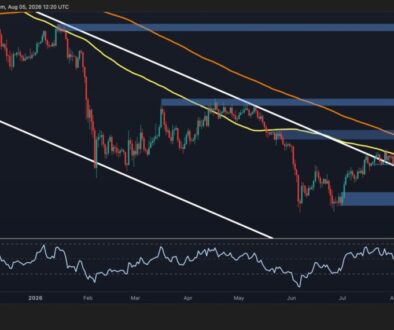
Ethereum Recent Gains in Danger – Could We See Another Drop?
Ethereum has retreated below key support levels in recent trading, signaling potential weakness ahead. The second-largest cryptocurrency by market cap is currently struggling to hold ground above $4,500, with technical indicators suggesting bearish momentum may intensify if price action breaks through critical support zones.
Current Price Action and Technical Positioning
ETH is trading below both the $4,500 psychological level and its 100-hourly simple moving average, two important technical markers for near-term momentum. This positioning leaves Ethereum vulnerable to further downside pressure in the immediate sessions ahead.
A significant bearish trend line has formed on the hourly chart, with resistance positioned near $4,460. The price’s inability to sustain a move above $4,500—despite multiple attempts—suggests that buyers lack the conviction needed to establish a sustained rally at this level.
Ethereum is still struggling to settle above the $4,500 zone, indicating seller pressure remains intact.
— CCS Technical Analysis
Fibonacci retracement levels are playing a meaningful role in the current price structure. The 61.8% retracement of the decline from the $4,660 high to the $4,261 low continues to act as overhead resistance, preventing bulls from gaining meaningful traction.
Major Resistance: $4,500 | Major Support: $4,340 | Secondary Support: $4,260
Market Context and Industry Implications
Ethereum’s recent price weakness arrives during a critical period for the cryptocurrency market. The second-largest blockchain by market capitalization, Ethereum serves as the backbone for decentralized finance (DeFi), non-fungible tokens (NFTs), and thousands of decentralized applications. Its price movements often influence broader cryptocurrency market sentiment and investor risk appetite.
The current weakness in ETH price action carries significant implications across multiple sectors within the crypto ecosystem. DeFi protocols that depend on Ethereum as their primary settlement layer face potential liquidity pressures during prolonged downturns. The total value locked (TVL) in Ethereum-based smart contracts tends to decline during bearish price phases, as users reduce exposure to volatile assets and leverage positions face forced liquidations.
From a market structure perspective, Ethereum’s inability to hold support above $4,500 suggests that institutional investors may be reducing exposure ahead of anticipated volatility. The crypto derivatives market has been pricing in increased realized volatility expectations, with funding rates across major exchanges reflecting cautious sentiment from leveraged traders.
Ethereum’s performance relative to Bitcoin also merits consideration. The ETH/BTC ratio has compressed during this decline, indicating that Ethereum weakness may be outpacing broader cryptocurrency sell-offs. This divergence suggests that Ethereum-specific factors—such as network utilization concerns or perceived competitive threats from alternative Layer 1 blockchains—may be contributing to the current technical breakdown alongside general market headwinds.
Downside Scenarios and Support Zones
If Ethereum fails to establish a sustained break above $4,500, the downside scenario becomes increasingly probable. A clear breakdown below the $4,340 support level would represent a critical failure point, potentially opening the door to accelerated selling pressure.
The support structure develops in layers. Initial downside support appears near $4,375, followed by the first major support zone at $4,340. Should this level fail to hold, price could extend toward $4,320, then down toward the $4,260 level that previously served as a recovery low.
Further losses beyond $4,260 would target the $4,150 zone, representing a substantial decline from current levels. Such a move would suggest a loss of intermediate-term momentum and would require significant deterioration in broader market conditions or Ethereum-specific fundamentals.
A breakdown below $4,150 would signal a more severe technical capitulation, potentially targeting the $4,000 psychological level that has historically provided support during previous market cycles. At such levels, margin liquidations across centralized exchanges could accelerate downside movement, creating feedback loops that punish leveraged positions.
Rally Requirements and Resistance Barriers
For a meaningful recovery, Ethereum must first reclaim $4,500 as a support floor. Breaking above this level with conviction would signal renewed buyer interest and could set the stage for a test of the $4,565 resistance zone.
Should bulls successfully clear the $4,565 barrier, further upside toward $4,650 becomes feasible in the near term. An even more aggressive scenario would see price reach the $4,720 level, though such a move would require a substantial shift in current market sentiment and technical positioning.
An upside break above $4,565 resistance might call for more gains in the coming sessions, potentially toward $4,650 or higher.
— CCS Technical Analysis
The path to recovery requires multiple steps. First, bulls must defend against further deterioration below current levels. Then, they must establish $4,450 as a floor. Only after those conditions are met does a test of $4,500 become probable, let alone upside breaks toward $4,565.
A sustained recovery above $4,650 would suggest that institutional accumulation is resuming, potentially indicating confidence in Ethereum’s longer-term prospects. Such price action would likely coincide with positive catalysts such as network upgrades, increased enterprise adoption announcements, or broader cryptocurrency market strength driven by favorable macroeconomic conditions.
What Technical Indicators Are Signaling
The hourly MACD is generating bearish momentum, suggesting that sellers currently have the advantage in the technical setup. This indicator reinforces the weakness visible in price action and supports caution regarding near-term downside risk.
The RSI has fallen below the 50 midpoint level, indicating that momentum has shifted toward the bearish side. While this doesn’t guarantee further declines—oversold conditions can sometimes precede sharp reversals—it does confirm that current momentum favors sellers over buyers.
MACD: Bearish momentum building | RSI: Below 50 midpoint | Trend: Downward pressure
For traders, the combination of bearish MACD momentum and a depressed RSI suggests caution. Price remains positioned below key moving averages, and multiple resistance levels need to be cleared before a sustained rally can develop.
Volume analysis reinforces the bearish narrative. The sell-off has been accompanied by above-average trading volume on several occasions, suggesting that selling pressure carries institutional participation rather than representing isolated retail liquidations. This volume characteristic makes support levels potentially less durable and increases the probability of extended downside moves if key support breaks.
Industry Headwinds and Competitive Dynamics
Beyond pure technical factors, Ethereum faces competitive pressures from alternative blockchain platforms. Solana, Polygon, Arbitrum, and other Layer 2 scaling solutions have captured meaningful portions of the DeFi and NFT activity that previously concentrated entirely on Ethereum. Higher gas fees and network congestion during peak usage periods have motivated developers and users to explore alternatives, creating a structural headwind for Ethereum’s dominance metrics.
Regulatory developments also influence Ethereum’s market positioning. Ongoing regulatory clarity regarding proof-of-stake validation and smart contract liability creates uncertainty for institutional investors evaluating exposure allocation. Ethereum’s shift to proof-of-stake, while technically successful, continues to be scrutinized by regulators worldwide, and adverse regulatory developments could trigger sharp sell-offs among institutional holders.
What This Means for Ethereum Traders
The current setup presents a risk-reward asymmetry that favors defined downside protection over aggressive long positions. The $4,340 level represents the critical line in the sand—break that, and the technical picture deteriorates significantly.
Traders should monitor price action around $4,450 carefully. A sustained hold above this level would suggest that buyers are willing to defend against further losses. A clear break below would confirm that the bearish bias remains intact.
For context on broader market conditions affecting Ethereum, review our latest coverage of Ethereum’s technical landscape and recent cryptocurrency price movements. Understanding how Bitcoin’s positioning influences Ethereum can also provide valuable perspective on correlation dynamics.
The coming sessions will be informative. Either buyers demonstrate renewed conviction and establish support above current levels, or the bearish momentum accelerates and tests lower support zones. Technical traders should maintain discipline around key levels and avoid forcing positions in either direction until clearer directional commitment emerges.
Forward-Looking Perspective
While current technical conditions appear challenging, Ethereum’s long-term utility and network effects remain intact. The platform continues to process billions of dollars in daily transaction value and maintains substantial developer activity despite competitive pressures. Recovery from the current technical breakdown would likely coincide with renewed institutional interest and positive sentiment shifts across the broader cryptocurrency market.
Investors and traders should distinguish between short-term technical weakness and longer-term fundamental positioning. The current price action creates potential entry opportunities for those with extended time horizons, even as near-term traders exercise appropriate caution around deteriorating technical conditions.
Get weekly blockchain insights via the CCS Insider newsletter.