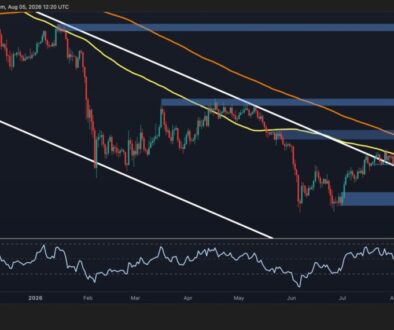
Ethereum Price Faces Selling Pressure, Bulls Eye $4,600 Comeback
Ethereum is facing renewed selling pressure after retreating from resistance around $4,630, with the second-largest cryptocurrency now trading below key moving averages and technical support levels. The pullback has triggered a breakdown of an uptrend structure on the hourly timeframe, raising questions about whether bulls can defend the $4,460 support level or if further downside may unfold in the near term.
Current Market Structure and Price Action
ETH/USD has declined from its recent attempt to reclaim territory above $4,630, a level that has proven resistant to sustained buying interest. The cryptocurrency is currently trading beneath the 100-hour simple moving average, a widely watched indicator of intermediate-term momentum. This technical deterioration suggests that near-term buyers have lost the initiative.
Earlier in the session, Ethereum found a low near $4,310 before mounting a modest recovery that carried the price above the $4,400 and $4,420 checkpoints. During this advance, the asset cleared the 23.6% Fibonacci retracement level measured from the recent $4,956 swing high down to the $4,310 low. However, that upside momentum proved short-lived once the price approached $4,630.
The breakdown below the rising channel structure represents a shift in short-term momentum, with hourly technicals now aligned to the bearish side.
— CCS Technical Analysis
The recent break below a rising channel that had supported prices at approximately $4,600 marks a meaningful shift in the technical picture. Loss of this support boundary often signals that intermediate-term buyers are stepping aside, allowing sellers to test lower levels.
Resistance: $4,630 (initial), $4,710 (major), $4,820 (secondary)
Support: $4,460 (critical), $4,420, $4,310, $4,240
Ethereum’s Market Position and Industry Context
Ethereum’s current technical weakness occurs within a broader context of the cryptocurrency market’s evolution and its increasing institutional adoption. As the leading smart contract platform, Ethereum’s price movements carry significance far beyond its standalone technical picture, influencing sentiment across decentralized finance (DeFi), non-fungible token (NFT), and broader blockchain ecosystems.
The Ethereum network has established itself as the backbone of decentralized applications, with total value locked (TVL) in DeFi protocols remaining substantial despite market volatility. This fundamental utility provides a backstop for valuations during technical corrections, as long-term holders continue to recognize the platform’s strategic importance. The recent Shanghai upgrade enhanced Ethereum’s staking mechanisms, creating structural demand from validators seeking yield in a proof-of-stake environment.
Current price weakness must be contextualized against macroeconomic headwinds affecting risk assets broadly. Rising interest rate expectations, inflation concerns, and corporate earnings uncertainty have pressured equities and cryptocurrencies alike. When traditional markets face headwinds, digital assets often experience accelerated selloffs as leveraged positions are liquidated and risk-off sentiment dominates capital allocation decisions.
Downside Scenario and Support Levels
Should Ethereum fail to establish a floor at $4,460 in the coming sessions, the technical picture would deteriorate materially. A confirmed break below this critical support could accelerate selling toward the $4,420 zone, where another significant support cluster exists. The cryptocurrency has already found footing near $4,310 once in this session, and that level would serve as the next meaningful floor if the $4,420 checkpoint gives way.
Deeper losses would expose support near $4,240, a level that could be tested if bearish pressure intensifies. Beyond that, the $4,150 support represents the next defended area. For traders monitoring Ethereum price action, these levels define the range of potential downside if bears maintain control.
The 50% Fibonacci retracement of the decline from $4,956 to $4,310 sits near the $4,630 resistance that has just rejected the price, reinforcing its technical significance. Mean reversion studies would suggest that extended declines from this zone carry elevated risk of strong reversals, particularly if volume markers confirm capitulation.
Market Implications and Sector Impact
Ethereum’s technical breakdown carries material implications for the broader cryptocurrency sector and decentralized finance ecosystem. The platform hosts the majority of major DeFi protocols, including Aave, Curve, Uniswap, and others that collectively manage tens of billions in user assets. Sharp price declines in ETH can trigger cascading liquidations across these protocols, particularly in collateralized lending markets where Ethereum serves as primary collateral.
From a market structure perspective, Ethereum’s breakdown below key moving averages signals a potential shift in trader positioning. On-chain analytics firms monitor large transaction flows, and recent data suggests institutional entities have trimmed long positions ahead of the $4,630 resistance. This institutional repositioning often precedes more significant price moves, as professional traders typically reduce exposure before significant technical deterioration accelerates.
The weakness in Ethereum also reflects broader concerns about the sustainability of cryptocurrency valuations absent sustained growth in adoption metrics. While Ethereum continues to process meaningful transaction volume, the pace of new application development and user onboarding has moderated relative to 2021-2022 expectations. This gap between technical price weakness and fundamental adoption growth creates vulnerability to extended selloffs.
Bullish Case and Recovery Targets
The path to a meaningful recovery requires Ethereum to clear and hold above the $4,630 resistance zone. A sustained break above this level would reactivate the bullish structure and bring the $4,710 major resistance into focus. That level, if overcome, would position the price toward $4,820 as the next upside target.
If buying momentum accelerates above $4,820, Ethereum could potentially extend toward $4,880 and beyond to the psychologically significant $5,000 level in the medium term. However, accomplishing this sequence requires a convincing reversal of the current selling pressure that has driven the price below the 100-hour moving average.
A clear move above $4,820 would signal renewed bullish commitment and potentially open the door to $5,000 within a reasonable timeframe.
— CCS Price Analysis
The $4,710 level represents a critical juncture—a zone where breakout traders often place initial profit targets and where overhead resistance typically intensifies. Breaking this point cleanly is essential for any sustained rally toward higher price objectives.
Recovery prospects depend significantly on external factors including macroeconomic stabilization, resolution of regulatory uncertainty surrounding cryptocurrency exchanges and asset classification, and renewed positive sentiment toward risk assets. Positive developments on any of these fronts could rapidly reverse technical positioning and trigger relief rallies toward $4,800 and beyond.
Momentum and Oscillator Signals
The MACD indicator on the hourly timeframe is exhibiting bearish momentum, with the histogram extending further into negative territory. This suggests that selling pressure is building rather than waning, a warning sign for bulls hoping for a rapid reversal. MACD readings in the bearish zone often persist for extended periods once established.
The Relative Strength Index (RSI) has dipped below the 50 centerline, confirming that momentum has shifted from neutral to negative. Readings in this range are consistent with intermediate-term weakness. For a meaningful bounce to materialize, the RSI would need to climb back above 50 and establish itself there, a process that typically requires constructive price action over several periods.
These oscillators reinforce the message sent by price structure: near-term momentum favors the bears. However, oscillators can remain in oversold or bearish territory for considerable time, so traders should not assume a reversal based on these signals alone. Confirmation through price action—such as a rejection of lower support levels—would carry greater weight.
Ethereum is testing critical support after breaking below a rising channel on the hourly chart. The MACD is bearish and RSI is below 50, indicating weakness. A hold above $4,460 is necessary to stabilize; a break below would accelerate losses toward $4,310 and $4,240.
Traders tracking cryptocurrency price levels across the broader market should note that Ethereum’s weakness is partly mirroring Bitcoin’s own recent struggles. When the two largest cryptocurrencies move in tandem downward, it often reflects broader risk-off sentiment affecting the entire sector.
Forward Outlook and Strategic Considerations
The near-term outlook hinges on whether the $4,460 support can hold under continued selling pressure. A failure at this level would likely spark an acceleration toward $4,310 and potentially lower targets. Conversely, a bounce from current levels that recaptures the 100-hour moving average would suggest the sell-off is exhausting itself, potentially setting up a recovery attempt toward $4,630 and beyond.
Investors with medium to long-term horizons should recognize that technical corrections of 5-10% are normal within healthy uptrends, and Ethereum’s current weakness does not necessarily invalidate longer-term bullish theses regarding smart contract platform adoption and DeFi growth. However, traders with shorter time horizons must respect technical deterioration and manage positions accordingly to avoid catastrophic losses if support levels fail.
The interplay between technical price action and fundamental adoption metrics will ultimately determine Ethereum’s trajectory. Temporary weakness creates opportunity for contrarian investors who believe the platform’s underlying value remains intact, while maintaining discipline about technical risk management remains essential during periods of elevated volatility and uncertain market direction.
For additional context on Ethereum’s technical setup and macroeconomic factors influencing digital assets, follow our latest blockchain news and analysis for detailed market breakdowns.
Get weekly blockchain insights via the CCS Insider newsletter.