How Bitmine could surpass its 5% Ethereum goal without buying more ETH
Bitmine’s path to 5% Ethereum ownership no longer depends primarily on aggressive buying, staking yields alone could close the majority of the gap, provided the network’s token supply remains relatively stable. For institutional investors tracking treasury strategies and protocol economics, this shift reveals how large holders can use protocol incentives to compound their positions without deploying additional capital.
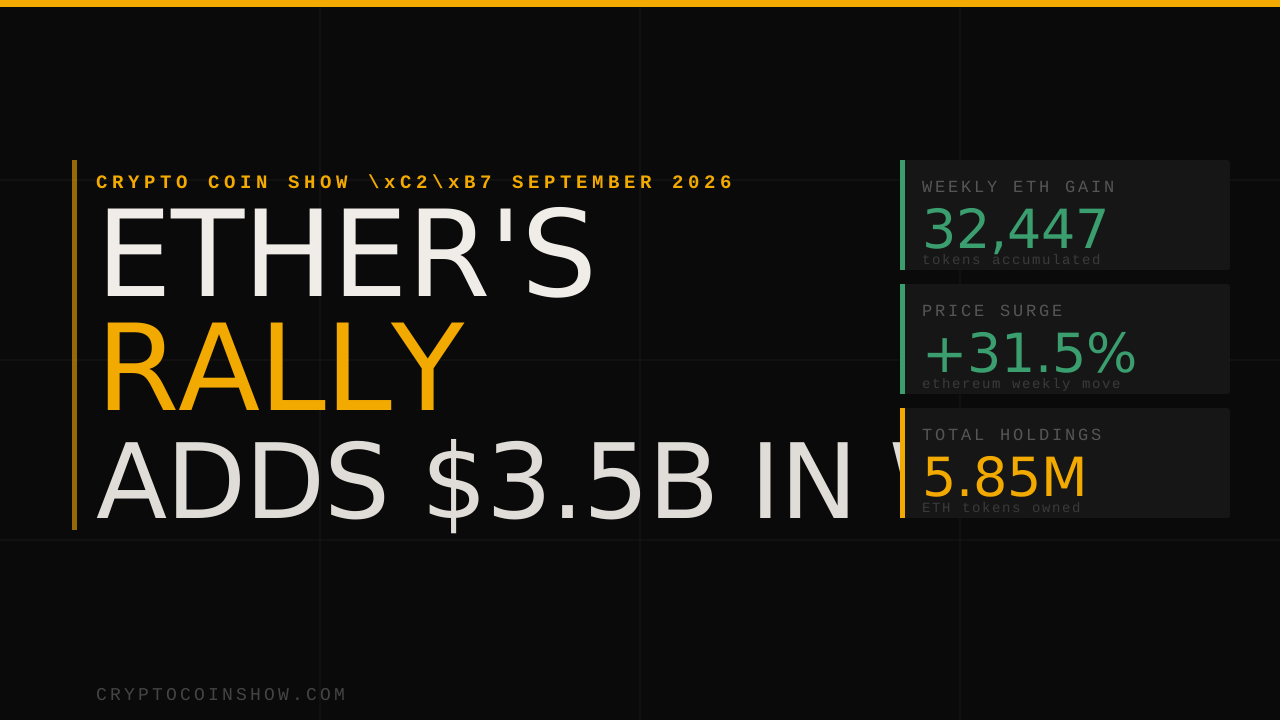
- Bitmine acquired 53,501 ETH in the week through Aug. 30, bringing disclosed holdings to 5.9 million tokens, roughly 135,000 ETH short of its 5% target.
- The company has 5.06 million ETH staked at a 2.67% annualized seven-day yield, generating approximately 135,000 ETH in annual rewards at current rates.
- Ethereum supply expansion poses the primary risk: at 1% annual growth, retaining every staking reward would still fall short without additional purchases.
- 5.9M ETH held by Bitmine as of Aug. 30, compared to 5% target requiring 6.035 million
- 2.67% annualized staking yield on 5.06 million staked ETH, generating 135,000 tokens yearly
- 122.02M total ETH outstanding on Sept. 5, versus 120.7 million used in Bitmine’s 5% calculation
Bitmine, the Nasdaq-listed treasury company, stands within striking distance of its publicly stated goal to own 5% of Ethereum’s circulating supply, but the math has shifted in ways that matter for how the company deploys capital going forward.
As of Aug. 30, the firm held 5.9 million ETH and had staked 5.06 million of that amount, leaving it approximately 134,000 tokens short of the 6.035 million needed to claim a 5% stake based on the 120.7 million ETH supply it uses as its benchmark. The gap appears modest, roughly equivalent to one year of the company’s staking rewards at current yields.
Yet what distinguishes Bitmine’s position now is that buying aggressively and retaining staking yields are no longer equivalent paths; they are overlapping strategies with different tradeoffs depending on how Ethereum’s total supply evolves.
Bitmine Acquired 53,501 ETH in Single Week While Staking Accelerates
The company’s acquisition pace has remained relentless. Bitmine purchased 53,501 ETH during the seven days ended Aug. 30, according to its own corporate disclosures, and blockchain analysis platform Lookonchain reported on Sept. 1 that wallets attributed to Bitmine acquired an additional 51,000 ETH worth approximately $126 million from institutional dealers FalconX and BitGo.
While Bitmine has not formally confirmed the second transaction in its latest public filing, the two purchases combined would bring its total holdings to approximately 5.95 million tokens if the on-chain attribution is accurate.
That buying activity masks a structural shift in how Bitmine can reach its target. The company’s staking position, 5.06 million ETH earning 2.67% annualized, generates roughly 135,000 ETH in annual rewards at current rates.
Against a gap of 134,000 ETH measured as of Aug. 30, the company’s staking income alone would nearly close the distance within twelve months if it retained almost all those rewards and if Ethereum’s supply remained flat.
The implied message is stark: Bitmine can continue buying without depending on those purchases to hit 5% ownership.
Supply Growth Transforms Staking Yields From Sufficient to Insufficient
The calculation depends critically on one variable that sits outside Bitmine’s control: Ethereum’s token supply. As of Sept. 5, Ethereum’s circulating supply stood at approximately 122.02 million tokens, already 1.32 million ETH higher than the 120.7 million benchmark Bitmine uses in its public 5% target statement.
That gap alone widens the ownership threshold Bitmine must meet and demonstrates how supply expansion works against large holders whose holdings remain static.
The mechanics are unforgiving. Using Bitmine’s actual Aug. 30 holdings of 5.9 million ETH against the Sept. 5 supply figure of 122.02 million results in an ownership share around 4.84%, below the 5% target. The gap widens to nearly 200,000 ETH. Over a two-year horizon with modest supply growth, the compounding effect becomes severe.
If Ethereum’s supply grows at 0.5% annually, Bitmine would need to retain roughly 96.5% of its staking rewards just to maintain pace; at 1% annual growth, retaining every single reward would still fall short without additional capital deployed to buying.
This dynamic fundamentally reshapes Bitmine’s treasury optimization problem. The company is not facing a choice between buying and staking, but rather between buying at different rates depending on supply trajectory assumptions. Slower supply growth makes the existing staking position increasingly valuable; faster growth makes it insufficient regardless of yield rates.
Two-Year Path to 5% Depends on Ethereum Supply Stability
Bitmine’s own disclosures and the on-chain evidence suggest the company is operating under an assumption of moderate supply conditions. If the Sept. 1 purchase of 51,000 ETH is confirmed as an incremental acquisition, the company’s gap would shrink to approximately 83,000 tokens.
At that point, roughly 61% of one year’s staking rewards would be sufficient to close it under flat-supply conditions, a threshold that appears achievable.
However, the longer-term outlook hinges on Ethereum’s issuance policy and actual network conditions.
Ethereum’s supply has expanded as the network processes transactions and validators earn block rewards and MEV. The difference between a stable or slowly-growing supply and a 1% annual growth rate determines whether Bitmine’s staking strategy functions as a self-sustaining compounding engine or as a supplementary income stream that requires ongoing buying to hit the 5% target.
Bitmine has not publicly stated which supply growth assumption it is modeling or when it expects to reach 5% ownership.
The near-term answer lies in monitoring Bitmine’s quarterly disclosures for the next two quarters and watching whether Ethereum’s actual supply growth matches the flat or low-growth scenarios that make staking-driven accumulation viable, or whether network expansion outpaces the company’s staking yields and forces it into an accelerated buying program to preserve its 5% objective on the current timeline.
Staking Yield Arithmetic Reshapes Capital Allocation Logic for Large ETH Holders
The mathematics of passive accumulation through staking rewards have become material enough to reshape how institutional treasuries model their ownership targets.
Bitmine’s situation illustrates this pivot: at a 2.67% annualized yield on 5.06 million staked ETH, the company generates roughly 135,000 tokens per year without deploying additional capital, exactly the amount needed to close its 5% gap.
This dynamic did not exist when Ethereum staking yields were materially higher or when large holders faced steeper opportunity costs on capital deployed to ETH purchases rather than alternative yield-bearing strategies.
For context, Ethereum’s staking yield has compressed significantly since The Merge in September 2022, when validators earned 4.5% to 5% annualized returns on the back of lower validator participation. Today’s 2.67% seven-day average represents a roughly 40% reduction from that post-Merge baseline, yet it remains attractive enough to outpace passive ETH accumulation in some scenarios.
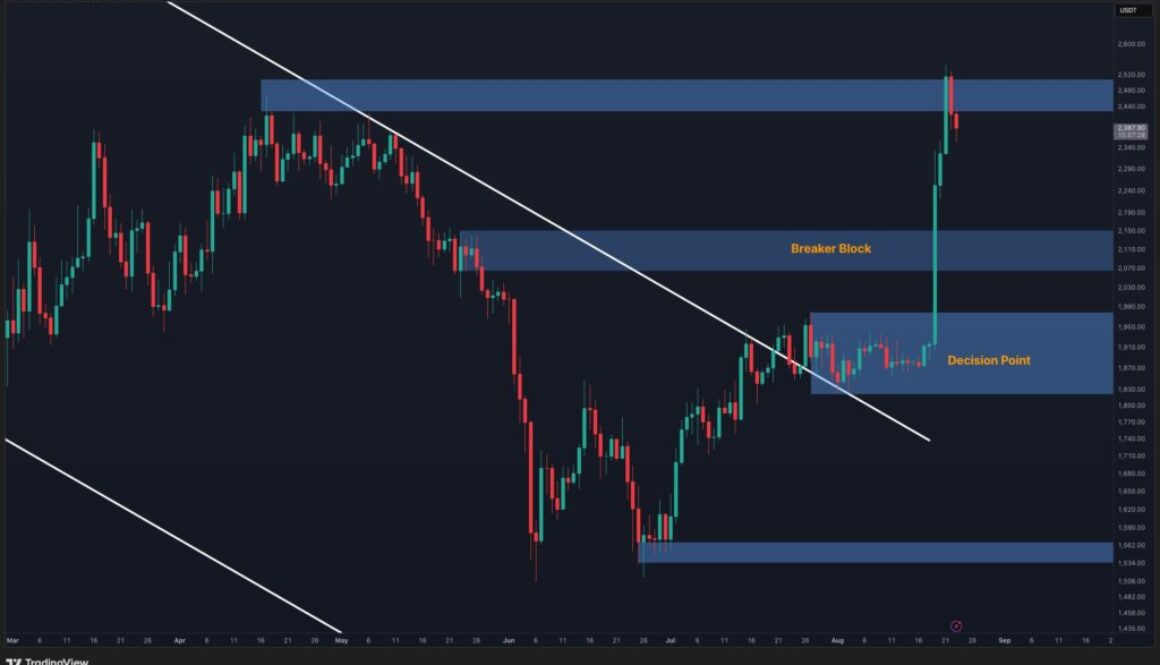
The compounding effect matters at scale: if Bitmine forgoes 135,000 ETH in annual purchases and instead relies on staking rewards for three years, it avoids deploying approximately $400 million to $500 million in capital (at current spot prices of $2,400 to $2,600 per token) while achieving the same endpoint, provided Ethereum’s supply does not expand beyond 1% annually.
The critical variable now becomes Ethereum’s supply trajectory. Current protocol design includes a 0.5% annual issuance cap intended to be burned down further through increased network activity, but any acceleration in validator entry or sustained low burn rates could extend the timeline Bitmine faces. The company’s next public disclosure, due in its Q3 2024 earnings report, will signal whether management is pricing in this staking-first dynamic or maintaining an aggressive purchase schedule regardless of yield economics.