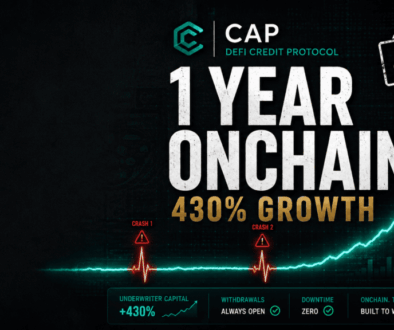
CAP Is Bringing Real-World Borrowers Onchain — Without Asking Them
to Trust a Crypto Team With Their Money
Private credit is a multi-trillion dollar market in traditional finance — and onchain lending has barely scratched it. Here’s why CAP’s three-party model may be the architecture the industry has been waiting for.
Crypto’s lending market has a dirty secret: for all its sophistication in technology, it has spent years fighting over the same small pool of borrowers. Projects compete ruthlessly for collateral-backed loans to a group so concentrated it would embarrass most community credit unions. The infrastructure is real. The market is not — or at least, not yet.
What’s missing isn’t smarter smart contracts. It’s a credible bridge between the $1.7 trillion private credit market in traditional finance and the permissionless lending protocols that have been designed, almost entirely, for people who already own crypto. CAP is attempting to close that gap — and the structural logic of how it’s doing so is worth understanding carefully.
Why Everything Built Before This Failed
The collapses of 2022 — Celsius, BlockFi, Voyager — were widely attributed to market conditions, contagion, and bad luck. That framing lets the real culprit off the hook: they were credit platforms run by teams with no business underwriting credit.
Each of those platforms made the same foundational error. They raised capital from depositors seeking yield, then made their own lending decisions about where to deploy it. Investment committees staffed with crypto entrepreneurs rather than credit professionals evaluated loans to counterparties that, in hindsight, presented obvious risks. When those counterparties defaulted or when liquidity dried up, there was nothing structural to stop the cascade.
The lesson wasn’t that onchain lending is dangerous. It’s that centralized credit decisions made by unqualified teams, with other people’s money and no meaningful accountability mechanism, will tend toward failure. This is not a crypto insight. It’s a 200-year-old lesson from traditional banking, rediscovered the hard way.
Post-collapse, the industry bifurcated. One camp moved toward pure permissionless markets — protocols where depositors choose their own counterparties and bear their own risk. The other camp moved toward custodian-heavy structures that trade decentralization for institutional credibility. Both are reactions. Neither is a solution to the underlying problem: how do you scale credit decisions without centralizing them in the hands of people who have no business making them?
The Three-Party Model: Who Actually Makes the Decision
CAP’s architecture introduces a third participant that most lending protocols have ignored: the underwriter. In traditional private credit, an investment committee evaluates a borrower and decides whether to extend a loan. At CAP, that function is distributed to a market of independent underwriters who compete to evaluate and back specific borrowers.
The mechanism has an elegant incentive structure. Underwriters don’t just issue opinions — they post collateral to back their decisions. If they approve a borrower who subsequently defaults, that collateral is seized. If their underwriting is sound, they earn a credit spread on the loan. Their compensation is tied directly to the quality of their judgment, not to the volume of loans processed.
This is meaningfully different from how Apollo or Blackstone runs a credit desk, where the same investment committee must review every deal, creating the bottleneck that makes sub-$10 million loans economically irrational for large private credit funds. CAP’s parallel underwriter structure has no such constraint. A $1 million loan to a manufacturing firm in Boston and a $200 million facility to a blue-chip HFT firm can be underwritten simultaneously by entirely separate participants who have no exposure to each other’s decisions.
The dollar depositors — the liquidity providers — sit outside this underwriting process. They are, in CAP’s framing, price takers. They receive a yield determined by the utilization rate of the dollar pool plus whatever credit spread the underwriter has applied. They do not choose their counterparties; they provide capital to a pool that the underwriter has already approved. The separation of those two roles is the structural insight that distinguishes CAP from what came before.
market — TradFi, 2025
across all onchain credit
Depositor · Borrower · Underwriter
The Collateral That Nobody Wanted
There’s a second dimension to the underwriter model that deserves attention: where the collateral comes from and why anyone would provide it.
CAP’s underwriters post collateral in assets like gold, Bitcoin, S&P-linked instruments, or Japanese yen — assets that are held as stores of value but generate no yield in their native form. The carry trade analogy is instructive here. In traditional finance, the carry trade involves borrowing in a low-yield currency and investing in a higher-yield one. The risk is the exchange rate move that wipes out the spread.
CAP’s underwriter position is structurally similar but strips out several of those risks. The underwriter doesn’t sell their base asset. They don’t need to hedge currency exposure. Their collateral sits in escrow on-chain, generating a credit spread from the dollar loans they underwrite, while remaining fully titled to them. The only real risk they bear is the creditworthiness of the borrowers they approve — which is precisely the risk they’re being paid to evaluate.
This creates a compelling proposition for holders of substantial, low-yielding hard assets: participate in credit markets without liquidating positions, without currency hedging complexity, and with exposure only to risks you actively select and price.
Franklin Templeton’s role as CAP’s lead investor is significant not merely as a capital signal but as a distribution and legitimacy signal. The firm manages over $1.5 trillion in assets and has been among the most aggressive traditional asset managers in exploring tokenized financial products. Their active participation in CAP’s cap table — alongside Susquehanna and IMC Trading — represents the kind of institutional endorsement that moves the conversation with other allocators from “interesting experiment” to “credible infrastructure.” For borrowers who have never interacted with a blockchain, the presence of a name like Franklin Templeton in the ownership structure meaningfully lowers the barrier to entry. The Genius Act’s passage has accelerated this dynamic, with institutions that previously required stablecoin clarity before engaging now entering conversations that would have stalled 18 months ago.
The Regulatory Tailwind Is Real — and Fragile
The passage of the Genius Act created a clearer regulatory perimeter for stablecoins in the United States, and its downstream effects on credit platforms are significant. Institutions that hold stablecoins need somewhere to put them to work. The Genius Act explicitly forecloses certain yield mechanisms on the instrument itself — which makes dedicated credit platforms the natural destination for yield-seeking stablecoin holders operating within a compliant framework.
CAP’s observation that borrowers with no blockchain experience are now engaging more seriously post-Genius is worth noting. It suggests that regulatory clarity functions less as a permission slip and more as a psychological threshold — once crossed, the friction of engagement drops dramatically.
The Clarity Act’s progress represents a potential second wave of this effect, this time for digital asset classification more broadly. If passed in its current form, it would extend institutional comfort to a wider category of on-chain activity, potentially expanding the universe of both depositors and borrowers willing to engage with platforms like CAP.
The caveat is structural. Regulatory progress in this cycle is tightly coupled to the current Congressional composition. Enforcement postures, guidance letters, and even some legislative momentum can reverse with an administration change. The durability of gains depends on whether they reach the threshold of codified legislation rather than remaining as regulatory interpretation. For a platform building multi-year credit relationships, this is not an abstract concern.
The Security Question: Smart Contracts vs. Custodians
The DeFi hacks of early 2026 pushed the broader industry toward custodian-reliant structures. For lending markets in particular, the argument is straightforward: if collateral is held by a regulated custodian, the protocol’s smart contract attack surface shrinks.
CAP pushes back on this reasoning in a way worth examining. A custodian is not a risk-neutral party. They are a counterparty — one with their own incentive structures, jurisdictional complexities, and in some cases, regulatory ambiguity of their own. Custody arrangements that appear to reduce risk actually transmit it into a different form: counterparty exposure to an entity whose failure mode is opaque, and whose fiduciary obligations may not be aligned with depositors.
CAP’s position is that the solution to insecure smart contracts is better smart contracts — and specifically, contracts that have immutable admin key structures and don’t rely on team wallets for ongoing control. Most of the high-profile incidents in early 2026 were not novel exploit discoveries but admin key compromises: either teams that lost control of their signing keys, or situations that are indistinguishable from deliberate exits. In neither case would a smarter piece of code have helped. But removing the admin key attack surface — through contract design rather than custodial workarounds — would.
The additional protection CAP builds in is the KYB requirement for all borrowers. Collateral going to zero does not extinguish a borrower’s legal obligation to repay. This is how traditional secured lending works — the collateral is an enforcement mechanism, not the only mechanism. CAP’s hybrid of on-chain collateral management and off-chain legal enforceability mirrors institutional credit practice more closely than any pure DeFi lending protocol.
| Feature | Celsius / BlockFi (Pre-collapse model) |
Aave / Morpho (Permissionless DeFi) |
CAP (Three-party model) |
|---|---|---|---|
| Who underwrites credit? | Internal team | Algorithmic / none | ✓ Independent underwriters, stake-backed |
| Collateral required from borrower? | ✗ Often unsecured | ✓ Crypto over-collateral | ✓ Underwriter collateral + legal obligation |
| Borrower types served | Retail + institutions | Crypto-native only | ✓ TradFi businesses, HFT, asset managers |
| Team decision-making power | ✗ Full control | Protocol governance | ✓ Removed from credit decisions |
| Regulatory alignment | ✗ Minimal | Gray area | ✓ KYB, legal agreements, institutional backers |
| Can process small loans in parallel? | ✗ Committee bottleneck | ✓ Permissionless | ✓ Parallel underwriters, no bottleneck |
What Expansion Into New Verticals Actually Means
CAP’s roadmap through the end of 2026 focuses on onboarding new borrower categories: film financing, shipment financing, inventory lending. To an audience accustomed to thinking of crypto credit as something that happens between funds and market makers, these verticals might read as aspirational. They aren’t.
These are exactly the borrowers being underserved by the current private credit market. The large platforms — Apollo, Blackstone, Ares — are fully committed to AI infrastructure, data center debt, and leveraged corporate credit. A $3 million line of credit for a specialty manufacturer or a short-term inventory advance for a mid-sized importer doesn’t fit their underwriting economics. The deal is too small for the committee time it requires.
CAP’s parallel underwriting architecture theoretically eliminates that constraint. An underwriter who specializes in trade finance can evaluate import/export inventory deals without competing for committee time with a $500 million infrastructure loan. The protocol doesn’t care what size the loan is — it treats them identically at the infrastructure level.
The practical challenge is underwriter recruitment in non-native verticals. Film financing underwriting requires domain expertise that is meaningfully different from credit analysis of a crypto fund. Building that underwriter base across diverse industries will require deliberate market development — not just technical infrastructure.
The Token Question
CAP has announced a platform token, separate from governance, and explicitly ruled out a DAO structure. This is a more defensible position than it might appear. The DAO experiment of 2020–2023 produced a consistent outcome: governance was captured either by a small group of large token holders or by professional “DAO service providers” who extracted value through proposal overhead and service fees. Actual protocol decisions remained with the core team; the DAO added cost without adding accountability.
A platform token without governance rights sidesteps those failure modes. It can still serve legitimate functions — fee distribution, protocol incentives, underwriter bonding mechanics — without creating a governing body that is simultaneously too slow to be useful and too easily captured to be trustworthy.
The detail to watch when the token launches is how it interfaces with the underwriter collateral and credit spread mechanics. A well-designed token here reinforces the incentive structure of the core protocol; a poorly designed one creates misaligned incentives that compete with it.