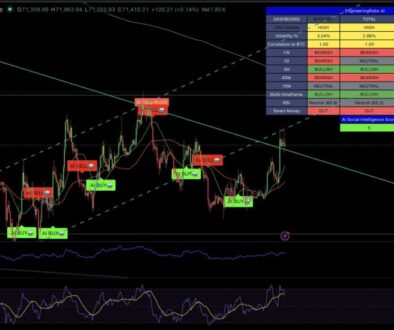
Bitcoin Price Bleeds Lower With $65K Becoming The Battleground
Bitcoin has retreated from recent highs, with the digital asset struggling to maintain footing above key technical levels. The pullback reflects mounting selling pressure as traders reassess positions, with bitcoin price action now centered around the $65,000 mark as a critical support zone.
Recent Price Action and Technical Breakdown
Bitcoin traded above $68,800 earlier in the current cycle but failed to sustain that level. The cryptocurrency subsequently fell through multiple support zones, including $68,000 and $67,000, before declining further below the 50% Fibonacci retracement level derived from the earlier $60,500 low to the $72,255 high.
The selloff has pushed BTC beneath both the $67,000 mark and the 100-hour simple moving average, both of which had served as technical anchors. Bears have demonstrated particular force, driving the asset down to test levels near $65,500 in recent trading sessions.
Bitcoin is now trading below $67,000 and the 100 hourly simple moving average, with a bearish trend line forming resistance at $67,500.
— Crypto Coin Show Technical Analysis
A bearish trend line has materialized on the hourly chart of the BTC/USD pair, with resistance positioned at $67,500. This technical formation suggests the prevailing momentum remains tilted toward the downside in the near term.
Support Levels and Downside Scenarios
The $65,000 level has emerged as a significant psychological and technical support zone for bitcoin. This represents the 61.8% Fibonacci retracement level from the recent upward move and marks a threshold traders are monitoring closely.
Immediate support sits near $65,500. The primary support level stands at $65,000. Should weakness persist, traders should watch $62,750, followed by $61,200 and ultimately the $60,500 foundational support.
If bitcoin fails to establish stability above $65,000, the next technical target would be the $62,750 zone. Further deterioration could extend losses toward $61,200 in the intermediate term. The $60,500 level represents the major support floor, below which recovery momentum could be severely compromised.
The bearish technical backdrop is supported by momentum indicators currently registering weakness. The MACD on the hourly timeframe is accelerating in the bearish zone, while the Relative Strength Index has fallen below the 50 midpoint, confirming oversold conditions are not yet present but momentum has turned decidedly negative.
Resistance Barriers for Recovery
For bulls to regain control, bitcoin must first reclaim the $68,000 resistance zone. A sustained close above this level would represent an important technical confirmation of reversal interest.
Should buyers overcome the $68,000 hurdle, the next target would be $69,200. Continued gains could then extend toward $70,500, with $72,000 and $72,500 representing the subsequent resistance tiers where supply could reemerge to challenge further appreciation.
Immediate resistance is positioned at $67,500 and the trend line. The first major resistance sits at $68,000. Secondary resistance levels include $69,200, $70,500, $72,000, and $72,500.
The path to recovery remains constrained by the technical structure that has developed over recent sessions. Without a clear catalyst to reverse momentum, the immediate bias remains tilted toward the downside.
Industry Context and Market Dynamics
Bitcoin’s current pullback occurs within a broader context of cryptocurrency market maturation and evolving institutional participation. Over the past several years, the digital asset has transitioned from a niche retail trading instrument to an asset class commanding significant institutional capital allocation. Major financial institutions now maintain bitcoin holdings as part of diversified portfolios, which has introduced both deeper liquidity and new volatility patterns tied to macroeconomic conditions.
The cryptocurrency market capitalization currently exceeds $2 trillion, with bitcoin maintaining roughly 45-50% of total digital asset value. This concentration reflects bitcoin’s position as the dominant cryptocurrency and primary proxy for digital asset risk sentiment. When bitcoin experiences significant price movements, it typically reverberates across altcoin markets and influences overall market risk appetite.
Recent regulatory developments across major jurisdictions have also contributed to market dynamics. The approval of Bitcoin spot exchange-traded funds (ETFs) in the United States and expansion of cryptocurrency trading infrastructure globally have legitimized bitcoin as an investable asset class. However, this institutionalization has also introduced correlation with traditional markets during periods of macroeconomic stress, as institutional traders reassess risk exposure across all asset classes simultaneously.
The current pullback reflects this broader market dynamic. Rather than being driven solely by technical exhaustion or cryptocurrency-specific factors, bitcoin’s retreat appears correlated with broader equity market weakness and shifting interest rate expectations. Federal Reserve policy remains a critical variable, as higher-for-longer interest rates increase the opportunity cost of holding non-yielding assets like bitcoin.
Market Implications and Structural Considerations
The significance of bitcoin’s current technical breakdown extends beyond immediate price concerns. A failure to sustain prices above $65,000 could signal that the recent rally lacked institutional conviction and retail participation sufficient to drive the asset toward new all-time highs. This would carry important implications for market psychology and investor sentiment toward digital assets more broadly.
Bitcoin’s price discovery mechanism depends on equilibrium between buyers and sellers across spot markets, futures contracts, and derivatives platforms. When support levels fail, liquidation cascades can occur as leveraged traders are forced to close positions, creating additional selling pressure that extends price declines beyond fundamental valuations.
The current technical environment suggests we may be in a period of price discovery and range formation. Bitcoin has historically spent extended periods consolidating after significant rallies before breaking out to new levels. The current consolidation between $60,500 and $72,500 represents a roughly 20% range, which is relatively modest for bitcoin but significant enough to contain substantial trading activity.
Market participants should note that cryptocurrency markets operate 24/7 without circuit breakers or trading halts, which creates different risk dynamics than traditional equity markets. Price movements can accelerate rapidly during low-liquidity periods, particularly during Asian trading hours when institutional participation is lighter.
Market Context and Trading Considerations
The current price action reflects the inherent volatility characteristic of cryptocurrency markets, where rapid directional shifts can occur around key technical levels. Bitcoin’s struggle to hold above $68,000 suggests that the recent rally lacked the conviction necessary to push toward fresh all-time highs.
Traders employing technical analysis are monitoring both the Fibonacci retracement levels and the trend line formation as critical guides for near-term direction. The alignment of multiple technical factors—the moving average, the Fibonacci level, and the trend line—creates a cluster of resistance that the current rally has not yet overcome.
Short-term traders should exercise caution until clearer directional signals emerge from the crypto market. The consolidation around current levels may represent either a prelude to further weakness or a setup for a more sustained recovery attempt. Volume analysis becomes particularly important during these consolidation periods, as increasing volume on breakouts signals conviction while declining volume suggests exhaustion.
Risk management remains paramount in the current environment. Traders holding positions should establish clear stop-loss levels relative to the support zones outlined above. Similarly, those seeking entry points should wait for confirmation of support holds before adding to positions. Position sizing becomes critical in periods of elevated volatility, as individual trades carry greater downside potential.
The price could dip toward $62,750 and then $61,200 if $65,000 support fails to hold in the near term.
— Technical Analysis Assessment
The broader market context suggests that bitcoin’s movement remains tied to macroeconomic factors and sentiment shifts within the institutional and retail trader communities. Without a fundamental catalyst to drive renewed buying interest, the technical framework outlined above will likely continue to dictate price movement. Potential catalysts include changes in Federal Reserve policy signaling, resolution of regulatory uncertainty, or significant institutional adoption announcements.
As always, traders should remember that past technical patterns do not guarantee future results. Market conditions can shift rapidly, particularly in the cryptocurrency space where liquidity can evaporate at critical support or resistance levels. The development of new technologies, regulatory changes, or macroeconomic shocks can fundamentally alter market dynamics and invalidate previously reliable technical patterns.
Forward-Looking Perspective
Looking beyond the immediate technical setup, bitcoin’s longer-term trajectory depends on several fundamental factors. Institutional adoption continues expanding, with major corporations and asset managers allocating capital to digital assets. However, macroeconomic uncertainty and competitive pressures from central bank digital currencies represent ongoing headwinds.
The cryptocurrency industry has matured substantially, with institutional-grade infrastructure now supporting large-scale transactions and custody solutions addressing security concerns that previously deterred institutional participation. This maturation suggests that extreme volatility may gradually decline as market participants diversify and trading becomes more efficient.
Bitcoin’s current price action should be understood within this broader context of market evolution. The asset continues transitioning from speculative trading vehicle to institutional portfolio component, which will inevitably introduce periods of consolidation and mean reversion—precisely the environment we observe today.
- Bitcoin has declined from recent highs above $68,800, now trading below $67,000
- The $65,000 level represents critical support that bulls must defend
- A bearish trend line has formed with resistance at $67,500 on the hourly chart
- MACD momentum indicators are accelerating in the bearish direction
- Recovery requires reclaiming $68,000, with further targets at $69,200 and $70,500
- Downside risks extend to $62,750, $61,200, and ultimately $60,500
- Broader market context involves institutional participation and macroeconomic correlation
- Bitcoin’s pullback reflects industry maturation and shifting sentiment toward digital assets
- Technical consolidation may represent either continuation of weakness or prelude to recovery
- Risk management and clear entry/exit parameters remain essential for traders
Get weekly blockchain insights via the CCS Insider newsletter.