Ethereum Takes a Blow, Though Buyers Continue Shielding Key Price Floors
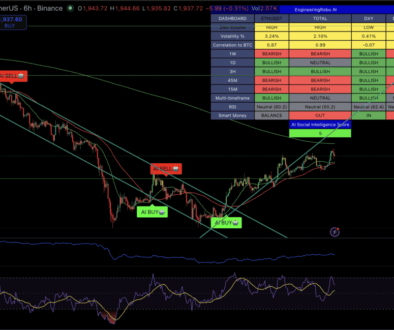
Ethereum has retreated from recent highs, with ETH/USD struggling to maintain momentum above key technical levels as the broader crypto market navigates choppy waters. The second-largest cryptocurrency by market capitalization descended below the $2,880 mark and tested support near $2,720, leaving traders to assess whether institutional and retail buyers will continue defending these critical price floors or if further losses may materialize in coming sessions.
Pullback From Resistance Tests Buyers’ Resolve
The Ethereum price action over recent hours reflects a familiar pattern: initial strength followed by a failure to sustain gains at resistance. ETH failed to hold above $2,950 and rolled over decisively, piercing through $2,880 and eventually $2,800 before finding a temporary floor around $2,718.
The recovery attempt that followed shows buyers are not entirely absent from the market. Price has climbed back above the $2,750 level and cleared the 23.6% Fibonacci retracement of the downward move from the $3,052 swing high. However, Ethereum remains trapped below the 100-hourly Simple Moving Average, a sign that intermediate-term selling pressure persists.
The bulls might face resistance at multiple levels on any further upside attempts, suggesting this recovery remains fragile without a decisive break above prior support-turned-resistance zones.
— Technical Analysis, CCS
Ethereum’s $2,880 level represents both a near-term technical ceiling and a test of conviction among buyers. A sustained move above this zone would target $2,920, with a break above $2,920 potentially unlocking a run toward $3,000 and the $3,050–$3,150 range.
Momentum Indicators Signal Caution
The technical backdrop suggests limited immediate upside enthusiasm. The hourly MACD indicator is losing momentum within bearish territory, indicating that selling pressure, while fading, has not yet fully reversed. The hourly Relative Strength Index has dipped below the 50 level, a neutral threshold that typically separates oversold from overbought conditions.
These readings are not catastrophic—they do not suggest panic selling or capitulation—but they do confirm that Ethereum price action lacks the strength required for a clean break to new highs. Any attempted recovery must overcome both the $2,820 bearish trend line resistance and the $2,880 psychological barrier to gain credibility among longer-term traders.
Support Levels Define Downside Risk
Should Ethereum fail to establish a foothold above $2,880 and roll over once more, a multi-tiered support structure exists to potentially arrest further declines. The first meaningful floor sits at $2,760, followed by $2,740, which serves as major support. A break below $2,740 could open the door to the $2,720 level and potentially the $2,650 region in the near term.
Critically, deeper support resides at $2,550 and $2,500. These levels remain well above recent lows and would represent a significant draw-down, but they provide a reference point for risk management among larger market participants who entered positions during higher price levels.
Ethereum’s current struggle mirrors broader Bitcoin weakness, suggesting that macro sentiment and the appetite for risk assets weighed on both the largest and second-largest cryptocurrencies simultaneously. This synchronized weakness often indicates that individual technical factors matter less than overarching market conditions—regulatory news, macroeconomic headwinds, or capital reallocation away from digital assets.
The fact that buyers have stepped in to defend the $2,720 level rather than allowing a complete capitulation is noteworthy. In a genuinely bearish environment with no institutional interest, prices tend to collapse more decisively. Instead, the pattern resembles a consolidation range where both bulls and bears are testing each other’s conviction.
The defense of key support levels suggests that despite the pullback, market participants still view Ethereum valuations as worth accumulating at these prices.
— Market Commentary, CCS
Ethereum’s Role in the Digital Asset Ecosystem
Ethereum’s significance extends far beyond its role as a standalone digital asset. As the leading smart contract platform, it underpins a multi-billion-dollar ecosystem encompassing decentralized finance (DeFi), non-fungible tokens (NFTs), layer-2 scaling solutions, and enterprise applications. The network’s performance and sentiment directly influence capital flows across this entire infrastructure layer, making Ethereum price movements a bellwether for institutional and retail confidence in blockchain technology adoption.
The shift toward proof-of-stake consensus via the Merge and subsequent Shanghai and Dencun upgrades has fundamentally reshaped Ethereum’s economic model. These upgrades have introduced staking mechanisms, reduced issuance rates, and improved transaction throughput through blob data storage. These developments have attracted institutional capital and enhanced the platform’s efficiency, yet price action remains subject to the same market cycles that affect all cryptocurrencies.
Current weakness in Ethereum has not deterred ongoing development or enterprise deployments. Major financial institutions continue building on the network, and decentralized exchange volumes remain robust despite price consolidation. This divergence between technical price action and fundamental ecosystem activity suggests that the present pullback may represent an opportunity rather than a structural weakness in the underlying protocol or its adoption trajectory.
Market Implications for Institutional and Retail Participants
The current price consolidation carries distinct implications for different market participants. Institutional investors utilizing Ethereum for yield-bearing strategies through staking and protocol participation face a benign environment where positions can be accumulated or maintained without triggering forced liquidations or margin calls. The network’s reliability and upgrade trajectory remain intact regardless of near-term price movements.
For retail traders, the extended consolidation presents both risk and opportunity. Extended periods of range-bound trading tend to frustrate directional traders while rewarding those employing mean-reversion strategies or careful position sizing at support and resistance levels. The technical setup—with defined support at $2,720 and $2,740, intermediate resistance at $2,880, and higher targets at $2,920 and $3,000—provides a clear framework for managing risk and identifying favorable entry and exit points.
The broader cryptocurrency market’s macroeconomic sensitivity remains acute. Central bank policy decisions, inflation data, and equity market performance continue to drive capital allocation decisions. Ethereum’s performance remains correlated with broader risk sentiment, meaning that geopolitical developments or economic data releases can quickly overwhelm technical patterns or fundamental tailwinds specific to the Ethereum ecosystem.
Path Forward: Recovery or Retest
The near-term trajectory depends on whether $2,880 acts as a dynamic resistance that eventually yields to buyer pressure or as a ceiling that forces another test of support. A clear move above $2,920 would signal that the pullback was merely a correction within a larger uptrend, opening the possibility of a run toward $3,000 and beyond.
Conversely, rejection at $2,880 coupled with a slide below $2,760 would suggest that the recovery lacked sufficient fuel and that lower support levels merit attention. Traders should monitor both the price action and the technical indicators for signs of divergence—if price makes a new low but momentum indicators fail to confirm it, that often precedes a sharp reversal.
The resolution of this consolidation will likely depend on exogenous factors rather than technical patterns alone. Positive regulatory developments, upgrades to competing protocols, or macroeconomic news could trigger a decisive break in either direction. Until such a catalyst materializes, Ethereum appears positioned for a multi-week consolidation where volatility remains contained and range-bound trading strategies remain optimal.
Ethereum remains poised between two outcomes: a rebound that tests the $2,920–$3,000 zone or a breakdown that revisits the $2,650–$2,550 support band. The absence of strong momentum in either direction suggests a multi-day consolidation period is likely before the next significant directional move materializes. Long-term holders should remain focused on the ecosystem’s fundamental development trajectory rather than short-term price volatility.
Conclusion and Investment Perspective
Ethereum’s pullback from recent highs represents a natural consolidation within a market that has demonstrated sustained interest in digital assets and blockchain infrastructure. While technical analysis provides valuable guidance for traders navigating the near-term price action, the broader context—including the network’s technological advancement, increasing institutional adoption, and evolving regulatory landscape—suggests that long-term conviction in Ethereum’s utility and value proposition remains justified.
The current price consolidation affords participants the opportunity to reassess their risk tolerance, portfolio allocation, and investment thesis without the distraction of parabolic price movements. Whether this pullback ultimately resolves higher or lower will depend on a combination of technical factors, market sentiment, and exogenous developments. For traders and investors monitoring Ethereum, the current price action reinforces the importance of respecting both support and resistance levels while remaining flexible about directional assumptions. The market has shown that it will defend key floors, but it has not yet demonstrated sufficient strength to overcome intermediate resistance with conviction. Patience and discipline remain paramount as the market works through this critical consolidation phase.
Get weekly blockchain insights via the CCS Insider newsletter.