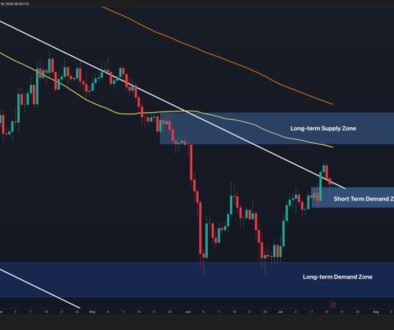
Ethereum Price Slides Below $4,000 Support As Sellers Tighten Their Grip
Ethereum price has slipped below the $4,000 support level, signaling renewed selling pressure in the second-largest cryptocurrency by market capitalization. The ETH/USD pair is now consolidating losses near $3,828 after failing to sustain gains above key resistance zones, raising questions about whether further downside may be imminent.
Current Market Position
Ethereum has struggled to maintain footing above $4,020 and $4,000, with the asset now trading firmly below both levels and the 100-hourly simple moving average. The recent pullback tested support around $3,828 before stabilizing, though the overall tone remains decidedly bearish.
A notable bearish trend line has formed on the hourly timeframe, with resistance now positioned near $4,070. This technical setup suggests sellers remain in control of the near-term price action, limiting upside momentum even on modest recovery attempts.
Ethereum price is now trading below $4,000 and the 100-hourly Simple Moving Average, with a key bearish trend line forming resistance at $4,070 on the hourly chart.
— Technical Analysis, CCS Research
Major support: $3,820. Major resistance: $4,070. A move below $3,820 could trigger accelerated selling toward $3,740 and $3,650.
Industry Context and Market Implications
The recent weakness in Ethereum reflects broader challenges facing the decentralized finance and blockchain development ecosystems that depend heavily on the platform. Ethereum’s dominance as the leading smart contract platform means its price movements carry significant implications for the entire digital asset industry. With over $200 billion in total value locked across DeFi protocols built on Ethereum, price volatility directly impacts developer confidence, user participation, and the viability of blockchain projects leveraging the network.
The cryptocurrency market has entered a period of heightened uncertainty following macroeconomic headwinds, including persistent inflation concerns and shifting interest rate expectations. These factors have historically pressured risk assets, including cryptocurrencies, as investors reassess return expectations and rebalance portfolios toward safer alternatives. Ethereum, despite its utility-driven fundamentals, has not been immune to these broader market forces.
Market data reveals that institutional investors have been gradually reducing exposure to Ethereum in recent weeks, as evidenced by declining inflows to Ethereum spot exchange-traded products and reduced derivatives trading volume. This institutional pullback, combined with retail capitulation, has created a confluence of selling pressure that has overwhelmed recent support levels.
Ethereum’s Competitive Positioning
Within the blockchain landscape, Ethereum maintains its position as the dominant platform for decentralized applications, but faces increasing competition from alternative Layer 1 blockchains and Layer 2 scaling solutions. Networks like Solana, Polygon, and Arbitrum have captured meaningful market share, particularly among developers seeking lower transaction costs and faster execution times. These competitive dynamics add pressure to Ethereum’s valuation multiples, as the market questions whether the platform can maintain its network effects and developer mindshare amid rapid technological evolution.
The upcoming Shanghai upgrade, scheduled to introduce staking rewards and further enhance Ethereum’s proof-of-stake mechanism, represents a potential catalyst for recovery. However, current market sentiment suggests investors are pricing in extended consolidation before meaningful positive catalysts can meaningfully influence price action. The transition to proof-of-stake, while successful, has not yet delivered the scalability improvements that many developers and users anticipated.
Resistance and Recovery Scenarios
Should Ethereum attempt a bounce from current levels, the first hurdle emerges near $3,950. A sustained recovery would require clearing the $4,020 level, which aligns with the 50% Fibonacci retracement of the recent decline from the $4,215 swing high.
If buyers can decisively break above $4,070—where the bearish trend line sits—the door opens for upside continuation. Price could then target $4,120, followed by resistance near $4,220 and potentially $4,250 in the near term. However, such a scenario would require significant shift in momentum away from current selling pressure.
The relative strength index (RSI) on the hourly chart has dropped below the 50 midpoint, reinforcing the bearish bias. The moving average convergence divergence (MACD) is also gaining negative momentum, suggesting sellers may have further room to push lower.
Recovery momentum would need to overcome not just technical resistance but also significant psychological barriers. Ethereum’s failure to sustain levels above $4,000—a round number with substantial psychological weight—signals that buyer conviction remains weak. Breaking through resistance in this environment typically requires either positive news catalysts or a broader market rally driven by changes in macroeconomic sentiment.
Potential For Further Losses
The more immediate concern for ETH holders is downside risk. If Ethereum cannot reclaim $4,020, a fresh decline appears likely. Initial support on the downside is positioned near $3,880, providing a modest cushion for price stabilization.
The critical support zone sits at $3,820. A convincing break below this level would represent a significant technical breakdown and could accelerate selling momentum. In that scenario, $3,740 would become the next major target, with $3,650 following if weakness persists.
Broader market conditions matter here. Bitcoin‘s recent price action has been similarly challenged, with the leading cryptocurrency also correcting from recent highs. This correlation suggests systemic factors may be influencing the broader digital asset complex.
From a market structure perspective, the formation of lower lows and lower highs indicates an ongoing downtrend. Should Ethereum continue to make lower lows, the technical damage would become increasingly difficult to repair in the near term. Historical analysis suggests that once this pattern establishes itself, recovery often requires a complete retesting of previous lows before genuine stabilization occurs.
If Ethereum fails to clear the $4,020 resistance, it could start a fresh decline with initial support near $3,880 and major support at $3,820.
— Technical Analysis, CCS Research
Entity Background and Market Participation
The Ethereum network continues to process record transaction volumes despite price weakness, indicating that fundamental usage metrics remain robust. Decentralized exchange volumes, token transfer activity, and smart contract interactions have all remained elevated, suggesting that the underlying utility and demand for Ethereum’s blockchain services persist independent of price movements.
However, market participants must distinguish between fundamental strength in network usage and sentiment-driven price movements. Historically, cryptocurrency markets have been prone to extended periods where price does not align with fundamental metrics. Current market conditions appear to represent such a disconnect, with price weakness not fully justified by operational metrics or network development progress.
Major institutional players holding Ethereum, including venture capital firms, asset managers, and corporate treasuries, have largely maintained their positions despite recent price weakness. This suggests that long-term conviction regarding Ethereum’s value proposition remains intact among sophisticated market participants, even if shorter-term trading sentiment has turned negative.
What To Watch
The path forward for Ethereum depends on whether bulls can defend the $3,820 support zone. This level has proven significant during the recent price action and represents a line in the sand for the current technical structure.
Traders monitoring ethereum price action should watch for hourly closes either above $4,070 or below $3,820. These would signal directional clarity, whereas consolidation in the $3,820-$4,070 range suggests continued uncertainty.
Volume analysis will be important as well. Weak volume on any attempted recovery could suggest that the selling is not exhausted, while elevated volume on downside moves would confirm conviction among sellers.
Additionally, monitoring the correlation between Ethereum and Bitcoin will provide valuable insight into whether selling pressure is idiosyncratic to Ethereum or part of a broader cryptocurrency market retreat. Divergence between the two assets could signal that Ethereum-specific factors are driving weakness, whereas continued correlation would suggest macro factors dominate.
Watch for developments surrounding Ethereum upgrade timelines, regulatory news affecting blockchain platforms, and changes in macroeconomic policy expectations. Any of these could catalyze significant shifts in market sentiment and price direction.
Hourly MACD gaining bearish momentum. RSI below 50 midpoint. Bearish trend line overhead at $4,070. Major support at $3,820 critical for preventing further losses. Lower lows and lower highs pattern in place. Break below $3,820 would accelerate decline toward $3,740.
The current environment underscores the importance of risk management. Ethereum’s position below key moving averages and support levels, combined with deteriorating technical indicators, suggests caution for new long positions until clearer signs of stabilization emerge.
Conclusion and Forward Outlook
Ethereum’s current price weakness represents a critical juncture for both short-term traders and long-term holders. While the technical outlook remains bearish in the near term, the broader fundamental case for Ethereum’s continued importance as a blockchain platform infrastructure remains intact. The challenge facing the market is reconciling short-term selling pressure with medium-to-long-term growth prospects.
Investors should view current price levels within a broader timeframe context. For those maintaining positions or considering entry points, understanding the difference between temporary technical weakness and structural decline is essential. Current evidence suggests we are experiencing cyclical weakness rather than a fundamental invalidation of Ethereum’s value proposition, though confirmation would require successful defense of key support levels.
The coming weeks will likely determine whether Ethereum can establish a sustainable consolidation pattern or whether selling pressure extends further. Success at the $3,820 support level would be a critical first sign that the decline may be nearing completion. Conversely, failure at this level would extend the downtrend and create conditions for capitulation-style selling that could extend losses significantly further.
For context on broader market developments affecting Ethereum, stay tuned to the latest crypto news and analysis from our team.
Get weekly blockchain insights via the CCS Insider newsletter.