0G Labs Wants to Make AI a Public Good — And It’s Building the Blockchain Stack to Prove It
At Consensus 2026 in Miami, 0G Labs co-founder Michael laid out a sweeping vision for decentralized AI — one where users own their data, agents handle payments on-chain, and a blockchain truth layer holds AI accountable. Here’s everything you need to know.
MIAMI — The air at Consensus 2026 is thick with AI energy, and few projects embody that collision of worlds more than 0G Labs — the self-described “Layer 1 for AI.” We sat down with co-founder Michael on the conference floor to get a full picture of where decentralized AI stands today and what the team is building next.
“Our mission is to make AI a public good — and we’re not stopping anytime soon.”
— Michael, Co-Founder, 0G Labs · Consensus 2026The Case Against Blackbox AI
The conversation started with a sharp critique of the current AI landscape. Today’s hyperscalers — the OpenAIs and Anthropics of the world — operate what Michael calls “blackbox AI.” Massive GPU clusters, potentially nuclear-powered data centers, and API interfaces that give users zero visibility into what actually happens to their data behind the scenes.
“You may be able to click a button to say don’t use my data for AI training, but how can you verify that?” Michael asked pointedly. “The moment it’s on somebody else’s server, they can technically do whatever they want.” For users with sensitive medical, financial, or personally identifiable data, that’s a trust problem blockchain is uniquely positioned to solve.
How 0G’s Decentralized AI Actually Works
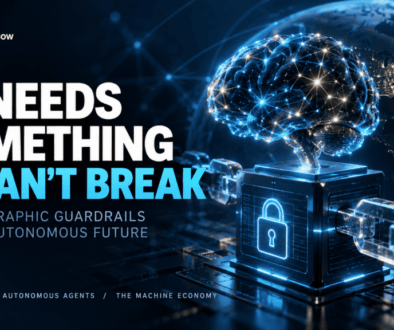
0G’s answer is a full-stack decentralized AI infrastructure — not just a blockchain, but a layered architecture combining a storage network, a distributed compute network, an AI safety layer, and a service marketplace. The core privacy mechanism relies on Trusted Execution Environments (TEEs) — physical hardware on graphics cards that cryptographically enforces data privacy during computation. Once a job is complete, a verifiable entry is written to the blockchain.
Any user — not just enterprises — can contribute GPU resources to the network, earning from it while powering a permissionless AI ecosystem. The modular design also means other blockchains, including Ethereum and Solana-based projects, can plug into 0G’s storage, compute, and safety components independently.
Key Updates From Consensus 2026
- New fine-tuned model released showing a 20–30% benchmark improvement over base Qwen 3.6, achieved through targeted retraining.
- Two research papers accepted to ICML, covering agent-to-agent interactions, decentralized compute, and AI safety.
- Apollo Accelerator launched in partnership with Stanford and the Blockchain Builders Association, funding projects from DeFi liquidity layers to AI applications.
- app.0g.ai vibe coding app went live; burned over 4 billion tokens in its first three weeks.
- Gas AI browser plugin (running OpenClaw on Chrome) is live with thousands of early users after just a few weeks.
- X402 payment protocol integration underway, enabling AI agents to handle on-chain payments autonomously.
The Killer App Question: Onboarding Without the Pain
The elephant in the room for any blockchain-based product remains user experience. Wallets, gas fees, and unfamiliar token currencies create friction that keeps mainstream users on centralized platforms. Michael acknowledged this honestly — but outlined a clear path forward: abstraction via AI agents and seamless payment layers that hide blockchain complexity entirely.
The parallel to ChatGPT’s App Store moment wasn’t lost on him. OpenAI spent seven years building before their inflection point. 0G is only three years in. The gap between open-source models and state-of-the-art proprietary ones — currently roughly three months — is closing, and the team believes it will be narrow enough to matter for most use cases soon.
AI Agents, X402, and the Future of Autonomous Commerce
One of the most forward-looking threads in the conversation was agentic AI commerce. The X402 payment protocol is designed specifically for AI agents to transact on-chain — paying for services, data, and compute autonomously without human sign-off on every transaction. Michael put the current scale in perspective: stablecoin transaction volume last year hit $33 trillion; X402 has processed around $600 million — a fraction of a percent, but a foothold in what the team believes will be the dominant transaction type on blockchains within five years.
The trust problem is front and center here too. “Do you really want your agent to hold your private keys and have access to all your wealth right now?” Michael asked rhetorically. The answer, for most users, is no — which is exactly why the blockchain truth and safety layer isn’t just a nice-to-have, but the foundational prerequisite for the agentic economy to exist at all.
Follow 0G Labs’ updates at hub.0g.ai and on X at @0G_Labs. Try the vibe coding app live at app.0g.ai.
Recorded live on the Consensus 2026 floor · Miami, FL · May 2026 · Crypto Coin Show Exclusive