Washington tightens EV market access as geopolitical tensions fuel global demand
The U.S. Commerce Department’s denial of market authorization to Swedish EV maker Polestar, owned by Chinese automaker Geely, marks the first major enforcement action under the Connected Vehicle Rule, a sweeping national security measure that bans foreign software and hardware deemed controlled by China or Russia from new vehicles sold domestically. For institutional investors, the decision signals that Washington is prepared to enforce its automotive supply chain restrictions selectively and case-by-case, creating material risk for companies with complex foreign ownership structures while offering potential competitive advantages to authorized players like Volvo.
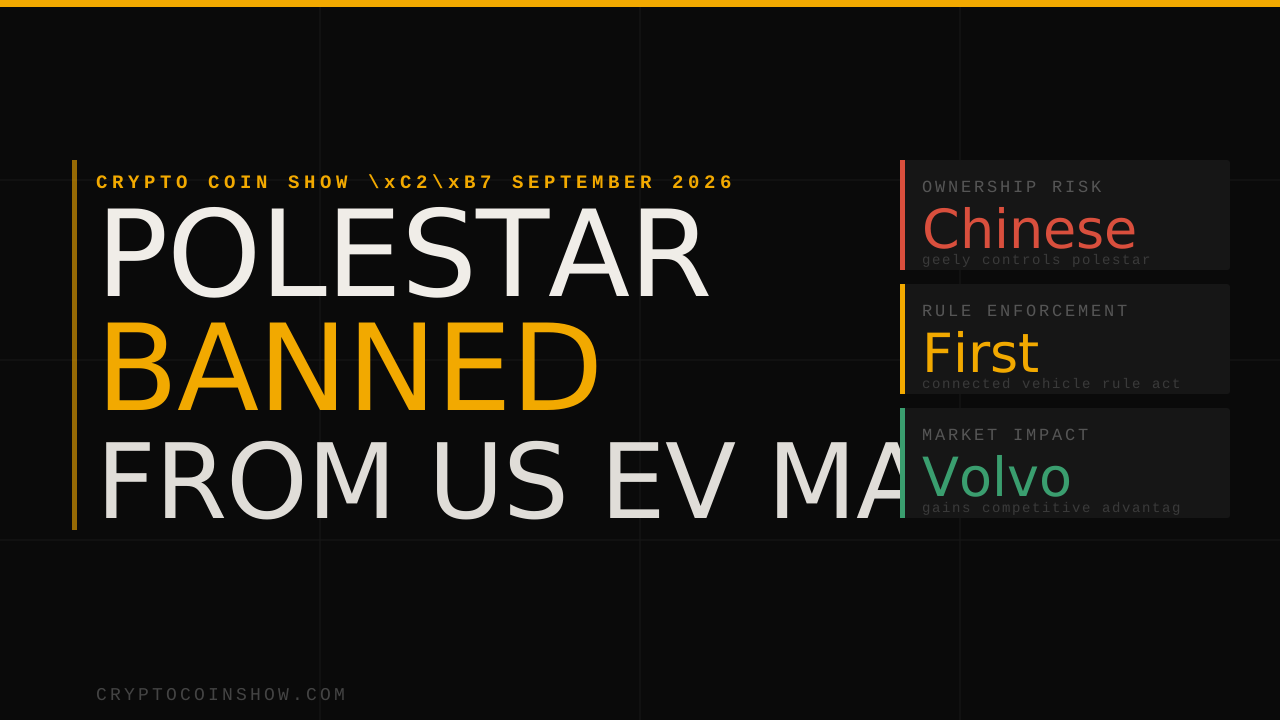
- Polestar, Geely-owned Swedish EV maker, lost U.S. sales authorization under Connected Vehicle Rule; stock fell 13 percent.
- Volvo received waiver from same rule through Commerce Department discussions on governance and data security standards.
- Global EV market share hit record 26.1 percent, driven partly by geopolitical tensions and oil price volatility.
- 13% Polestar share price decline following Commerce Department authorization denial announcement
- 26.1% Global EV sales share, highest on record excluding September 2025 tax-credit surge
- 3.4 pp Increase in EV market share since February geopolitical tensions over Iran conflict
Polestar announced it will cease U.S. vehicle sales after the Commerce Department declined to grant authorization under the Connected Vehicle Rule, a regulatory framework designed to protect national security by restricting foreign-controlled technology in connected automobiles.
The ban prevents the company from advertising or selling its 2027 model-year vehicles in the American market, effective immediately. Shares fell more than 13 percent by midday trading, reflecting investor concern over the loss of a major market for the Stockholm-based subsidiary of Chinese parent company Geely.
The Connected Vehicle Rule operates through a dual-timeline enforcement mechanism targeting both software and hardware. Beginning with the 2027 model year, all vehicle software controlled by Chinese or Russian entities is prohibited; the hardware restriction follows in 2030.
The rule was established on the premise that connected vehicles transmit sensitive data, location, driving patterns, and infrastructure information, that could pose national security risks if routed through or controlled by adversarial nations.
Polestar Blocked While Volvo Receives Waiver Under Same National Security Rule
The authorization denial creates an unusual competitive dynamic within Geely’s portfolio. Polestar and Volvo manufacture the Polestar 3 in a shared factory, both operating under the same parent company’s ownership structure, yet only Volvo secured Commerce Department approval to continue U.S. sales.
Volvo’s waiver, announced in May, followed what the company described as “constructive discussions” with the Commerce Department and other U.S. officials regarding governance frameworks, technology architecture, and data security protocols.
The process is carried out on a case-by-case basis and the issuance of a specific authorization follows constructive discussions with the US Department of Commerce and other US officials regarding Volvo Cars’ governance, technology and data security.
Volvo Cars, company statement
The case-by-case approval structure signals that Commerce Department officials evaluated both companies’ corporate governance, operational independence, and data handling procedures rather than applying a blanket rule based on Geely’s Chinese ownership alone.
Polestar’s failure to secure equivalent clearance suggests the company either could not demonstrate sufficient operational separation from Chinese control or did not satisfy data security requirements under departmental review.
Polestar plans to phase out U.S. operations and redirect resources to European markets, where regulatory frameworks differ substantially from American national security mandates.
Record Global EV Adoption Accelerates Amid Oil Price Volatility and Geopolitical Risk
Polestar’s U.S. market exit arrives during a period of unprecedented electric vehicle adoption worldwide. Global EV market share reached 26.1 percent in recent months, the highest level on record outside of a September 2025 anomaly driven by U.S. federal tax credit expiration, according to Goldman Sachs analysis.
The surge reflects both consumer response to oil price volatility and sustained policy incentives favoring electrification across major economies.
A brief closure of the Strait of Hormuz, a critical chokepoint for global crude oil shipments, triggered crude price increases that have persisted in consumer behavior even after the strait reopened and prices retreated to pre-conflict levels. Goldman Sachs data indicates EV market share climbed 3.4 percentage points following February geopolitical tensions involving the U.S., Israel, and Iran.
China recorded the largest absolute gain, but 12 of the 15 largest EV markets expanded their electric vehicle share during the same period.
South Korea represents the sole significant exception to the global expansion trend, though the decline reflects an earlier spike tied to local federal tax incentives rather than weakening demand fundamentals.
The persistence of elevated EV adoption despite oil price normalization suggests geopolitical risk has altered long-term consumer expectations about fuel security and transportation resilience.
U.S. Trade Enforcement Strategy Creates Uncertainty for Foreign Automakers with Chinese Ties
The Polestar authorization denial establishes practical enforcement of restrictions that have existed in regulatory form since the Connected Vehicle Rule’s adoption. Prior to this decision, the rule remained largely theoretical for the automotive sector, with no major manufacturer having lost market access.
The Commerce Department’s willingness to deny Polestar while granting Volvo conditional approval suggests officials possess detailed operational criteria for distinguishing between acceptable and prohibited foreign technology integration.
For institutional investors in global automotive supply chains, the decision introduces material regulatory risk for any EV manufacturer with Chinese or Russian ownership stakes that cannot establish clear operational independence and data governance separation.
The approval process’s opacity creates strategic uncertainty. Volvo’s disclosure that authorization followed “constructive discussions” but lacked detailed public explanation of what specific governance measures satisfied Commerce Department requirements leaves other manufacturers without clear benchmarks for compliance.
Companies with foreign ownership structures face mounting pressure to either restructure corporate governance, relocate sensitive technology operations, or accept exclusion from the U.S. market, currently the world’s second-largest EV market by absolute units sold.
Institutional Impact: Market Access Restrictions Create Winners and Losers in Competing EV Ecosystems
The outcome benefits domestically-controlled EV manufacturers and those with pre-established compliance frameworks, while penalizing companies that assumed ownership structure alone would not trigger enforcement. Tesla, General Motors, Ford, and other U.S.-based producers gain competitive advantage through unrestricted market access and unencumbered data architecture.
European manufacturers like Volvo that successfully navigated the authorization process secure protected market position against competitors from jurisdictions subject to the ban.
Polestar’s exit removes approximately 15,000 to 20,000 annual U.S. sales capacity from the market, a modest figure relative to total EV volumes but strategically significant as proof-of-concept that the Commerce Department will enforce the rule against even legacy automotive brands with strong market positions.
The company’s pivot toward Europe reflects rational capital allocation, as the continent has not implemented equivalent national security restrictions on Chinese automotive technology.
The critical open question for institutional investors concerns enforcement scope: whether the Commerce Department will expand the Connected Vehicle Rule to additional manufacturers or specific vehicle platforms, and whether other Geely-owned brands beyond Polestar, including Geometry, Zeekr, or Volvo subsidiaries, face similar authorization reviews. The May approval of Volvo’s waiver application remains the only publicly disclosed successful authorization under this framework, leaving the standards for future approvals undefined and vulnerable to political shifts in trade enforcement priorities.
Original reporting: cryptopolitan.com