Editorial Summary
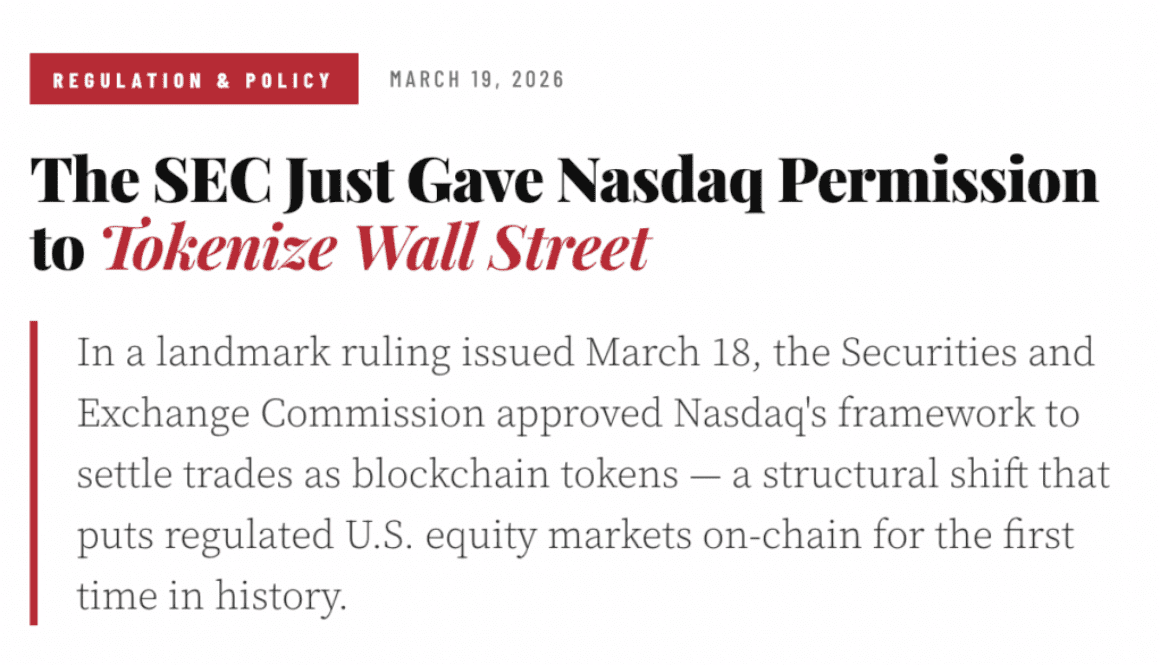
The SEC’s approval of Nasdaq’s tokenized securities trading framework represents a watershed moment for institutional adoption of blockchain infrastructure in equity markets. This regulatory green light, following a rigorous seven-month review process, establishes the first major U.S. stock exchange pathway for digital asset trading while maintaining full compliance with federal securities laws—signaling that mainstream financial institutions now have a clear, regulated route to tokenization deployment.
On Wednesday, the U.S. Securities and Exchange Commission granted final approval to significant rule amendments enabling Nasdaq, one of the world’s largest stock exchanges, to facilitate trading in tokenized securities. The decision culminates a comprehensive seven-month regulatory assessment that commenced in September 2025 and incorporated extensive modifications designed to ensure adherence to federal securities statutes and stringent investor protection standards. Tokenized securities represent blockchain-based digital representations of traditional financial instruments—equities, fixed-income securities, or investment funds—where ownership rights and claims are encoded as distributed ledger tokens. Industry advocates contend that tokenization infrastructure enables continuous market operations beyond traditional trading hours, substantially accelerates settlement cycles, and permits fractional ownership arrangements, thereby modernizing fundamental components of market infrastructure that have historically depended on legacy technology systems. The SEC’s approval establishes Nasdaq’s authorized pilot initiative operating in direct coordination with the Depository Trust Company (DTC), furnishing market participants with a comprehensively regulated institutional pathway for executing transactions in these digitally-represented securities while maintaining custodial and clearing standards consistent with existing market infrastructure.
Nasdaq’s Regulatory Framework and DTC Integration
The SEC’s seven-month technical review of Nasdaq’s proposed rule modifications examined compliance architecture, investor safeguards, and operational resilience across the tokenization lifecycle. The regulatory assessment focused particularly on how tokenized instruments would interface with the Depository Trust Company’s existing clearing and settlement infrastructure, ensuring that blockchain-based trading could operate within the established regulatory perimeter without creating novel systemic risks or circumventing investor protection requirements. By conditioning approval on direct DTC coordination, the SEC preserved the institutional settlement infrastructure that undergirds U.S. equity markets while simultaneously authorizing the technological modernization that tokenization proponents have advocated. This hybrid approach—combining distributed ledger innovation with centralized custodial safeguards—represents a pragmatic regulatory framework that addresses institutional investor concerns regarding operational risk, regulatory clarity, and asset custody standards.
The approved pilot structure establishes explicit compliance pathways that tokenized securities must traverse before reaching Nasdaq’s trading environment. Issuers seeking to tokenize equity or debt instruments must conform to SEC disclosure requirements, corporate governance standards, and shareholder communication protocols established under existing securities regulations. The tokenization process itself—converting ownership claims into blockchain-native digital representations—must preserve all legal rights and economic entitlements attached to the underlying instruments. Nasdaq’s framework specifies that token holders retain identical claim priorities, dividend participation rights, and voting privileges as shareholders of traditionally-issued securities. This structural preservation of investor rights distinguishes the SEC-approved framework from speculative tokenization experiments that have operated outside regulatory jurisdiction, where token holders often lack clearly-defined legal remedies or enforceable ownership claims.
The DTC coordination mandate represents particularly significant infrastructure development. The DTC, operating as the primary clearinghouse for U.S. securities transactions, will integrate tokenized instruments into its existing risk management, custody, and reconciliation systems. This integration ensures that tokenized equities clearing through Nasdaq will benefit from the same settlement finality, counterparty protections, and regulatory oversight that institutional investors expect from traditional equity transactions. Market participants utilizing the approved trading pathway gain access to DTC’s insurance protections, its immobilization safeguards, and its role as custodian of last resort—critical institutional infrastructure elements that venture-backed tokenization platforms operating outside regulatory frameworks cannot replicate.
Cross-Border Institutional Connectivity and Emerging Partnerships
The SEC’s approval catalyzes a series of institutional initiatives that extend tokenized securities infrastructure beyond Nasdaq’s U.S. trading venue into international settlement systems and permissionless DeFi networks. Earlier this month, Payward Ecosystem—the parent holding company of cryptocurrency exchange Kraken—announced a formal partnership with Nasdaq designed to construct an equities transformation gateway that bridges regulated market infrastructure with decentralized finance protocols. The collaboration pairs Nasdaq’s established institutional trading systems, regulatory credentials, and market surveillance capabilities with Kraken’s xStocks framework, which provides technological pathways for tokenized equities to migrate seamlessly between permissioned institutional environments and permissionless decentralized networks. This architectural design addresses a longstanding institutional concern: how to extend tokenized securities into DeFi liquidity pools and lending protocols while maintaining issuer control, regulatory compliance, and protection of shareholder rights.
Nasdaq has articulated explicit design standards for its equity token representation, emphasizing that the tokenization process must preserve issuer governance authority, maintain compatibility with existing regulatory frameworks, and protect shareholders’ traditional claim rights. These specifications distinguish Nasdaq’s approach from alternative tokenization protocols that emphasize technological innovation without guaranteeing legal enforceability or regulatory compliance. By linking tokenized equities to Nasdaq’s corporate action processing systems, issuers can execute dividend distributions, capital restructurings, and shareholder votes through token-based mechanisms that integrate with established corporate finance infrastructure. The framework enables institutional investors to participate in corporate actions through smart contract automation while maintaining the legal formality and regulatory documentation that institutions require.
Concurrently, Nasdaq disclosed a partnership arrangement with Boerse Stuttgart Group’s tokenized securities settlement platform, Seturion, establishing technological and operational connections between Nasdaq’s U.S. trading venue and European settlement infrastructure specifically engineered for tokenized instruments. This transatlantic initiative demonstrates that tokenization standardization is advancing across major institutional markets simultaneously, with European and North American exchanges converging on compatible technical specifications and regulatory compliance frameworks. The Seturion partnership extends Nasdaq’s approved tokenization pathway into European equities markets, potentially enabling cross-border institutional trading of tokenized securities across regulated venues operating under compatible risk management and custody standards.
Institutional Adoption Implications and Market Evolution
The SEC’s approval creates decisive competitive incentives for other major U.S. stock exchanges to develop comparable tokenized securities trading capabilities. Market participants seeking execution venues for tokenized instruments will initially concentrate activity on Nasdaq, DTC-affiliated platforms, and established institutional infrastructure providers. This concentration effect may accelerate adoption among institutional asset managers, broker-dealers, and custodians evaluating tokenization’s operational efficiency gains. Institutions implementing tokenized securities trading gain access to continuous global market liquidity, accelerated settlement cycles reducing working capital requirements, and fractional ownership capabilities that expand the investor base for high-value equities. For asset managers overseeing substantial positions in individual securities, tokenization enables position segmentation across multiple institutional investors without the corporate action complexity and transaction costs that traditional fractional share mechanisms impose.
The regulatory framework established through Nasdaq’s approval also clarifies the institutional pathway for future tokenization initiatives across asset classes. Commodity exchanges, fixed-income trading venues, and derivatives platforms can reference Nasdaq’s compliance architecture and DTC integration model when designing their own tokenized instruments frameworks. Regulators at the SEC and CFTC gain operational experience observing how tokenized securities perform under real market conditions, enabling future regulatory guidance to incorporate practical knowledge about blockchain infrastructure resilience, custody safeguards, and market surveillance methodologies. This learning cycle—combining regulatory approval with operational market experience—creates a sustainable foundation for expanding tokenization across U.S. financial markets rather than relying on speculation or untested technological assumptions.
Looking forward, the convergence of Nasdaq’s approved trading framework, Payward’s DeFi connectivity initiatives, and Boerse Stuttgart’s European settlement infrastructure suggests that tokenized securities will progressively migrate from regulatory pilots toward mainstream institutional trading activity. Institutional investors evaluating tokenization adoption face materially reduced regulatory and operational uncertainty following the SEC’s approval, enabling finance teams to allocate capital toward technology infrastructure integration and operational process redesign. The approved framework does not eliminate all tokenization complexities—issuers must still navigate corporate governance questions, shareholders must understand digital custody mechanisms, and market participants must adapt to token-based settlement—but the regulatory clarity provided by the SEC’s decision substantially accelerates institutional adoption timelines. As tokenized securities gain institutional market share, traditional settlement infrastructure and legacy trading systems will face competitive pressure to modernize, potentially catalyzing a multi-decade transition toward blockchain-native financial market infrastructure that operates with greater efficiency and transparency than existing centralized systems.