
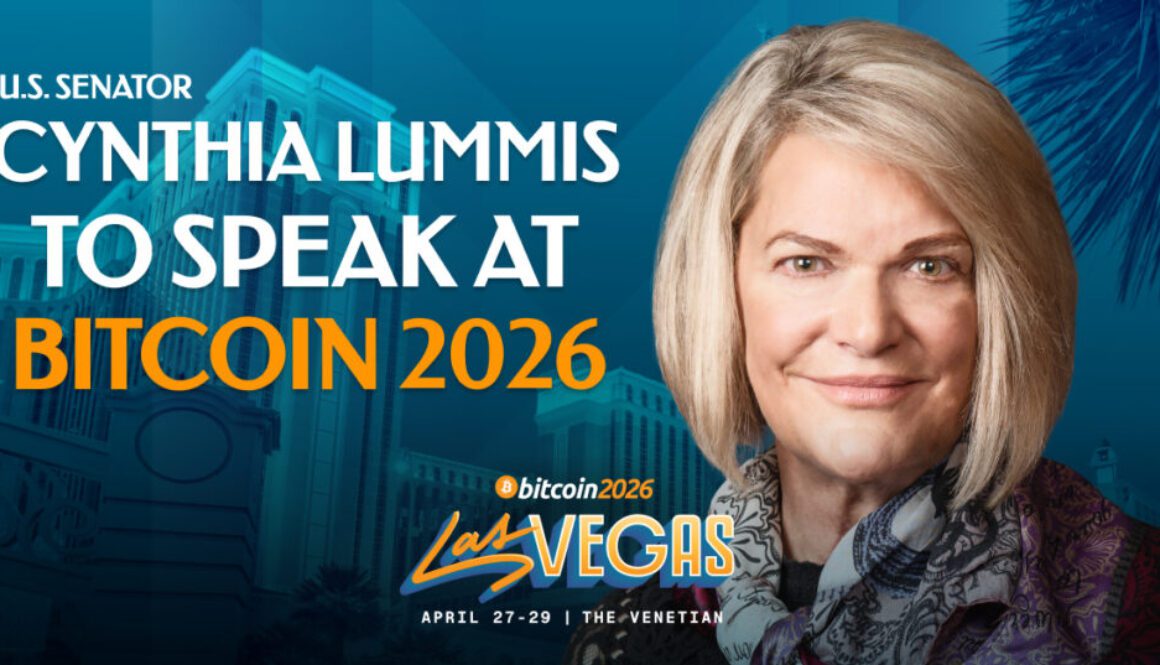
U.S. Senator Cynthia Lummis Confirmed As A Bitcoin 2026 Speaker
U.S. Senator Cynthia Lummis of Wyoming has been confirmed as a keynote speaker at Bitcoin 2026, the industry’s flagship annual conference scheduled for late April in Las Vegas. The announcement underscores the growing intersection of legislative action and cryptocurrency policy at the highest levels of American government, with Lummis positioned as one of the most active lawmakers advancing digital asset regulation on Capitol Hill.
A Senator Shaped by Conviction and Long-Term Commitment
Lummis brings considerable credibility to the digital assets conversation based on both personal conviction and institutional authority. She has held Bitcoin in her own portfolio since 2013, making her one of the few sitting senators with a documented, long-term exposure to the asset class. In January 2025, leadership appointed her to chair the Senate Banking Subcommittee on Digital Assets—a newly elevated position that reflects growing congressional recognition of crypto’s importance to financial regulation and innovation policy.
Throughout her Senate tenure, Lummis has consistently positioned herself as an architect rather than merely a commentator on digital asset rules. Her work has focused on creating coherent legislative pathways for blockchain technology and cryptocurrencies to operate within the American regulatory system, rather than at odds with it.
I’m a big proponent of self-custody, of individual wallets, of the sovereignty I have to store my wealth.
— U.S. Senator Cynthia Lummis
Lummis announced in December 2025 that she will not seek reelection in 2026, making her Bitcoin 2026 appearance a significant moment during the final chapter of her Senate service while major legislation she has championed remains in motion through Congress.
The BITCOIN Act and Strategic Reserve Framework
The cornerstone of Lummis’s legislative agenda is the BITCOIN Act—formally known as the Boosting Innovation, Technology, and Competitiveness through Optimized Investment Nationwide Act. The proposal represents an ambitious reimagining of how the United States government might interact with Bitcoin as a strategic asset.
Under the BITCOIN Act framework, the U.S. Treasury would be authorized to accumulate up to one million Bitcoin over a five-year acquisition period. The legislation includes a mandatory 20-year holding requirement, preventing rapid liquidation and signaling a long-term institutional commitment to the asset. The bill also mandates quarterly public reporting through proof-of-reserves mechanisms, ensuring transparency and accountability throughout the accumulation and holding phases.
This approach differs fundamentally from treating Bitcoin as a speculative investment or short-term revenue source. Instead, it positions Bitcoin acquisition as a deliberate policy choice aligned with sovereign wealth management—comparable to how nations maintain strategic petroleum reserves or gold holdings. The multi-year timeline and extended holding period reflect a patient capital philosophy that prioritizes institutional stability over market timing.
Market Implications of Strategic Bitcoin Accumulation
The adoption of a BITCOIN Act would carry profound implications for global cryptocurrency markets and U.S. fiscal policy. Current Bitcoin supply stands at approximately 21 million coins, with institutional and governmental holdings representing a small fraction of the total circulating supply. A U.S. government acquisition of one million Bitcoin—roughly 4.8% of all Bitcoin that will ever exist—would represent the single largest institutional accumulation in digital asset history.
From a market perspective, such sustained, government-mandated purchasing over five years would likely create baseline demand that could influence price discovery mechanisms. Market analysts have modeled scenarios in which a strategic reserve announcement alone could shift investor behavior, as the mere signal of long-term institutional commitment often precedes actual capital deployment. The quarterly reporting requirements further amplify this dynamic by creating scheduled transparency events that markets can anticipate.
For international relations, a U.S. strategic Bitcoin reserve would also reshape geopolitical narratives around digital assets. Several nations—including El Salvador and more recently proposals from Argentina and other economies—have explored Bitcoin integration into their monetary systems. U.S. institutional adoption at the sovereign level would likely accelerate similar explorations globally, particularly among allies seeking to align with American financial infrastructure standards.
In addition to the BITCOIN Act, Lummis co-sponsored the 2025 GENIUS Act focused on stablecoin regulation and introduced separate legislation creating tax exemptions for small Bitcoin transactions. She has also predicted that a comprehensive crypto market structure bill should advance from the Senate Banking Committee by late April 2026, indicating that necessary policy compromises have been reached.
Broader Digital Asset Regulation Agenda
Lummis’s portfolio extends well beyond Bitcoin strategy. She has positioned herself at the center of multiple parallel regulatory conversations shaping how American law treats digital assets more broadly. Her co-sponsorship of stablecoin regulation demonstrates engagement with the intersection of cryptocurrency markets and traditional financial stability concerns.
Tax policy has emerged as another active area. In February 2026, Lummis pressed Treasury Secretary Scott Bessent on de minimis exemptions—a technical but consequential provision that would waive tax reporting requirements on small Bitcoin transactions. Rather than dismissing the concern, Bessent committed to having Treasury’s Office of Tax Policy collaborate with her team on implementing guidance. This exchange demonstrates how technical tax questions increasingly require specialized expertise and legislative-executive collaboration.
The convergence of multiple bills—BITCOIN Act, CLARITY Act, and stablecoin regulation—all moving through Congress simultaneously under her leadership suggests that 2026 represents a critical inflection point for American digital asset policy. Few lawmakers have maintained this level of sustained legislative momentum on crypto issues, combining vision with operational capability.
Industry Evolution and Regulatory Framework Maturation
The cryptocurrency industry has undergone significant structural transformation over the past decade, evolving from a niche technological pursuit to a multi-trillion-dollar asset class with institutional participation from traditional finance. This transition has created regulatory urgency—policymakers recognize that clear frameworks are necessary both to protect consumers and to enable legitimate innovation.
Lummis’s multi-pronged legislative approach reflects this maturation. Rather than pursuing a single omnibus bill, she has strategically developed separate legislation addressing distinct market segments: Bitcoin as a reserve asset (BITCOIN Act), stablecoins as payment infrastructure (GENIUS Act), and transactional tax efficiency (de minimis exemptions). This modular approach allows for more targeted problem-solving and reduces the legislative surface area for opposition.
Internationally, regulatory jurisdictions including the European Union (through MiCA), Switzerland, and Singapore have already established comprehensive digital asset frameworks. The United States has lagged in creating a unified regulatory architecture, instead relying on overlapping jurisdiction among the SEC, CFTC, OCC, and FinCEN. Lummis’s legislative initiatives aim to reduce this regulatory fragmentation by clarifying which agencies hold primary authority over specific asset classes and use cases.
With the BITCOIN Act, the CLARITY Act, and stablecoin regulation all in motion simultaneously, her appearance in Las Vegas this April promises to be one of the most substantive policy conversations of the event.
— Crypto Coin Show Analysis
Bitcoin 2026: The Convergence Point
Bitcoin 2026 runs April 27–29 at The Venetian in Las Vegas, positioning itself as the year’s definitive gathering for the industry. Lummis’s confirmed participation carries special weight given the legislative timeline. She will address an audience deeply invested in policy outcomes that her committee and bills directly shape.
For an industry that has historically existed in regulatory ambiguity, having a sitting Senate subcommittee chair actively engaged in policy architecture and willing to defend digital asset innovation on a public stage signals a maturation of the conversation. Her appearance is not merely ceremonial; it reflects genuine policy momentum backed by legislative action and institutional authority.
The timing also carries significance. With Lummis declining to seek reelection, this represents one of her final opportunities to shape the narrative and rally support for her legislative agenda before her Senate tenure concludes. For Bitcoin 2026 attendees, her remarks will likely synthesize her vision for how digital assets can be responsibly integrated into American financial infrastructure while maintaining innovation incentives.
Implications for the Crypto Industry and Beyond
The convergence of Lummis’s legislative activity and her Bitcoin 2026 keynote presents a unique moment for the cryptocurrency industry. Regulatory clarity has long been identified as one of the primary obstacles to mainstream institutional adoption and retail confidence. Lummis’s work—particularly the BITCOIN Act and comprehensive market structure proposals—directly addresses this gap.
For Bitcoin specifically, a strategic reserve at the federal level would fundamentally alter its regulatory and market status. Rather than existing primarily as a speculative asset or alternative currency, Bitcoin would become integrated into American fiscal policy as a recognized reserve asset. This classification carries significant downstream effects for how financial institutions price, hold, and promote Bitcoin to their clients.
The stablecoin and broader digital asset regulation simultaneously underway creates conditions for expanded institutional participation across the entire cryptocurrency ecosystem. Clearer rules around tokenized assets, smart contracts, and decentralized finance (DeFi) protocols could unlock hundreds of billions in capital currently sidelined due to regulatory uncertainty. International coordination on these standards—particularly alignment with EU frameworks—would accelerate this capital deployment.
The digital asset community has invested considerable political capital in supporting lawmakers who engage constructively with blockchain technology and cryptocurrency. Lummis’s sustained effort—driven by personal conviction, institutional position, and legislative action—represents one of the more credible bridges between the crypto industry and Washington policymaking. Her Bitcoin 2026 keynote will likely crystallize the current state of this bridge and preview the direction of future regulatory developments.
Get weekly blockchain insights via the CCS Insider newsletter.