
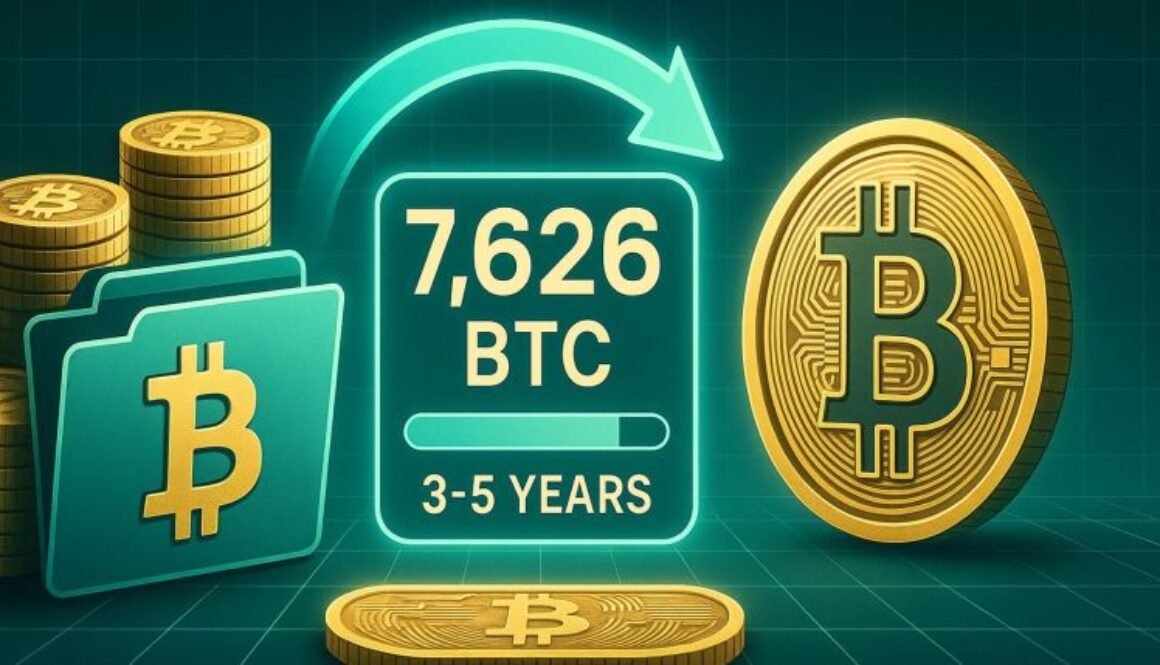
Old Bitcoin Supply Unlocks: 7,626 BTC Aged 3–5 Years Moves Onchain
Bitcoin has retreated more than 9% from its $124,500 all-time high, testing investor resolve as older cryptocurrency holdings enter the market at an accelerating pace. The movement of dormant bitcoin supply—particularly 7,626 BTC aged between three and five years—signals a structural shift in how long-term holders are managing their positions, raising questions about whether institutional demand through ETFs can absorb the incoming supply without triggering a sharper correction.
The Supply Rotation Phenomenon
Long-dormant Bitcoin holdings are moving onchain at a scale that warrants close attention. When coins remain stationary for years, their eventual movement typically indicates strategic decisions by holders who accumulated during earlier market cycles—often at substantially lower prices than current levels.
Analyst Maartunn has identified what he describes as a “major Bitcoin reshuffle,” characterized by three distinct waves of old supply flowing toward exchange-traded fund wallets: summer 2024, fall 2024, and summer 2025. This pattern represents a departure from historical precedent. In previous cycles, such redistribution episodes typically occurred once before subsiding. The repetition of this cycle suggests a more fundamental change in how Bitcoin’s supply is being distributed and held.
Old coins are increasingly flowing into ETF wallets, a phenomenon marked by three significant waves that shows a repeated pattern unlike previous cycles.
— Maartunn, Analyst
This ongoing rotation reflects the divergence between different market participants. Long-term holders appear to be gradually reducing their exposure, whether to lock in gains, rebalance portfolios, or hedge against uncertainty. Simultaneously, institutional investors accessing Bitcoin through regulated ETF structures continue to accumulate supply.
7,626 BTC aged 3–5 years has recently moved onchain, signaling supply redistribution from long-term holders.
The ETF Revolution and Market Structure Transformation
The approval and rapid growth of spot Bitcoin ETFs represents one of the most significant developments in cryptocurrency history. Since their inception in early 2024, these instruments have fundamentally altered the mechanics of Bitcoin price discovery. Traditional asset managers, pension funds, and wealth advisors now have regulatory clarity and tax efficiency to recommend Bitcoin exposure to their clients—a threshold that was absent in previous market cycles.
The implications extend beyond simple capital allocation. ETF structures create persistent, institutional-grade demand channels that operate independently of retail sentiment cycles. Unlike previous waves of adoption that relied heavily on individual investor enthusiasm and risk appetite, today’s institutional participation provides a more stable foundation for price discovery. However, this stability comes with dependency—when ETF inflows slow or reverse, the cushioning effect diminishes rapidly.
Industry data indicates that Bitcoin ETFs have accumulated over 600,000 BTC in total holdings since approval, representing approximately 3% of circulating supply. This concentration of ownership within regulated vehicles means that ETF fund flows have become the primary driver of institutional demand absorption. For Bitcoin to sustain price levels above $110,000, these vehicles must continue attracting capital flows that match or exceed the supply entering the market from long-term holder liquidations.
Price Support and Institutional Absorption
Despite the influx of older supply, Bitcoin has demonstrated resilience by maintaining levels above $110,000. The $105,000 zone has emerged as a meaningful support level, preventing a more severe pullback. This stability suggests that demand is meeting supply at current price levels, though the sustainability of that balance remains uncertain.
ETF inflows appear to be playing a stabilizing role. These regulated investment vehicles function as predictable demand channels, channeling institutional capital into Bitcoin through structures that appeal to traditional asset managers and pension funds. Without this institutional participation, the selling pressure from newly unlocked coins would likely have forced prices materially lower.
However, this dependency carries risk. If ETF inflows decelerate or reverse, the incoming supply from long-term holder profit-taking could overwhelm available demand. Recent Bitcoin purchasers would then face the prospect of defending lower support levels as momentum shifts.
Bitcoin has held above $110,000 despite profit-taking from long-term holders, suggesting institutional buyers are absorbing supply at current price levels.
Market Implications and Industry Context
The cryptocurrency derivatives and spot market have matured significantly, with daily trading volumes now regularly exceeding $50 billion across major venues. This liquidity provides structural support for price discovery, but it also amplifies the importance of directional capital flows. When institutional money enters the market through ETFs, it moves the needle meaningfully. When that capital pauses or redirects to alternative assets, the market must recalibrate.
For the broader cryptocurrency industry, the current supply rotation carries meaningful implications. Bitcoin’s price stability at elevated levels normalizes cryptocurrency as an asset class worthy of institutional inclusion. Successful absorption of long-term holder supply without triggering a crash validates the argument that Bitcoin has graduated from speculative asset to mature store of value. Conversely, a failed absorption—resulting in a sharp correction—would raise questions about price sustainability and institutional demand durability at current valuations.
The backdrop of macroeconomic uncertainty adds another layer. With global central banks managing inflation concerns and interest rate environments in flux, Bitcoin’s positioning as a non-correlated asset has become increasingly relevant to institutional portfolios. If economic conditions deteriorate, traditional assets may underperform, which could either accelerate institutional Bitcoin demand or trigger a broad risk-off rotation that includes cryptocurrencies. The direction matters significantly for how ETFs respond to future supply waves.
A Cycle Unlike Previous Ones
The current Bitcoin market structure differs meaningfully from cycles before ETF approval. In earlier periods, supply redistribution typically occurred during sharp corrections, when older holders capitulated amid price weakness. The current pattern—repeated waves of supply flowing into institutional vehicles while prices remain elevated—suggests a more orderly, persistent transition.
Cryptocurrency pricing action reflects this tension. Bulls point to Bitcoin’s ability to absorb substantial selling pressure without breaking critical support levels. Bears counter that the repeated waves of old supply could eventually overwhelm institutional demand, triggering the deeper correction needed to reset overheated sentiment.
The distinction matters for positioning. If this supply rotation is gradual and orderly—with ETFs consistently absorbing coins from long-term holders—the market could stabilize at higher levels without a significant drawdown. If, conversely, ETF demand weakens before the supply rotation completes, Bitcoin could face pressure toward the $105,000 support zone or potentially below it.
ETF participation and repeated redistribution of old coins are reshaping the market structure in ways that differ from previous Bitcoin cycles.
— Market Analysis, Crypto Coin Show
Entity Background and Regulatory Environment
The major Bitcoin ETF providers—including Blackrock, Fidelity, and other institutional asset managers—have collectively established themselves as credible stewards of cryptocurrency assets. This institutional credibility matters. Their presence in the Bitcoin market signals to pension funds, insurance companies, and wealth advisors that Bitcoin custody, pricing, and regulatory compliance have achieved institutional standards. This normalization has compressed the risk premium previously associated with Bitcoin exposure, allowing larger capital pools to consider allocation decisions that would have been unthinkable in earlier cycles.
Regulatory clarity has improved substantially. The SEC’s approval of spot Bitcoin ETFs represented an acknowledgment that Bitcoin and cryptocurrency markets could operate within existing financial regulatory frameworks. While cryptocurrency regulation remains a work in progress globally, the establishment of clear ETF approval criteria in major markets has reduced tail-risk concerns that previously constrained institutional participation.
What Happens Next
The trajectory of Bitcoin over the coming weeks hinges on the relative strength of two forces: the consistency of institutional inflows through ETF channels versus the pace at which long-term holders elect to monetize their positions. Analysts remain divided on the likely outcome.
Some observers argue that the repeated waves of supply rotation represent a natural, healthy market process—old coins finding new institutional homes at a profit. Others warn that each wave of selling tests the floor beneath which significant panic could emerge.
For investors monitoring crypto market news, the key metrics to watch include ETF fund flows, the velocity at which additional old supply enters the market, and Bitcoin’s ability to hold the $105,000 support zone. These factors will determine whether the current reshuffle leads to consolidation at higher prices or triggers a retest of lower support levels before the next leg upward.
The current environment underscores how Bitcoin’s market structure has evolved. Where previous cycles relied primarily on retail sentiment and on-chain behavior, today’s price discovery increasingly depends on how institutional vehicles respond to supply events. Understanding this dynamic is essential for positioning through the volatility ahead. The success or failure of this supply absorption cycle will likely determine whether Bitcoin establishes a new baseline price range or retreats to test previous support levels, potentially reshaping market expectations for the remainder of the year.
Get weekly blockchain insights via the CCS Insider newsletter.