
LTC Price Soars 11% to $129: Analysts Eye $135 Breakout as ETF Approval Buzz Grows
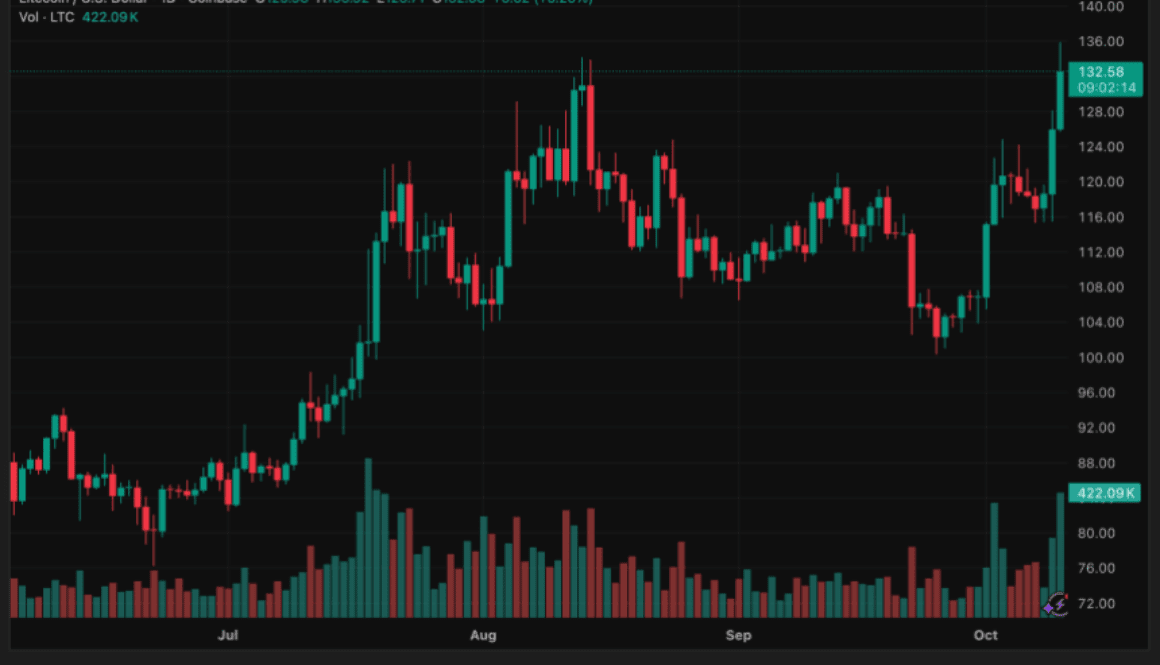
Litecoin surged 11% to trade between $129 and $131 this week, decisively outperforming Bitcoin and Ethereum as spot ETF approval momentum builds behind the altcoin. The rally coincided with a sharp spike in trading activity—volume climbed 143% to $1.66 billion while futures open interest jumped 25% to $1.21 billion, indicating fresh leverage entering the market and renewed conviction among traders on directional bets.
ETF Filing Progress Fuels Institutional Interest
The primary driver behind Litecoin’s recent strength appears to be accelerating confidence that a U.S.-regulated spot Litecoin ETF could be approved in the near term. Canary Capital’s updated S-1 filing now lists the ticker symbol LTCC and discloses a 0.95% management fee—granular details that experienced ETF watchers typically associate with the final stages before SEC sign-off.
Several issuers are actively pursuing Litecoin ETF products, including established names like Grayscale and CoinShares. Institutional observers note that Litecoin’s profile as a proof-of-work asset with a two-decade track record, combined with its positioning as digital silver to Bitcoin’s gold, makes it a comparatively straightforward candidate for regulatory approval once normal SEC operations resume following the government shutdown.
Litecoin’s commodity-like profile and long proof-of-work history make it one of the cleaner alternative candidates for regulated fund access once the SEC returns to full operations.
— Market Analysts
ETF approval would represent a watershed moment for Litecoin adoption, potentially opening the door for pension funds, endowments, and other institutional investors currently restricted from direct cryptocurrency holdings.
Trading volume spiked 143% to $1.66 billion. Futures open interest climbed 25% to $1.21 billion, signaling increased leverage positioning in the LTC market.
Litecoin’s Market Position and Industry Context
Litecoin, created by Charlie Lee in 2011 as a direct derivative of Bitcoin’s codebase, has maintained a consistent position within the top ten cryptocurrencies by market capitalization for over a decade. With a market cap currently hovering near $20 billion and a fixed supply of 84 million coins, Litecoin operates as the fourth-largest proof-of-work blockchain by network security and computational power committed to transaction validation.
The cryptocurrency’s layer-one network processes an average of 1.1 million daily active addresses and handles approximately $4.2 billion in weekly transaction volume. Unlike many speculative altcoins, Litecoin maintains genuine utility as a payment rail, with adoption among merchants increasing steadily since 2020. The network has successfully implemented Mimblewimble privacy upgrades and maintains institutional-grade infrastructure through leading exchange integrations and custody providers.
The broader altcoin market has historically experienced cyclical outperformance relative to Bitcoin during bull market phases when risk appetite increases and investors diversify beyond the flagship cryptocurrency. However, Litecoin’s current momentum stands apart because it stems from concrete regulatory progress rather than speculative sentiment alone. This distinction matters significantly for institutional capital allocation decisions.
Regulatory Landscape and Market Implications
The cryptocurrency ETF approval trajectory has accelerated dramatically since the Bitcoin spot ETF approvals in early 2024. That breakthrough established precedent, demonstrating that the SEC under current leadership recognizes properly structured cryptocurrency funds as viable investment vehicles for regulated advisors and institutions. The approval process for Bitcoin took years to resolve, but Ethereum spot ETFs received approval just months later, revealing a streamlined pathway once regulatory frameworks solidify.
Litecoin’s ETF candidacy benefits from this established precedent. Unlike newer cryptocurrencies lacking proven market maturity, Litecoin operates in a mature regulatory environment with established custody solutions, audited trading pairs, and transparent on-chain data. Financial advisors and compliance officers already possess decades of academic literature and market analysis evaluating Bitcoin and the monetary characteristics that apply equally to Litecoin’s underlying technology.
The market implications extend beyond simple price appreciation. A Litecoin spot ETF would likely trigger cascading institutional adoption across wealth management platforms, retirement accounts, and algorithmic portfolio rebalancing strategies. Historical precedent from Bitcoin and Ethereum ETF launches suggests initial inflows often exceed analyst projections, particularly when compliance officers perceive regulatory legitimacy as definitively established.
Industry analysts project that a successful Litecoin ETF launch could capture between 0.5% to 1.2% of allocated cryptocurrency assets from U.S. institutional portfolios within the first twelve months. Given institutional cryptocurrency allocations currently total approximately $160 billion, even conservative penetration assumptions suggest meaningful inflow potential.
Technical Setup Points to $135 Breakout
On the price charts, Litecoin has reclaimed critical technical ground. The token moved decisively above the $127.45 swing high and recaptured both its 7-day and 30-day simple moving averages, transforming what had been a resistance ceiling into support.
Momentum indicators remain constructive without showing extremes. The relative strength index sits at 68—strong but not yet in overbought territory. The MACD (moving average convergence divergence) remains firmly in positive territory, suggesting momentum has room to extend.
The next meaningful resistance cluster sits at $130 to $131. A confirmed daily close above that zone opens a clearer path to $134 to $135, followed by $138 as the subsequent target. Beyond that, analysts point to a broader price vacuum extending toward the $150 to $160 region, Litecoin’s highest traded levels since early 2022.
Immediate resistance: $130–$131. Secondary resistance: $134–$135. Extended target: $138–$150. Support floor: $125 (critical). Deeper support: $115–$118.
Some technical analysts tracking longer timeframes note that a confirmed breakout from a year-long diagonal pattern could preserve a stretch target toward $275 over coming months. That extended scenario would likely require sustained inflows tied to ETF approval and strong institutional demand.
Risk Factors and Invalidation Levels
While the near-term setup looks favorable for buyers, several macro headwinds could derail the rally. Government shutdown duration remains uncertain, potentially delaying SEC review timelines. Broader cryptocurrency risk appetite can shift quickly in response to macroeconomic data or Fed policy signals.
For momentum traders, the $125 level represents the critical line in the sand. A decisive break below that support could trigger swift profit-taking, potentially dragging Litecoin back into the $122 to $125 band. Further deterioration could test $115 to $118 as a deeper retest zone.
Hold above $125 and reclaim $130 with volume, and bulls keep control into $135–$138. A green light for the LTCC ETF could be the spark that extends the move toward $150–$160.
— Technical Analysts
As long as the $125 floor holds and $130 flips from resistance to support, the probability of reaching the $135 to $138 breakout zone remains solid. Conversely, any failure to hold $130 on intraday strength would suggest consolidation rather than sustained momentum.
Competitive Dynamics Within Layer-One Alternatives
Litecoin’s potential ETF approval occurs within a competitive landscape where other proof-of-work and proof-of-stake alternatives pursue similar regulatory pathways. Bitcoin Cash, Dogecoin, and newer layer-one platforms like Solana compete for institutional capital allocation. However, Litecoin’s specific advantages—two-decade network maturity, deep liquidity, established custody infrastructure, and Charlie Lee’s reputable stewardship—position it distinctly relative to comparable candidates.
The cryptocurrency industry has matured significantly since 2011. Today’s institutional capital demands not merely technological innovation, but proven resilience through market cycles, established governance models, and transparent community development. These characteristics play directly into Litecoin’s favor during SEC review processes.
What to Monitor Going Forward
Market participants should watch three key developments. First, SEC communications regarding ETF applications once government operations normalize. Second, Bitcoin and Ethereum price action, since broader crypto market sentiment still heavily influences altcoin performance. Third, futures positioning data to gauge whether leverage is building sustainably or approaching exhaustion.
The $130 level remains the pivotal price point. A sustained hold above $130 with volume confirmation would validate further upside toward $135 and beyond. An ETF approval announcement would likely serve as the catalyst needed to propel Litecoin toward the $150 to $160 resistance zone over the intermediate term.
For traders monitoring crypto market movements, the convergence of technical breakout potential and institutional approval tailwinds creates a notable setup. The key question is whether renewed institutional interest materializes or whether speculative positioning simply corrects lower from current levels.
Conclusion: Convergence of Regulatory and Technical Catalysts
Litecoin’s recent outperformance reflects something more substantive than typical altcoin volatility—it represents the market pricing a high-probability regulatory outcome alongside strong technical setup confirmation. The combination of established fundamentals, demonstrated network security, regulatory precedent from Bitcoin and Ethereum approvals, and detailed ETF filing progress creates a scenario where institutional capital flows become increasingly probable.
A successful spot Litecoin ETF launch would represent validation of the cryptocurrency industry’s maturation and institutional integration. For Litecoin specifically, approval would likely unlock trillions of dollars in addressable market capital currently inaccessible to fiduciaries and regulated investors. The current price momentum, while impressive, may represent merely the early stages of a more substantial institutional adoption cycle.
Traders and investors should distinguish between speculative momentum and structural market transformation. In Litecoin’s case, the current setup increasingly exhibits characteristics of the latter, making the technical breakout potential at $130 to $135 particularly significant as a confirmation signal for broader institutional participation ahead.
Get weekly blockchain insights via the CCS Insider newsletter.