Solana cuts block time to 250 milliseconds despite validator network lag concerns
Solana’s validator network began producing blocks on a 250-millisecond target slot time at epoch 1037 on Sept. 18, compressing the handoff window between leaders to roughly one second. For institutional investors comparing Solana’s throughput claims against rival high-performance chains, the real test is whether transaction forwarding, block repair and multiple validator client implementations hold up once that timing cushion shrinks further toward a proposed 200ms setting.
- Epoch 1037 activated 250ms slots at roughly 05:06 UTC on Sept. 18, 2026, skipping about 0.05% of scheduled slots.
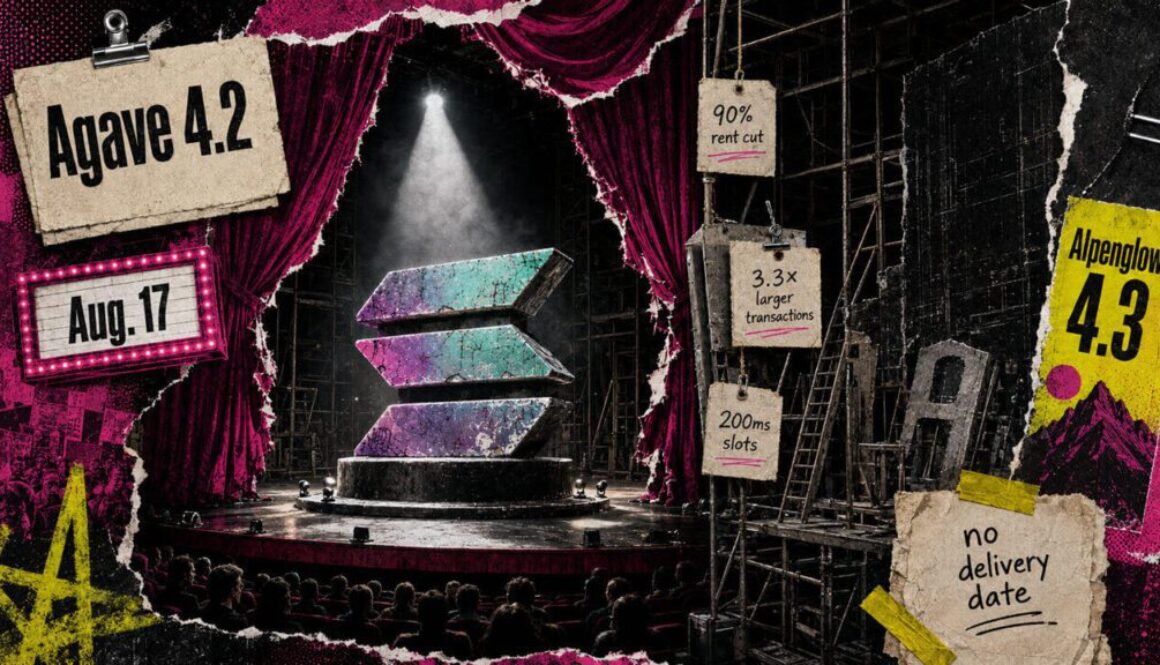
- Draft proposal SIMD-0525 cuts the per-slot compute budget from 62.5 million units at 250ms to 50 million units under a future 200ms setting.
- A Solana Foundation analysis found leaders located more than 8,000 kilometers apart lose a median 122ms handoff penalty, equal to 61% of a 200ms slot.
- 250ms new target slot time, one step before a proposed 200ms cadence
- 28.83% of network stake went delinquent during the Aug. 12 TeraSwitch outage
- 18 Nakamoto coefficient measured Sept. 7, against a top validator near 4% of stake
A slot is the network’s target interval for a validator to produce a block, so shrinking it gives users more frequent chances for a transaction to land while giving each leader less time to pick up production from the last one. The transition, confirmed by the Solana engineering changelog and a Solana Compass report placing it at roughly 05:06 UTC, became effective at epoch 1037 on Sept. 18. An early Sept. 20 sample covering 60 one-minute windows measured about 266ms per produced slot, close to the 250ms target, according to CryptoSlate’s analysis of the rollout.
Epoch 1037 Skips Just 0.05% of Slots in Early Reading
Epoch 1037’s skip rate of about 0.05% offers an encouraging first reading rather than a proven trend. The observation window covers a single epoch, not the sustained, multi-epoch record that would be needed to validate performance under varied network conditions.
The nominal protocol ceiling stays near 250 million compute units per second regardless of slot length, so the change reshapes cadence and latency more than raw capacity. Blocks now arrive more often, but each one carries less permitted work under the draft SIMD-0525 design. Realized throughput still depends on demand, scheduling and how efficiently leaders fill available blockspace, not on the slot timer alone.
Leader Windows Shrink to 800ms Under a Proposed 200ms Step
SIMD-0525 keeps a leader’s turn fixed at four slots, which produces a one-second production window at 250ms and just 800ms if the network moves to 200ms. That leaves validators less time to receive incoming traffic and start producing after a handoff, a margin that geography already erodes. A Solana Foundation engineering analysis found a median first-slot penalty of about 28ms when consecutive leaders sit less than 500 kilometers apart, rising to 122ms beyond 8,000 kilometers.
That larger figure equals 61% of a 200ms slot, showing how much of a shrinking window long-distance handoffs can consume. Recovery carries a similar constraint: the draft proposal keeps a 250ms repair-defer threshold even at the 200ms stage, making that delay longer than one target slot.
Engineers are working to protect the margin on both ends. Agave developers are building pessimistic forwarding that reroutes a transaction to the next leader when it may miss its intended destination, while client teams are testing block and transaction execution against conformance binaries across different implementations, per the Sept. 18 changelog.
TeraSwitch Outage Idled 28.83% of Stake for 33 Minutes in August
An Aug. 12, 2026 routing failure at hosting provider TeraSwitch predates the 250ms activation and was not caused by it, but the episode illustrates how a single infrastructure dependency can touch many nominally independent validators at once. TeraSwitch’s incident report says 12 sites lost reachability and a Miami location was removed for containment. Solana Compass measured 28.83% of network stake as delinquent for roughly 33 minutes, though blocks kept landing throughout, per the Solana Foundation’s account.
The event exposes three separate concentration risks that faster slots do not create but could make more costly if disrupted again.
A Sept. 7 snapshot put Solana’s stake-based Nakamoto coefficient at 18, with the largest single validator near 4% of active stake, while TeraSwitch itself hosted 22.1% of active stake on that same date; the Foundation has separately cited a 38% share “last year,” though the two figures lack a common date and method and should not be read as a continuous decline.
A Sept. 20 stake-weighted query separately found 87.4% of stake running 4.x client versions, versus 7.3% on 0.x and 5.3% on 26.x, spanning the Agave-family, Frankendancer and Firedancer codebases.
200ms Feature Remains Pending With No Firm Mainnet Date
The 200ms setting stayed pending for mainnet activation as of Sept. 20, 2026, with no firm date on Anza’s feature-gate schedule. Solana’s official reduced-slot-time documentation ties any further cut to acceptable network performance, including skip rates gathered over a longer window than the current single epoch.
Alpenglow, a separate consensus upgrade targeting roughly 150ms finality, runs on its own timeline and should not be conflated with slot-time cadence. Solana’s own pages give conflicting windows for it, ranging from a Q3 2026 target to an October Agave 4.3 release, without a confirmed activation day. The scrutiny around timing margins and validator coordination echoes concerns raised in prior coverage of blockchain infrastructure resilience, including Crypto Coin Show’s look at systems that can’t afford to break under load and its report on World Chain’s streamed block-access-list rollout as another network manages latency and throughput trade-offs.
The CCS read. The stake, client and hosting concentration figures matter more to institutional risk desks than the skip rate itself. A single-epoch skip rate near zero looks clean precisely because it hasn’t yet been tested against a repeat of the TeraSwitch-style outage under tighter 200ms handoff margins. Validators and custodians pricing Solana exposure should weight that untested combination, not the headline latency number.
Anza has not set a firm date for the 200ms activation, and Solana’s own documentation makes that step conditional on sustained skip-rate and leader-handoff data broken out by client family and hosting provider, a record the network has not yet compiled beyond epoch 1037’s single reading.