Ethereum Price Surges Past $4,500 – Key Levels to Watch for More Gains
Ethereum has climbed decisively above the $4,500 mark in recent trading, establishing itself as a critical reference point for technical analysts monitoring the cryptocurrency’s near-term direction. The second-largest digital asset by market capitalization is now consolidating around these levels, with traders positioned to evaluate whether additional upside momentum can materialize in the sessions ahead.
Current Price Action and Technical Setup
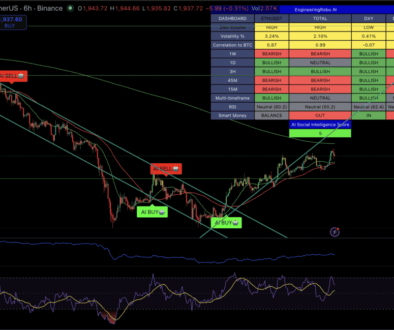
ETH/USD is trading comfortably above both the $4,500 psychological level and its 100-hourly simple moving average, a configuration that typically suggests underlying buying interest. The recent price action shows Ethereum formed a high near $4,531 before pulling back slightly, a pattern consistent with normal profit-taking behavior in uptrending markets.
A bullish trend line has established itself on the hourly timeframe with support anchored at $4,470. This technical structure suggests the broader momentum remains constructive, provided price action remains above this floor. The 23.6% Fibonacci retracement level from the $4,268 swing low to the $4,531 high is holding, indicating buyers have absorbed selling pressure at that junction.
The price is trading above $4,500 and the 100-hourly Simple Moving Average, suggesting underlying strength in the near term.
— Technical Analysis, CCS
For traders seeking entry points or confirmation of directional bias, Ethereum’s technical landscape offers several actionable levels worth monitoring closely.
Industry Context and Market Drivers
Ethereum’s current price trajectory occurs within a broader context of institutional adoption and scaling developments. The network’s Layer 2 solutions, including Arbitrum and Optimism, have successfully attracted billions in total value locked, reducing transaction costs and improving throughput. These technological improvements have enhanced Ethereum’s utility proposition, particularly for decentralized finance (DeFi) and non-fungible token (NFT) applications.
The transition to proof-of-stake consensus through the Beacon Chain merge has fundamentally altered Ethereum’s economic model. Staking rewards now provide yield opportunities that compete with traditional fixed-income instruments, attracting a new class of investors seeking exposure to cryptocurrency assets with built-in cash flows. This structural change has contributed to renewed institutional interest and helped stabilize valuations during market volatility.
Additionally, regulatory clarity regarding Ethereum’s classification has strengthened market confidence. Unlike Bitcoin, which faces contentious classification debates, Ethereum’s positioning as a utility asset has gained acceptance among financial regulators worldwide. This regulatory environment has encouraged traditional finance participation, with major custodians and investment platforms expanding their Ethereum offerings.
Market Implications of Current Price Levels
Ethereum’s sustained positioning above $4,500 carries significant implications for the broader digital asset market. As the leading smart contract platform, Ethereum’s price performance often telegraphs investor sentiment toward decentralized applications and blockchain infrastructure more broadly. A decisive breakout from current levels would likely stimulate buying interest across alternative layer-1 blockchain tokens and DeFi-related assets.
The current technical setup also reflects growing confidence in Ethereum’s competitive positioning relative to emerging competitors. While layer-1 alternatives like Solana and Polygon have attracted development activity, Ethereum’s network effects, security model, and accumulated ecosystem depth continue to dominate blockchain market dynamics. Price stability above $4,500 reinforces this market perception.
For the broader cryptocurrency market capitalization, Ethereum’s performance at these levels matters significantly. Ethereum typically represents 15-20% of total cryptocurrency market value, making its directional momentum a barometer for overall sector health. Upside breakouts from the current technical structure often correlate with broader risk-on sentiment that benefits smaller-capitalization digital assets and speculative trading activity.
Resistance Levels and Upside Targets
The immediate resistance cluster sits between $4,530 and $4,550. A sustained close above $4,550 would represent a meaningful technical achievement and could open the door for further appreciation. The next significant barrier is positioned near $4,580, described as the first major resistance level in the current technical structure.
Should Ethereum secure a clear break above $4,580, the technical picture becomes decidedly more bullish. In that scenario, traders would likely redirect their focus toward $4,650 as the next meaningful resistance zone. A successful penetration through $4,650 could trigger additional momentum, potentially carrying ETH toward the $4,740 to $4,800 range in the near term.
$4,550 | $4,580 | $4,650 | $4,740–$4,800
The progression through these levels would not be automatic, however. Each resistance zone represents an area where sellers have historically concentrated orders, and fresh supply could emerge as price approaches these thresholds.
Downside Risk and Support Zones
The analysis cannot ignore the possibility of a pullback, particularly if Ethereum encounters sustained selling pressure near $4,550. A failure to clear this resistance could trigger a fresh decline that tests the $4,470 trend line support first. This level represents an important technical floor; a break below it would signal a weakening of the bullish structure.
Below $4,470, the first major support cluster is positioned near $4,450. A decisive move through this zone would direct attention toward $4,400, which serves as a secondary support level. Further deterioration below $4,400 could see price action approach the $4,370 pivot point in the near term.
$4,470 (trend line) | $4,450 | $4,400 | $4,370 | $4,270
The $4,270 level represents substantial support and has proven significant in prior trading sessions. A move toward this price would indicate a substantial pullback from current levels and would likely require a significant shift in market sentiment.
Indicator Confirmation
Hourly momentum indicators are currently aligned with the bullish narrative. The MACD for ETH/USD is gaining momentum within the bullish zone, suggesting accelerating buying pressure. The relative strength index (RSI) is trading above the 50 centerline, another confirmation that bulls maintain a technical edge in the current timeframe.
These indicators provide supporting evidence for the upside scenario but should not be viewed as guarantees. Momentum indicators frequently diverge from price action during consolidation periods, and traders should remain alert to potential reversals if these technical signals begin to roll over.
The relationship between Ethereum and Bitcoin’s price action also merits attention, as the two assets often trade in correlation during broader market moves. Any significant shift in Bitcoin’s trajectory could influence Ethereum’s technical setup.
For investors and traders seeking a more comprehensive view of the current environment, real-time cryptocurrency pricing data and technical analysis tools can provide additional context for decision-making.
Entity Background and Market Positioning
Ethereum’s development is stewarded by the Ethereum Foundation, a non-profit organization that coordinates protocol research, development, and ecosystem initiatives. The foundation’s involvement in key upgrades and governance discussions provides institutional legitimacy that distinguishes Ethereum from purely decentralized projects. Major development teams, including ConsenSys, Paradigm, and numerous independent research groups, contribute to the protocol’s ongoing evolution.
The Ethereum ecosystem encompasses thousands of decentralized applications, with major platforms including Uniswap (decentralized exchange), Aave (lending), and OpenSea (NFT marketplace) generating billions in transaction volume. These established applications create sticky user bases and demonstrate Ethereum’s real-world utility beyond speculative trading.
Enterprise adoption has accelerated significantly, with major corporations exploring Ethereum-based solutions for supply chain management, identity verification, and financial settlement. This institutional engagement provides a foundational demand layer that supports sustained price valuations above psychological resistance levels.
Forward-Looking Considerations
The technical setup currently favors an upside breakout above $4,550, but this outcome is not assured. Price consolidation near current levels is providing an opportunity for the market to digest recent gains. The coming sessions will reveal whether buyers possess sufficient conviction to push through the $4,550-to-$4,580 resistance cluster or whether sellers will reassert control and drive price back toward support.
Ethereum’s performance at these critical junctures will establish the framework for broader market expectations around digital asset valuations. Until that directional clarity emerges, traders are wise to respect both the bullish trend line support and the major resistance levels outlined above. The confluence of improved technical positioning, fundamental network developments, and growing institutional participation suggests Ethereum remains well-positioned for sustained appreciation over intermediate timeframes, provided macroeconomic conditions remain supportive.
Get weekly blockchain insights via the CCS Insider newsletter.