edgeX pledges refunds to EDGE holders after 70% token crash, denies role in collapse
EdgeX has committed to refunding users affected by a 70% crash in its EDGE token on June 1-2, but blockchain investigators dispute the exchange’s claim that external manipulation caused the collapse, instead pointing to concentrated insider ownership as the likely culprit. The refund pledge, capped at 100,000 USDC per user, underscores mounting institutional scrutiny of token distribution practices and the risks posed by thin floats in derivative venues.
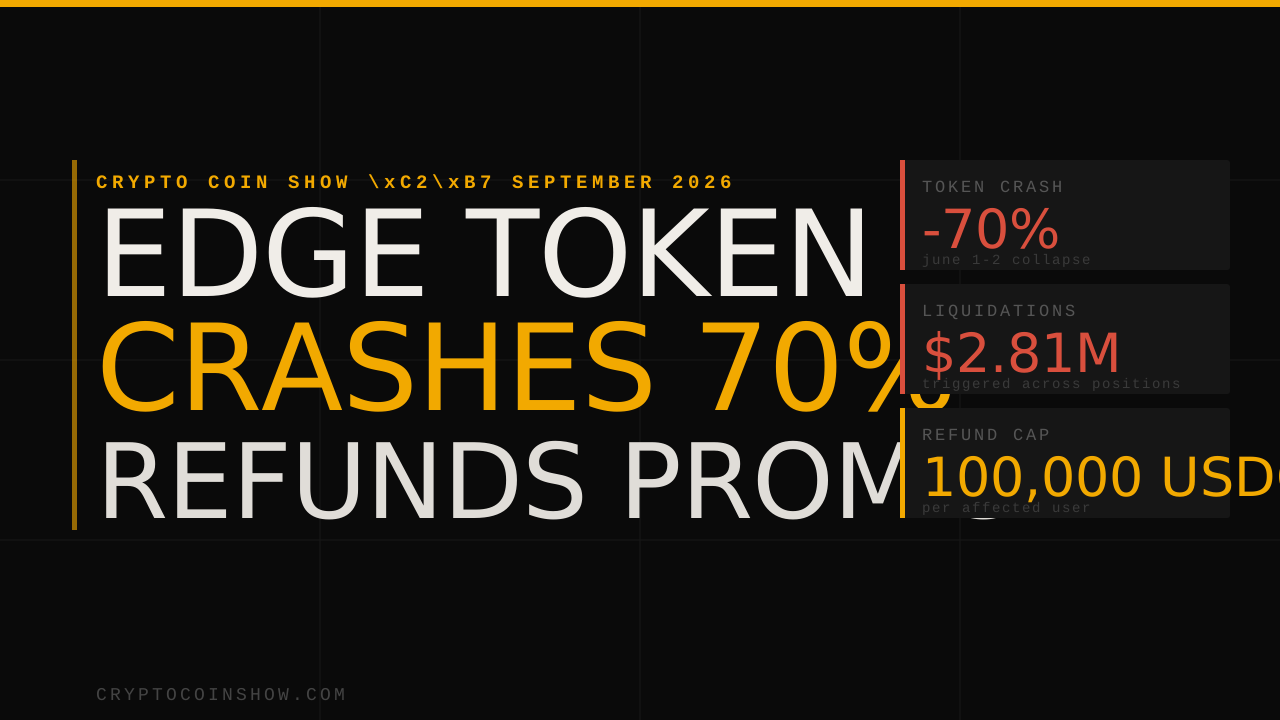
- EDGE crashed 70% from $1.14 to $0.366 on June 1-2, triggering $2.81 million in liquidations across long and short positions.
- EdgeX announced refunds capped at 100,000 USDC per user, to be distributed seven days after verification, calling it goodwill compensation.
- Blockchain investigator ZachXBT disputed the exchange’s external manipulation narrative, citing concentrated insider supply control matching patterns seen in prior token collapses.
- 70% EDGE token crash from peak to trough during single trading session
- $2.81M in liquidations triggered, against prior stable token valuation period
- 100,000 USDC maximum refund cap per affected user regardless of actual loss size
The EDGE token of derivatives exchange edgeX experienced a catastrophic one-hour collapse on June 2 UTC, falling from approximately $1.12 to $0.32 before stabilizing between $0.63 and $0.71 over subsequent hours.
The June 1-2 session saw the token plunge from a starting price near $1.14 to a low of $0.366, a 70% peak-to-trough decline that forced liquidations totaling $2.81 million, including $1.96 million in long positions and roughly $849,000 in short positions.
By June 3, EDGE was trading near $0.69 with a market capitalization around $242 million against a circulating supply of 350 million tokens out of 1 billion maximum, meaning the token had recovered partially from its intraday low but remained substantially underwater from pre-crash levels.
EdgeX attributes collapse to external market manipulation while dismissing insider involvement
In statements issued in the early hours of June 2 UTC, edgeX ruled out any technical failure, saying the exchange had not been hacked, exploited, or breached.
The exchange attributed the crash to deliberate market-price manipulation by external actors and rejected community suspicions about a specific smart contract address that users had flagged as suspicious, stating it belonged to edgeX itself and served only for user deposits and withdrawals.
This framing, that outside market participants engineered the sell-off rather than internal stakeholders, became the centerpiece of edgeX’s public defense in the hours immediately following the crash.
On June 3, edgeX announced a refund program for affected users, framing it as goodwill compensation that would match individual losses. The exchange stated that eligible users would receive refunds seven days after verification, but imposed a hard cap of 100,000 USDC per individual user, meaning that any trader who lost more than that amount would receive only partial reimbursement.
The refund pledge represented an attempt to restore confidence in the platform and signal that edgeX accepted responsibility for customer losses, even while maintaining that external actors caused the price collapse rather than any internal mismanagement or structural flaw.
ZachXBT questions concentrated ownership structure identical to prior token collapses
Blockchain investigator ZachXBT responded directly to edgeX’s public statements, rejecting the external manipulation narrative and instead highlighting concentrated insider supply control.
ZachXBT stated that “EDGE supply was being controlled by a few insiders with a low float” and called on the project to publicly name “the counterparties / MM agreements which lead to these events,” effectively challenging edgeX to disclose its market-making arrangements and key token holders.
This framing shifted focus from whether market manipulation occurred toward who held the power to manipulate, and whether those actors bore any relationship to edgeX’s leadership or founding team.
ZachXBT’s skepticism carried weight because of his prior investigative work on similar token collapses. In April, he investigated the RAVE token and found that addresses linked to the initial token distribution controlled approximately 95% of the supply before RAVE experienced a crash exceeding 95% from its peak.
ZachXBT then connected that pattern, extreme concentration among insiders, thin public float, sudden price collapse, to several other tokens including RIVER, SIREN, MYX, and SKYAI. Each of these incidents involved dramatic losses for retail traders while insiders retained or gradually exited large positions. The consistency of this pattern suggested a playbook rather than isolated accidents.
Analytics firm BubbleMaps also contributed to scrutiny by flagging SIREN’s concentrated ownership structure weeks before that token’s market capitalization fell from $1.52 billion, demonstrating that concentrated distribution was both identifiable in advance and predictive of subsequent collapses.
Institutional investors face widening concerns about derivative venue token risks
The edgeX incident raises material questions for institutional market participants evaluating exposure to derivative exchange tokens.
Exchange tokens have become common fundraising and governance tools, but when a small number of insiders retain large stakes relative to public float, the token becomes vulnerable to rapid devaluation if insiders face margin calls, liquidity needs, or incentives to exit.
Derivative venues like edgeX face additional structural risk: if the exchange token itself crashes sharply, it may undermine confidence in the platform’s financial stability or governance credibility, potentially triggering customer withdrawals or trading volume declines that feed back into additional losses.
The 100,000 USDC refund cap represents a compromise between edgeX’s willingness to acknowledge customer losses and its apparent inability or unwillingness to absorb the full cost of compensation.
Some traders who held positions worth hundreds of thousands of dollars at peak prices would recover only a fraction of their losses, raising questions about whether the refund was intended primarily to address retail outrage or to meet any formal obligation.
The seven-day verification window and the requirement for affected users to claim refunds also means that not all losses may be compensated if some users do not submit claims or fail verification.
For institutional investors, the incident highlights the need for due diligence on token distribution and insider holdings before committing capital to exchange platforms or their governance tokens. It also underscores the speed at which concentrated supply can create single-hour liquidity crises that force mass liquidations, regardless of underlying exchange fundamentals.
The key question remaining unresolved is whether edgeX will publicly disclose its market-making agreements, insider token holders, and vesting schedules, the transparency that ZachXBT explicitly demanded, or whether the exchange will treat the refund announcement as sufficient closure. Regulatory bodies and rival exchanges will likely be monitoring whether edgeX faces enforcement action or reputational consequences that affect its ability to attract institutional market makers or custody integrations.