
Bitcoin Price Fails to Rebound, Keeping Struggle Intact Near Crucial Zones
Bitcoin price is struggling to maintain momentum above key resistance levels, with the cryptocurrency finding temporary support near $88,500 but facing substantial headwinds as it attempts recovery. The digital asset remains trapped in a narrow trading band, unable to decisively break through resistance zones that have repeatedly stalled upward movement in recent sessions.
Current Price Positioning and Technical Resistance
Bitcoin is currently trading below $93,000 and has failed to sustain gains above the $92,000 threshold on multiple occasions. The bears have maintained control, pushing the asset lower to test support near $88,500 before a recovery attempt began to take shape.
A bearish trend line has formed on the hourly chart with resistance positioned at $93,500, creating a formidable barrier to upside progress. The price remains below the 100-hour simple moving average, a technical indicator that underscores the prevailing downward bias in the short-term timeframe.
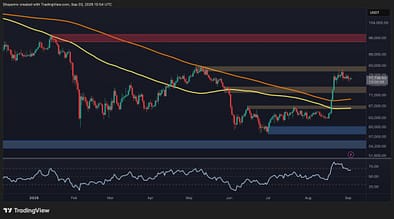
Bitcoin’s inability to clear $92,500 and $93,500 suggests sellers remain well-positioned to defend these critical zones.
— CCS Technical Analysis
Should bulls attempt a fresh recovery, they face an immediate obstacle near $92,500, which aligns with the 76.4% Fibonacci retracement level of the recent swing from $93,747 down to $88,570. This confluence of technical levels makes it a particularly significant resistance point to monitor.
Immediate support sits at $91,150, with primary support at $90,500 and $90,000. A breakdown below $90,000 could trigger momentum toward $88,500, while a drop below $86,500 might accelerate selling pressure significantly.
Upside Scenarios and Resistance Ladder
If Bitcoin manages to overcome the $93,500 resistance and the associated trend line, the next meaningful ceiling arrives at $93,750. A decisive close above this level would open the door to higher price targets, potentially allowing BTC to test $94,500 in subsequent trading sessions.
Further upside progression would encounter resistance near $95,000, followed by $95,500 and $96,200. These levels represent the upper boundary of the current trading range, though reaching them would require sustained buying pressure and successful resolution of nearer-term resistance points.
The path higher requires both technical and psychological breakthrough at $93,500, a level that has proven sticky during recent recovery attempts. Traders monitoring Bitcoin price action should watch for a convincing break above this zone as a signal of bullish commitment.
Downside Risks and Support Structure
The alternative scenario—a continuation lower—remains the path of least resistance given Bitcoin’s inability to close above key overhead levels. If the $93,500 zone holds as resistance, sellers could initiate another decline that first tests $91,150.
Breaking below $90,500 would position Bitcoin toward the psychological $90,000 support level. Loss of this support would expose the cryptocurrency to rapid downside movement toward the $88,500 zone, where the recent recovery began.
Below $88,500, the next meaningful support sits at $86,500. A breakdown below this level could trigger an acceleration of selling pressure and potentially signal a more significant bearish trend developing in the medium term.
The repeated failure to break higher suggests exhaustion among buyers at current price levels. This pattern of recovery rejection followed by renewed selling pressure has become the defining characteristic of recent Bitcoin price movement.
Technical Indicator Assessment
The hourly MACD indicator is currently losing momentum in bearish territory, suggesting diminishing strength behind the selling pressure. However, this does not yet constitute a clear reversal signal, as the indicator remains below its signal line.
The Relative Strength Index for BTC/USD has climbed above the 50 level, indicating neither strong overbought nor oversold conditions. This positioning leaves room for movement in either direction, though the technical backdrop remains weighted toward caution.
Major resistance clusters at $92,500 and $93,500 represent the primary zones to monitor for potential breakout signals. For comprehensive market analysis and daily cryptocurrency news, traders should maintain awareness of broader economic factors that may influence Bitcoin’s direction.
Market Context and Broader Industry Implications
Bitcoin’s current consolidation phase reflects broader market dynamics affecting the cryptocurrency ecosystem. The digital asset’s struggle to maintain upward momentum comes amid mixed macroeconomic signals, with traditional markets showing volatility that often correlates with Bitcoin price movements.
The cryptocurrency market capitalization, which has expanded considerably over the past year, faces scrutiny from institutional investors and retail participants alike. Bitcoin’s dominance within the broader digital asset market remains significant, though fluctuations in its price directly impact sentiment across altcoins and emerging blockchain projects.
Recent regulatory developments in major markets have influenced institutional participation in Bitcoin trading. Enhanced compliance frameworks in jurisdictions like the European Union and updated guidance from financial regulators worldwide have established clearer pathways for institutional capital allocation, though uncertainty regarding long-term regulatory treatment persists.
The ongoing debate surrounding Bitcoin’s role as a store of value versus a medium of exchange continues shaping investment narratives. Those viewing BTC as “digital gold” maintain conviction through price volatility, while traders focused on near-term price action respond more dramatically to technical breakdowns and technical recoveries.
Entity Background and Market Participants
Cryptocurrency exchanges and trading platforms experience significant volume fluctuations corresponding with price action patterns observed in Bitcoin. Major exchanges report varying order flow dynamics, with institutional desks showing different positioning than retail trading segments during consolidation phases.
Cryptocurrency investment products, including spot and derivatives markets, have matured considerably. Bitcoin futures contracts trading on regulated exchanges provide price discovery mechanisms that often lead spot market movements. The relationship between futures positioning and spot price action remains crucial for understanding momentum shifts.
Mining operations, which represent the infrastructure underpinning Bitcoin’s blockchain, maintain operations regardless of price movements in the short term. However, extended periods below profitability thresholds eventually force less efficient operations offline, potentially affecting network security and transaction processing capacity.
The cryptocurrency custody and security infrastructure has evolved substantially, reducing operational risk for institutional participants. This maturation continues attracting larger capital allocations, creating a bifurcated market with institutional behavior increasingly separated from retail activity patterns.
Market Implications and Forward-Looking Analysis
Bitcoin’s current price consolidation carries implications extending beyond technical analysis. A sustained breakdown below critical support levels could trigger cascading liquidations in leveraged positions, amplifying downward pressure. Conversely, a decisive breakout above resistance would likely attract momentum-based buying and potentially trigger short-covering activity.
The cryptocurrency remains sensitive to macro events, including Federal Reserve policy announcements, inflation data releases, and shifts in risk sentiment across financial markets. These exogenous factors often override purely technical signals, making it essential for traders to maintain awareness of the broader economic calendar.
Bitcoin’s long-term utility and adoption continue expanding despite short-term price volatility. Layer-two solutions, improved custody frameworks, and expanding merchant adoption support structural bullish narratives. However, these fundamental developments occur independently of near-term price action, creating potential disconnects between technical positioning and longer-term value propositions.
Conclusion and Strategic Outlook
Bitcoin’s current price action reflects a critical juncture where technical resistance levels will determine near-term directional bias. The $93,500 resistance zone represents the immediate battleground between bulls attempting to establish higher prices and bears defending established ceilings. Until this barrier is decisively overcome, the path of least resistance tilts toward renewed weakness testing lower support structures.
Traders should approach the current consolidation with disciplined risk management, recognizing that either breakout or breakdown scenarios carry significant implications for momentum. The technical setup, combined with diminishing MACD momentum and RSI positioning in neutral territory, suggests caution remains appropriate despite intermittent recovery attempts.
The broader cryptocurrency market evolution continues regardless of short-term price volatility. Bitcoin’s maturation as an asset class, institutional adoption trajectory, and regulatory progress all support long-term narratives that extend beyond immediate technical concerns. However, short-term traders must respect established support and resistance levels while awaiting clear directional signals confirming breakout sustainability or downside continuation.
The current price action represents a defining moment that will establish momentum for subsequent trading sessions. Clear breaks above $93,500 with follow-through buying would signal bullish reversal, while fresh lows below $88,500 would confirm ongoing weakness. Until one of these scenarios materializes decisively, Bitcoin remains range-bound and vulnerable to rapid directional moves once equilibrium breaks.
Get weekly blockchain insights via the CCS Insider newsletter.