China’s Ministry of Industry and Information Technology (MIIT) has issued a warning to automakers involved in aggressive price wars.The ministry vowed to crack down on what it describes as “involution-style” competition threatening the country’s fast-growing electric vehicle (EV) and auto sectors.
The statement, issued on Saturday, comes shortly after the China Association of Automobile Manufacturers (CAAM) launched an industry-wide initiative urging auto companies to preserve fair competition and avoid practices that could destabilize the market.
The MIIT said it will step up regulatory oversight and intervene where necessary to restore order to the market.
Escalating concerns over China’s EV price wars
At the core of MIIT’s warning is the escalating discount frenzy that has swept across China’s EV landscape. Over the past year, automakers, from EV leader BYD, to traditional players like Geely and Chery have slashed prices on dozens of models to hold or grow market share.
BYD, for instance, cut prices across more than 20 models in late May, setting off a new wave of markdowns throughout the industry.
The MIIT’s intervention is a deviation from the norm for how China manages its production sector. The regulatory approach for the auto market appears to have gone from fostering growth at any cost to ensuring long-term sustainability and quality across its strategic industries, including new energy vehicles (NEVs), which now account for over 40% of new car sales in the country.
The CAAM echoed the ministry’s concerns in a statement last week. While it acknowledged the impressive growth of the NEV sector, the association said profitability is declining due to the rise of destructive pricing tactics. While competitive pricing is legal and expected, the group cautioned that it should not come at the expense of industry fundamentals.
Tu Le, managing director of Sino Auto Insights, provided insights into the ongoing price wars, stating that the current pricing strategies could lead to a “bloodbath” later this year, particularly affecting weaker players like Neta and Polestar.
Industry analysts say the MIIT’s intervention is timely, though the effectiveness of its new regulatory push remains to be seen. Some fear that without enforceable penalties or an overhaul of pricing policies, companies may continue prioritizing volume over value.
Cryptopolitan Academy: Want to grow your money in 2025? Learn how to do it with DeFi in our upcoming webclass. Save Your Spot
The South African government has drawn heavy criticism for its proposal to loosen its Black Economic Empowerment (BEE) laws to accommodate Elon Musk’s Starlink.
Elon Musk exited the White House and immediately got himself caught up in more political drama, this time in his home country of South Africa.
The South African government is reportedly in the process of loosening its empowerment laws to accommodate Starlink, a feat that the South African telecom company, Vodacom failed to achieve.
Backlash over Starlink deal
The South African government has proposed to loosen its Black Economic Empowerment (BEE) laws to accommodate Elon Musk’s Starlink. This proposal has sparked public outrage and caused opposition parties to accuse the acting government of striking a “backdoor deal” to give the US tech giant preferential treatment.
Under existing regulations, telecom companies are required to sell at least 30% of their local equity to historically disadvantaged South Africans to operate in the country. The government intends to loosen the laws just enough to allow telecom companies to bypass that strict 30% Black ownership requirement by investing in alternative empowerment initiatives.
The government has been under pressure to improve internet access and modernize telecommunications, and argues that the law change is part of its economic reform strategy.
Critics have warned that the government’s decision sets a dangerous precedent by prioritizing foreign capital over domestic equity.
Opposition parties like Build One South Africa (BOSA) and the Economic Freedom Fighters (EFF) are leading the growing backlash against the government’s proposal. The BOSA deputy leader, Nobuntu Hlazo-Webster, said that the party has formally requested a public record of the decision from parliament to ensure transparency.
“The message being sent is that if you are a powerful foreign billionaire, you can sidestep South Africa’s laws, while our local businesses are forced to jump through hoops,” she said. “We cannot build an economy based on exceptions. Our laws must apply equally to all—foreign or domestic, rich or poor.”
Roger Solomons, a BOSA spokesperson, described the move as “impulsive” and accused the government of rewriting long-standing transformation rules to make Starlink’s market entry “favorable to them, and not the country.”
The EFF’s Julius Malema warned that he would oppose the decision in parliament. “We cannot be dictated to by business,” he said.
South Africa’s BEE laws
The loosening of rules in the telecom sector has inspired other industries to seek similar treatment. In the mining sector, the Minerals Council South Africa has urged the government to exclude exploration companies from proposed Black ownership requirements.
A new mining bill seeks to enshrine into law a 30% Black ownership target for mining companies. Allan Seccombe, the communications director at the Minerals Council, said: “Prospecting is extremely high risk. There’s no guarantee they’re going to find something that’s economically viable. Every cent they raise should ideally go towards drilling out or finding a resource.”
The Democratic Alliance (DA), the second-largest party in the ANC-led coalition government, is currently challenging the BEE laws in court.
James Lorimer, a DA Member of Parliament, said that the proposed mining legislation will “effectively end the already tottering case for foreign investment in South African mining.” He added that the bill “seeks to double down on racial transformation and brings back a legion of bad ideas.”
Despite mounting pressure, President Cyril Ramaphosa has remained firm in his defense of the BEE laws. In a parliamentary session this week, he rejected claims that the empowerment policies were stifling economic growth.
“I find it very worrying that we continue to have this notion that BEE is the one that’s holding our economy back,” he said. “It is the partial and exclusive ownership of the means of production in our country that is holding this economy from growing.”
Cryptopolitan Academy: Want to grow your money in 2025? Learn how to do it with DeFi in our upcoming webclass. Save Your Spot
Solana’s price can reach a maximum of $238.90 and an average trading value of $215.52 in 2025.
By 2028, SOL is expected to reach a new high of $492.29, driven by mainstream adoption of its dApps.
Solana’s price could surpass the $1,000 mark, potentially reaching $1,093.25 or higher by 2031.
Despite occasional challenges for Solana ecosystem, including network congestion and competition from other blockchain platforms, the current sentiment shows that Solana demonstrates resilience and adaptability, despite the current price fluctuations, positioning itself as a leading player in the decentralized finance (DeFi) and Web3 landscape.
Overall, the prevailing sentiment within the Solana community reflects the current sentiment of confidence and excitement among investors , driven by the growing interest in Solana with stakeholders eagerly anticipating the platform’s continued evolution and impact on the broader crypto ecosystem.
While uncertainties persist, Solana’s innovative approach and robust infrastructure instill optimism for its future price trajectory, as indicated by the technical analysis, solana price forecast and market dominance, particularly when evaluated against momentum indicators. How high can SOL go in 2025 and beyond?
Overview
Cryptocurrency
Solana
Token
SOL
Price
$177 (+3.06%)
Market Cap
$92.21 Billion
Trading Volume 24-hour
$3.05 Billion
Circulating Supply
520.28 Million SOL
All-time High
$294.33 Jan 19, 2025
All-time Low
$0.5052, May 11, 2020
24-hour High
$178
24-hour Low
$169
Solana price prediction: Technical analysis
Sentiment
Bullish
50-Day SMA
$151.33
200-Day SMA
$166.82
Price Prediction
$209.34 (+17.39%)
Fear & Greed Index
73 (Greed)
Green Days
16/30 (50%)
14-Day RSI
58.54
Solana price analysis: SOL faces bearish pressure below $180
TL;DR Breakdown:
Solana price analysis shows a bullish trend below $160.
Resistance for SOL is at $160.
Support for SOL/USD is at $155.
The price analysis of Solana for May 31 shows that SOL tried and failed at crossing past the $184 level. The price is still trading at $156 but may retrace further.
Solana price analysis 1-day chart: SOL fails to cross past $180
Solana showed significant bearish pressure on the daily chart, as the bulls could not climb past the $180 level, and the price headed towards $150. The bulls still hold strong at the level but the exhaustion might cause SOL to retrace further.
The Relative Strength Index (RSI) stands at 41.72, showing little room for further upwards movement across the daily charts. The Moving Average Convergence Divergence (MACD) line dives downwards, suggesting declining bullish momentum. Moreover, the MACD histogram shows rising bearish pressure in the cryptocurrency market as bulls struggle to hold above $155.00.
SOL/USD 4-hour price chart: Bearish momentum halts SOL at $184
The 4-hour chart for Solana reveals a steady fall as the bulls failed to rise past the $185 price level, and SOL fell to the $155.00 mark before recovering towards the $156 level. The high trading volume has caused high volatility in the last few days.
From a technical perspective, the MACD shows growing bearish momentum at -0.82, with the indicator showing rising bearish momentum with recent candles. This suggests that the bulls are yet to find a foothold at the level. The RSI (Relative Strength Index) is at 33.26, indicating that Solana has room for further movement in downwards direction across the short term and the selloff may continue towards $166.
The Solana price analysis across the daily and 4-hour charts indicates a notable decay after rising towards the $184 price level. The 4-hour chart reinforces this downward trend with a bearish dominance in the MACD and the RSI falling into unfavorable territory, signaling potential continued downward momentum as SOL retraces to $150.
The bulls find strong support at $155 suggesting the price may bounce back. The bullish market sentiment supports the notion and the increasing trade volume is also bullish. However, if the price falls below $155, the next support is at $148.
Is SOL a good investment?
Solana is a high-performance blockchain platform known for its scalability and speed, boasting a substantial Total Value Locked (TVL). The network continues to hit key development milestones. Despite a challenging month, price predictions indicate a more optimistic outlook, suggesting Solana prediction the potential for future growth.
Why is SOL down?
Solana failed to rise past the $184 price level, and the following selloff caused a drop to $150 before recovering towards the $157 level. However, the increasing bearish pressure might create a drop below $155.
What is Solana going to be worth in 2025?
The Solana (SOL) price prediction for 2025 suggests a minimum value of $97.47 with an average price of $215.52. The price could reach a maximum of $238.90 during the year.
Will SOL reach $1,000?
The price forecasts indicate that SOL could reach a minimum of $1,139 by 2030. Given the bullish scenario and the projected positive market sentiment and growth trend, SOL might reach $1,000 within the next five years.
Can Solana reach $5,000?
Reaching $5,000 is plausible but would likely take several years beyond the current forecast period. However, a snowball in the asset’s adoption might bring the moment sooner.
Does SOL have a good long-term future?
Yes, Solana has a good long-term future, with a promising market capitalization and exciting potential roi due to its high scalability, low transaction costs, robust ecosystem, and increasing institutional interest. Its growing adoption, strong developer community, and strategic partnerships further enhance Solana’s forecast of its potential for sustained growth.
Recent news/updates on Solana
Solana has announced the support for WBTC, which is backed by 1:1 by Bitcoin custodied. This is custodied by Bitgo exchange.
Bitcoin 🤝 Solana
WBTC, the most widely issued wrapped Bitcoin, is now natively available on Solana. https://t.co/89csX4wVXB
The sol price prediction for May 2025 suggests a range of outcomes based on current market trends and analysis. The forecast anticipates SOL fluctuating between a minimum of $122.00 and an average of $146.24, and potentially reaching a maximum of $261.28.
Month
Minimum Price ($)
Average Price ($)
Maximum Price ($)
May
122.00
146.24
261.28
Solana price predictions 2025
The Solana (SOL) price prediction for 2025 suggests a minimum value of $97.47 with an average price of $215.52. The price could reach a maximum of $238.90 during the year.
Year
Minimum Price ($)
Average Price ($)
Maximum Price ($)
2025
97.47
215.52
238.90
Solana (SOL) price prediction 2026-2031
Year
Minimum Price ($)
Average Price ($)
Maximum Price ($)
2026
233.41
262.93
274.17
2027
319.79
382.43
390.71
2028
418.09
471.33
492.29
2029
418.09
471.33
492.29
2030
515.46
582.88
595.53
2031
731.62
779.77
811.85
Solana price prediction 2026
Solana sol price is predicted to reach a minimum of $314.31 in 2026. Experts suggest that the coin could reach a maximum value of $369.21 and an average price of $354.07.
Solana price prediction 2027
In 2027, the price of Solana is forecasted to be around a minimum value of $430.63. Solana’s price can reach a maximum of $526.14, and the average trading value is $514.99.
Solana price prediction 2028
If the bullish run from previous years continues into 2028, SOL can reach a minimum price of $563.01, a maximum price of around $662.93, and an expected average trading price of $634.70.
Solana price prediction 2029
An analysis of SOL’s historical performance shows that the coin could attain new highs in 2029, reaching a maximum price of $662.93, a minimum of $563.01, and an average trading price of $634.70.
Solana price prediction 2030
Based on the Solana price prediction for 2030 and the support levels , investors can expect a maximum price of $801.96 and a minimum SOL price of $694.14. On average, the SOL coin could trade at $784.93.
Solana price prediction 2031
Solana’s price is projected to reach a minimum of $985.22 in 2031. Expert findings suggest that it could reach a maximum of $1,093.25 and an average forecast price of $1,050.05.
Solana Price Prediction 2025 – 2031
Solana market price prediction: Analysts’ SOL price forecast
FirmName
2025
2026
Changelly
$157.71
$244.91
DigitalCoinPrice
$339.32
$389.42
Cryptopolitan’s Solana (SOL) price prediction
Our predictions show that SOL will achieve a high of $321.71 in 2025. In 2028, it will range between $563.01 and $662.93, with an average of $634.70. In 2031, it will range between $985.22 and $1,093.25, with an average of $1,050.05. Note that these predictions are not investment advice, and it is crucial to consider investing strategies and conduct your own research before making any decisions. Seek independent professional consultation or do your research.
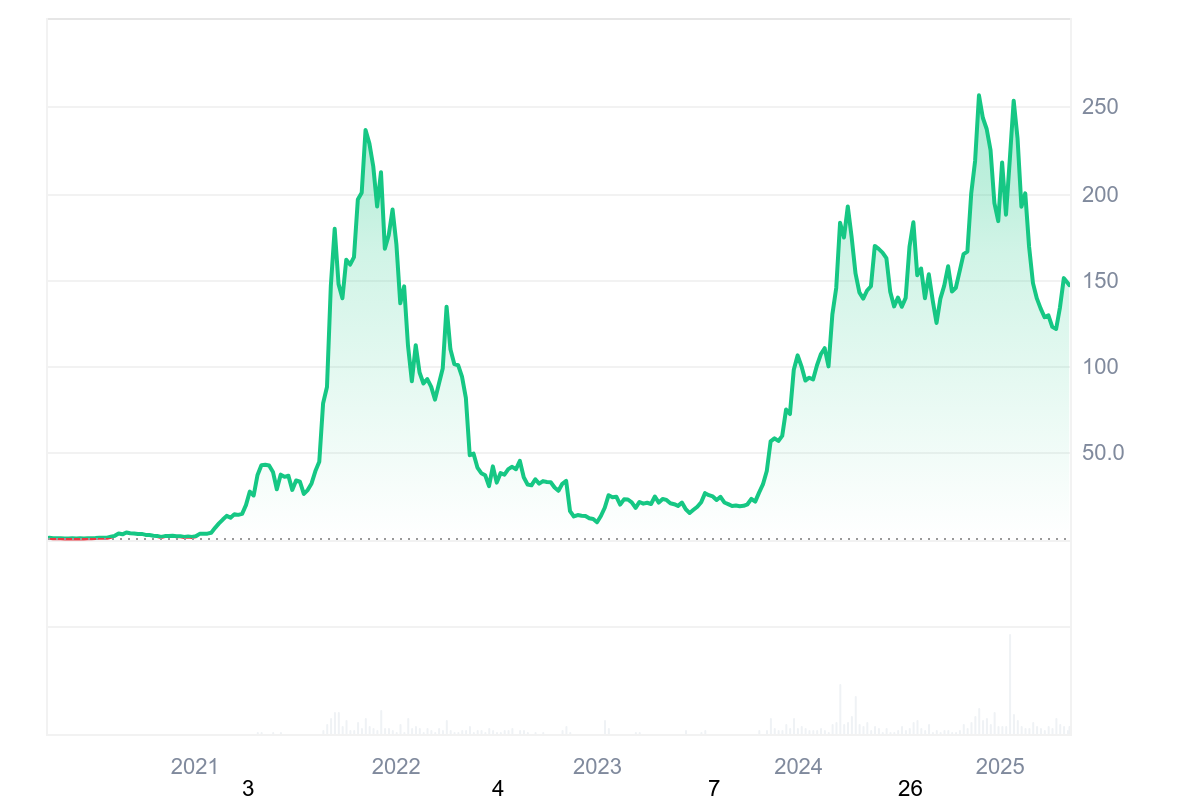
Solana was launched in April 2020 and has gained popularity over the last 18 months. Its price surged from $0.75 to a high of $214.96 in early September.
Following NFT hype and growing demand in the DeFi community, the cryptocurrency Solana (SOL) price more than tripled during the summer of 2021. Solana (SOL) token became the fastest-growing cryptocurrency and is currently ranked fifth with a live market cap of nearly $66 billion.
2022 saw Solana leap to its all-time high of $260, but SOL failed to close the year anywhere near that high, as the price came crashing down to below $40 by June. The bearish markets were marked by high skepticism as trading volumes declined throughout the crypto markets.
The price continued to trade below the $40 level until November 2023, when Solana gained momentum and started a bullish rally again to close the year at $101.84.
In 2024, Solana (SOL) saw significant growth, with its price rising from $83.62 in January to a high of $202.87, fueled by its dominance in DeFi, NFTs, and decentralized exchanges. However, the price fluctuated through the year, retracing to $131 in September after struggling to maintain key levels.
October brought a positive rebound as SOL rose from $152 to close at $167, but early November started bearish, with the price dipping to $160.
However, Solana bounced back sharply and closed the month above the $230 mark. December, on the other hand, has observed a slow start as price volatility remains low.
Solana’s (SOL) price rose significantly in January 2025 from below the $190 level to close the month above $210. However, the latter half of the month saw the price decline from the $230 mark, a trend that continued through February ending the month below $150.
In March the price continued falling as the bears continued dominating the short to mid term markets ending the month below $125. In April the bearish rally has only continued as the price falls towards $100. However, the bulls bounced back in the middle of the month and ended the month around $150.
Once the darlings of the meme coin mania, Dogecoin (DOGE) and Shiba Inu (SHIB) are showing signs of fatigue as seasoned investors begin pivoting toward higher-upside altcoins. DOGE has seen its momentum wane despite increased social buzz, while SHIB is hovering in consolidation territory with technicals hinting at either a breakout or deeper correction.
Both remain top crypto assets by market cap, but traders searching for the next crypto to explode are increasingly rotating into low-cap coins with better ROI potential. One such coin grabbing attention is Mutuum Finance (MUTM), a sub-$0.03 token that’s quietly gaining ground ahead of the 2025 bull cycle. The MUTM presale has witnessed over 11,500 participants before a token price rise to $0.035 at the start of the next phase. Investors at this level can potentially return up to 100% in profit when the estimated launch price of $0.06 is achieved.
DOGE and SHIB: Meme Coins at a Crossroads Amid Market Shifts
Dogecoin (DOGE) trades at a price of $0.2228, depreciating by around 1.3% within the past 24 hours. The coin is facing significant support levels, and technical indicators are indicating opposing signals whether the coin will be positive or negative in the near term.
Shiba Inu (SHIB) currently trades at a price of $0.00001429, depreciating by around 0.012% over the past day. However, SHIB has built up a bull flag pattern, which is a potential breakout that will push its price to the resistance of $0.000022. While DOGE and SHIB struggle with these market forces, new coins like Mutuum Finance (MUTM), whose price is at the moment $0.03, are catching investors’ eyes with their potential high returns.
Mutuum Finance Presale: A Growing DeFi Solution
Mutuum Finance has attracted more investors with its DeFi lending solutions. Through innovative decentralized finance mechanisms and crypto lending services the platform has collected more than $9.4 million and accumulated 11,500 holders in its community.
MUTM tokens currently sell for $0.03 before their value will grow to $0.035 within the next round of the presale. Investors will achieve a substantial gain of 100% when Mutuum Finance hits its official launch price of $0.06. The advanced lending system of Mutuum Finance drives the transformation of decentralized markets while it consolidates its market position.
Mutuum’s P2C and P2P Lending
Mutuum Finance’s (MUTM) technological edge is its hybrid lending model. Its Peer-to-Contract (P2C) model permits users to make passive income by loaning the USDT to liquidity pools operated through the use of smart contracts. The Peer-to-Peer (P2P) model on the other hand removes the middleman. It allows users to lend and borrow directly. This gives them more control and privacy.
By combining these two systems, Mutuum Finance (MUTM) positions itself as one of the best cryptos to invest in today. It offers decentralization, security, and efficiency.
Certik Audit Officially Completed, Stablecoin Secures Trust and Stability
Mutuum Finance is building a fully collateralized, USD-backed stablecoin to be issued on the Ethereum network. Its overcollateralized design ensures long-term price stability, avoiding the collapse risks that have affected algorithmic stablecoins.
Mutuum Finance (MUTM) is powered by open-source smart contracts that have now been officially audited and certified safe by Certik, providing a strong foundation for user trust and paving the way for institutional adoption.
Rewarding Early Investors & Expanding the Community
Mutuum Finance strives to acquire more users and provides financial benefits to its initial investor community. To award early investors MUTM platform provides ten lucky winners total of $100,000 distributed in equal amounts of $10,000 value MUTM tokens.
Priced at $0.03 in presale with a jump to $0.035 next phase and a $0.06 listing price, MUTM offers up to 100% gains. Backed by a Certik audit and over $9.4 million raised, it’s a top pick for early investors. Join the presale now.
For more information about Mutuum Finance (MUTM) visit the links below:
Microsoft Russia has announced that it plans to file for bankruptcy.It joins a list of other Western technology companies pulling out of the Russian market.
Geopolitical tensions are again affecting the technology industry as Microsoft is joining a list of other Western companies such as Google that are closing their Russian subsidiaries.
Microsoft Corp.’s Russian subsidiary, Microsoft Rus LLC, has announced that it will declare bankruptcy. The announcement was made through a notice published on the official Russian registry Fedresurs on Friday, May 30.
This decision seems like it was brought on by the ongoing pullback of Western technology companies from the Russian market, considering the escalating political tensions and economic isolation stemming from the war in Ukraine.
Microsoft’s Russia unit is on the brink
While Microsoft has not issued an official statement in response to inquiries, the notice signifies an end to the company’s already scaled-down presence in Russia. Over the last two years, the company has significantly reduced its presence in the country.
The notice came just days after the Russian President, Vladimir Putin, publicly criticized and suggested that foreign digital service providers like Microsoft and Zoom should be “throttled” in favor of domestically developed alternatives.
Microsoft was one of several Western technology giants that responded to Russia’s invasion of Ukraine in February 2022 by curtailing services and operations in the country. Initially, the company continued to provide essential services such as security updates and cloud support, but by June 2022, the company announced a substantial downsizing of its Russian operations due to the deteriorating economic environment and geopolitical instability.
After the announcement, the company removed the RT (formerly Russia Today) app from the Windows App Store and banned advertisements from Russian state-affiliated media.
The Fedresurs registry entry states that Microsoft Rus LLC is now proceeding with legal steps to enter bankruptcy, which would potentially dissolve its presence as a formal business entity in Russia. This is the pattern that other foreign companies exiting Russia have followed.
Russia’s TASS news agency noted that Microsoft operates three other affiliated entities in the country, namely: Microsoft Development Center Rus, Microsoft Mobile Rus, and Microsoft Payments Rus.
At this time, the status of these units remains unclear. Whether they will also initiate bankruptcy proceedings or attempt to continue operating under restricted conditions is yet to be seen.
Other companies exiting Russia
Earlier this week, President Vladimir Putin emphasized the need to wean Russia off Western digital tools, specifically naming Microsoft and Zoom.
While Russia’s “technological sovereignty” policy is not new, the pressure to use regulation to suppress foreign firms to prop up Russian-developed alternatives has grown since the war in Ukraine began.
In 2022, Google’s Russian subsidiary filed for bankruptcy after authorities froze its bank accounts, making it impossible for the company to pay local employees or fulfill obligations to suppliers.
Some foreign software continues to be used in Russia as of now and are often circulated through gray market channels or rebranded alternatives, but official policy increasingly favors domestic innovation, even at the cost of performance, reliability, or global integration.
Microsoft’s exit might accelerate Russia’s domestic innovation ambitions as sectors that relied on the company’s productivity tools, cloud services, and cybersecurity infrastructure will now be left empty handed.
Industry observers have noted that replicating the sophistication and integration of Microsoft’s ecosystem will be a significant challenge for Russian developers, at least in the short term.
KEY Difference Wire helps crypto brands break through and dominate headlines fast
Uphold stated it is seeking options to earn a yield on $XRP. They are experimenting with XRP staking via Flare Networks.
The company shared an X post: “Welcome to smart contracts and DeFi opportunities, #XRPArmy. The company then asked its users to “Stay tuned for the beta.”
Uphold intends to take root in the US in following Trump’s pro-crypto stance
In the last quarter of 2023, Uphold released Vault, a self-custodianship wallet that the company says empowers user to have more ownership of their digital assets. The wallet launched initially with XRP as an option, in keeping with Uphold’s existing dedication to the token.
The company has also highlighted the Flare Network (an EVM-compatible Layer 1 blockchain emphasizing cross-chain interoperability). The recent release of USDT₀, an omnichain variant of Tether’s USDT on Flare, has massively increased the network’s TVL, indicating surging demand for cross-chain DeFi utility.
Uphold is further expanding its users’ functionality with the re-launch of its crypto debit card, which is available in the UK and US. It plans to extend the offering to other countries soon. The card (available in a virtual and physical version) offers people a way to spend digital currencies directly from their wallets and thus use crypto more as everyday money.
The company’s broader push into the US market reflects a wider trend among crypto firms looking to capitalize on a more favorable regulatory climate under President Donald Trump’s administration. Uphold appears keen to position itself at the forefront of this shift.
In March, Uphold reinstated staking rewards for US customers on 19 digital assets such as Ethereum, Solana, and NEAR.
Concerning this, Uphold CEO Simon McLoughlin highlighted that staking is important in how blockchain works and the online economy. Based on his argument, users should be able to back this activity and earn rewards. He further stated that with the new focus on blockchain in the US, they are excited to provide staking services to their customers in the US once more.
Building on that momentum, Uphold announced on May 30 that it will soon offer direct deposits with integrated rewards for US users. This feature includes a “Direct Salary Deposit” option, paired with the industry’s first 4% XRP-back reward. Additionally, users can earn 5% rewards on RLUSD, Ripple’s new USD-backed stablecoin.
Through a mix of DeFi integrations, payment tools, and rewards, Uphold is aggressively expanding its footprint in the US while bringing greater utility to XRP and other digital assets.
As of 2023, Uphold did not offer staking services in the US due to regulatory uncertainty surrounding crypto staking. According to an SEC complaint, many staking firms failed to provide adequate information to clients, particularly regarding how they secured staked assets.
The SEC also considered whether staking services could be considered unregistered securities offerings. Accordingly, many companies were forced to cease or limit their staking activities in the United States.
One prime instance of this regulatory force was the SEC’s $30 million settlement with Kraken, one of the largest crypto exchanges, for unauthorized staking services. This high-profile case was a cautionary tale to the whole industry. It might have factored in Uphold’s decision to pause their staking offerings, shedding some light on why many companies still hesitate to offer staking services.
Uphold’s recent consideration to take root in the US in the staking sector marks a significant milestone in the crypto community. This is because as investors earn passive income through staking, liquidity, and stability will be achieved, thus representing a giant bet on cryptocurrencies.
Cryptopolitan Academy: Want to grow your money in 2025? Learn how to do it with DeFi in our upcoming webclass. Save Your Spot
Ripple’s Chief Legal Officer, Stuart Alderoty, has publicly endorsed the newly introduced Digital Asset Market Clarity Act (CLARITY Act).
He calls it a significant step toward establishing a clear and consistent regulatory framework for cryptocurrencies in the United States.
Alderoty argued that “Clarity shouldn’t be controversial” and that the bill would allow for a practical and intelligent regulatory environment.
The Ripple’s Chief Legal Officer thanked some prominent lawmakers for their role in leading the charge. This list includes Representatives French Hill, Congressman Glenn Thompson, Angie Craig, the GOP Majority Whip Dusty Johnson, Don Davis, Bryan Steil, Ritchie, and Davidson.
Their work underscores the need for new regulatory guidelines that can be spun up and revised quickly as the digital assets space accelerates. Rep. Bryan Steil released the following statement regarding the CLARITY Act on X.
The post mentions that the bill is designed to bring clarity to digital assets during this golden period. Supporters of the bill are united by a desire to enable the digital assets sector to expand by establishing a trustworthy and predictable set of laws. Right now, businesses and investors are often uncertain about which of their activities may delay the future of the industry.
Bipartisan CLARITY Act redefines crypto oversight
Introduced on May 29, 2025, by members of Congress from both sides of the aisle, the CLARITY Act seeks to clarify the regulatory roles of the Securities and Exchange Commission (SEC) and the Commodity Futures Trading Commission (CFTC) regarding digital assets. The bill is looking to categorize most cryptocurrencies as virtual commodities overseen by the CFTC rather than as a security regime, as is the current practice of the SEC.
With the rising use of digital assets, now is a good moment for such a move. This is because their increasing adoption and market maturity offer opportunities for broader economic integration. The rising use of these assets is also a concept shared by MicroStrategy executive chairman Michael Saylor.
Alderoty noted the bill’s significance in bringing “long-overdue clarity” to the digital asset landscape. The bill, he said, takes the industry closer to a “smart, workable framework” that creates an equilibrium between innovation and consumer protection.
CLARITY Act safe harbor advances as Ripple calls for clear crypto rules
The CLARITY Act also introduces a four-year safe harbor provision for primary token offerings if the underlying network reaches a “mature blockchain system” status and the total raise stays below $75 million during any 12-month window.
Alderoty also supported the CLARITY Act, as Ripple remains committed to advocating for regulatory clarity regarding the cryptocurrency industry.
He has sent a letter to the SEC requesting the commission to clarify when a digital asset ceases to be an investment contract. Not all of them, he contended, should be subject to the same securities regulations — especially not on secondary market transactions — and he offered a safe harbor to shield compliant crypto issuers from enforcement risk.
As XRP regains attention as a top crypto buy with the Ripple SEC lawsuit nearing resolution, uncertainty lingers following SEC Commissioner Hester Peirce’s recent “New Paradigm” speech.
Ripple’s letter directly responds to the pivotal question posed in the speech: “When does a digital asset separate from an investment contract?”
Ripple referenced established securities law analysis from legal experts like Lewis Cohen in its response. Cohen’s analysis contends that current US investment contract law does not consider routine transfers of most fungible crypto assets in secondary markets as securities.
With the CLARITY Act, the US may finally start taking concrete steps to provide regulatory clarity for the crypto industry.
While the bill gets consideration in the legislative committee, its passage would lay a benchmark for the future of how US regulators will oversee digital assets.
KEY Difference Wire helps crypto brands break through and dominate headlines fast
As the crypto market gears up for the next bullish breakout, investors are hunting for the next crypto to hit $1, and Mutuum Finance (MUTM) is emerging as a top performer. With major players like Ethereum (ETH) and Solana (SOL) cooling off after strong rebounds, new altcoins with low market caps and disruptive potential are beginning to steal the spotlight. While ETH and SOL continue to dominate in terms of utility and infrastructure, they may offer more modest upside compared to fast-rising Mutuum Finance, which are drawing interest for their exponential ROI potential.
Mutuum Finance presale has raised more than $9.5 million and attracted over 11,400 participants, ahead of a token price rise to $0.035 at the start of the next phase. Those investing at this stage stand to make up to 100% in profit once the projected launch price of $0.06 is reached. In a shifting market where crypto investing is increasingly focused on value-entry points, MUTM is quickly becoming a go-to option for those looking to get in early on the next big cryptocurrency.
Mutuum Finance Presale: A Growing DeFi Solution
Mutuum Finance has attracted more investors due its advanced Decentralized Finance (DeFi) lending solutions is gaining significant momentum in the market. Through innovative decentralized finance mechanisms and crypto lending services the platform has collected more than $9.5 million and accumulated 11,400 holders in its community.
MUTM tokens currently sell for $0.03 before their value will grow to $0.035 within the next round of the presale. Investors will achieve a substantial gain of 100% when Mutuum Finance hits its launch price of $0.06.
Certik Audit Finalized: Mutuum Finance Strengthens Position in DeFi Lending
The advanced lending system of Mutuum Finance drives the transformation of decentralized markets while consolidating its market position. A Certik smart contract audit has now been officially completed, and the results shared across various media platforms boosting investor confidence in the project. With this milestone, Mutuum Finance stands out as one of the best cryptocurrencies to invest in today.
Gamified Leaderboard Engages the Community
In addition to securing community ties, Mutuum Finance has established a leaderboard feature which displays the top 50 token holders in real-time. Bonus tokens will be received by the top 50 ranks, which becomes an entertaining, game-like incentive for users to move up and hold their positions. It is a smart merge of DeFi mechanics and community involvement.
Rewarding Early Investors & Expanding the Community
Mutuum Finance continues to acquire more users and provides financial benefits to its growing investor community. To award early investors Mutuum Finance platform provides ten lucky winners a total of $100,000 distributed in equal amounts of $10,000 value MUTM tokens. Mutuum Finance allows new investors to benefit when they refer members to the platform which creates an inclusive investor community.
One of the revolutionary aspects of the Mutuum Finance model is its Buy-and-Distribute mechanism. The Buy-and-Distribute mechanism is to purchase tokens in the open market and redistribute them to stakers, which ensures frequent user engagement and sustains the tokenomics of the project. By matching supply and rewarding users on a regular basis, the strategy entices committed, long-term investors.
Mutuum Finance (MUTM) is gaining serious traction as the next altcoin to watch, with over $9.5 million raised and 11,400+ investors already in. With a current presale price of $0.03 and a launch price of $0.06, early buyers could see 100% gains, plus more if post-launch momentum continues. With a completed Certik audit, gamified rewards, and strong DeFi utility, MUTM is a top contender to hit $1. Join the presale now.
For more information about Mutuum Finance (MUTM) visit the links below:
REX Shares has filed a prospectus with the US Securities and Exchange Commission (SEC) to launch two groundbreaking exchange-traded funds (ETFs) focused on staking Ethereum (ETH) and Solana (SOL).
Rather than opting for a 19b-4 process for traditional ETF filings, REX Shares chose the 40-Act filing under the Investment Company Act 1940. This structure circumvents the protracted job of obtaining regulatory approval from the SEC and should expedite the launch in the market.
James Seyffart, a Bloomberg ETF analyst, shared this news on social media and confirmed the details about REXShares’ filing.
BIG NEWS: @REXShares just filed an effective prospectus for Solana and Ethereum staking ETFs to list here in the US. Don’t know launch date but could be within the next few weeks. These are 40-act funds with a unique structure and do not go through the 19b-4 process pic.twitter.com/cqUCWlFAZW
The move is a major development in the growth of cryptocurrency investment products in the United States.
Rex Shares uses C-Corp and Cayman subsidiaries to speed ETH & SOL staking ETFs
Each fund will utilize a C-corporation structure, a rare choice in the ETF industry, to facilitate participation in staking activities while adhering to regulatory standards.
The funds will gain exposure to ETH and SOL through wholly owned Cayman Islands subsidiaries that will acquire and stake the cryptocurrencies. The launch date is uncertain, but Seyffart says these ETFs could be added within the next few weeks.
Today’s filing comes in the wake of the US regulator, the Securities and Exchange Commission, having recently affirmed that staking through a PoS-based network is not considered securities.
Commenting further on the Rex Shares filing, James Seyffart noted that it was a smart move
“As you can see in screenshot above. They will be getting their spot exposure to ETH and SOL via Cayman subsidiaries. All of this, assuming they launch in near future, is a bunch of clever legal and regulatory work-arounds to get these products to market,” he said in the X post.
SEC delays on spot crypto ETFs push Rex Shares to take alternative route
Rex Shares opting for this not-so-traveled path is likely an indirect result of the United States not approving any crypto spot ETFs to date.
The SEC recently delayed decisions on Grayscale’s Avalanche and Cardano spot ETF applications. This halt affects Grayscale’s work to transform its Avalanche Trust into a spot ETF and a similar application for Cardano.
The SEC began the 240-day statutory review period of Grayscale’s Cardano ETF proposal in February, and expectations remained high as the deadline neared. Prediction markets like Polymarket put the odds at about 71%, suggesting investors were highly optimistic.
However, the anticipation would be dampened by the delay. The SEC has also reopened comments to elicit feedback from the public, therefore continuing to assess both regulatory and market impact considerations.
In related news, the SEC moved WisdomTree’s XRP spot ETF proposal to the next stage in the review process. The solicitation of comments is requested through public notice regarding investor protection and potential market manipulation concerns.
This proposal is made pursuant to Section 19(b)(2)(B), which shows that continued review is appropriate. It would be one of the first spot XRP ETFs approved in the US if passed.
Nasdaq has also filed a Form 19b-4 to list and trade shares of the 21Shares Sui ETF on its exchange, representing the launch of the initial regulatory review period. This comes after 21Shares filed an earlier S-1, signaling its interest in providing institutional exposure to the SUI token.
Meanwhile, SUI — the native asset of the Sui network — saw a mere 2% price bump following the filing news. But it currently trades around $3.32, a drop of roughly 6.9% in keeping with the broader market.
Your crypto news deserves attention – KEY Difference Wire puts you on 250+ top sites
Solana Foundation, Jupiter, AIX, and Interbix signed an MoU yesterday to explore dual listing mechanisms and support companies seeking to pursue IPOs. The MoU outlined a framework for collaboration to assess if companies could list their securities on AIX and offer a tokenized listing on Interbix powered by the Solana blockchain and Jupiter.
According to Astana International Exchange (AIX) CEO Assel Mukazhanova, the partnership will unlock new efficiencies, increase access to capital markets, and give companies and investors the best traditional and digital asset ecosystems.
The MoU aims to explore dual listing mechanisms and blockchain integration
The parties involved in the MoU committed to work together to explore the technical and commercial aspects of the mechanism. The parties demonstrated a shared vision to create a robust, transparent, secure dual listing framework.
“This agreement marks a significant step toward the convergence of conventional capital markets and next generation blockchain based platforms. By joining forces, we are shaping an environment where innovation and trust go hand in hand.”
Jupiter said implementing the dual listing mechanism would begin a better approach to IPOs. Companies would be set to go public on AIX, Kazakhstan’s stock exchange platform while issuing tokenized versions of their assets through Interbix. The assets would be managed by Solana’s blockchain technology and Jupiter’s robust decentralized set of financial tools.
Solana Foundation revealed that the MoU blended the credibility and reach of regulated public markets with the transparency and efficiency of blockchain networks. According to the company, the hybrid model would attract a wide range of investors, align capital markets operations, and create better access to liquidity, all with a secure and compliant framework.
Talgat Dossanov, CEO of Interbix, commented that the MoU marked a transformative step for Kazakhstan and global markets. He added that the company is committed to bridging the gap between traditional finance and blockchain innovation. He continued to say that enabling tokenized listing alongside conventional IPOs lays the foundation for a new era of capital formation.
Solana Foundation reveals a hybrid model with AIX, Jupiter, and Interbex at the Solana Economic Zone event
The event, which was hosted by Forma, took place yesterday at the Solana Economic Zone. It aimed to showcase Kazakhstan’s growing status as a hub for blockchain innovation. Astana International Financial Centre (AIFC), which has over 3,800 registered global companies, reiterated the partnership’s role as a bridge between traditional finance and the emerging world of blockchain-enabled capital markets.
“ Capital markets are moving online beyond the borders of any country or exchange. We’re proud to collaborate with AIX to create a regulatory framework that supports next generation IPO paths, including dual listings and other internet native methods.”
-Akshay BD, non-CMO of Solana Foundation
Kash Dhanda, Jupiter’s COO, noted that Kazakhstan’s leadership signaled a future of capital formation with on-chain transparency and interoperability. He added that Jupiter is committed to collaborating closely to define compliant and scalable frameworks for decentralized finance.
Solana token SOL is currently trading at $163.64, down by 5.24% today, while Jupiter token JUP is trading at $0.5715, down by 5.33% today.
Jupiter, the leading decentralized exchange aggregator on the Solana blockchain, recently revealed a new lending protocol at the Solana Accelerate conference. According to Jupiter, the feature will be powered by partnering with Fluid, an Ethereum liquidity layer.
The Jupiter project distributed 700 million tokens worth about $580 million to users, stakers, and contributors based on trading activities after airdropping nearly 1 billion JUP tokens in 2023.
Solana Foundation recently announced another MoU with Superstate technology company, focusing on modernizing capital markets via blockchain infrastructure. Superstate was set to act as the primary agent for SOL strategies by providing the platform and infrastructure to issue tokens that represent Solana’s common stock.
Cryptopolitan Academy: Want to grow your money in 2025? Learn how to do it with DeFi in our upcoming webclass. Save Your Spot