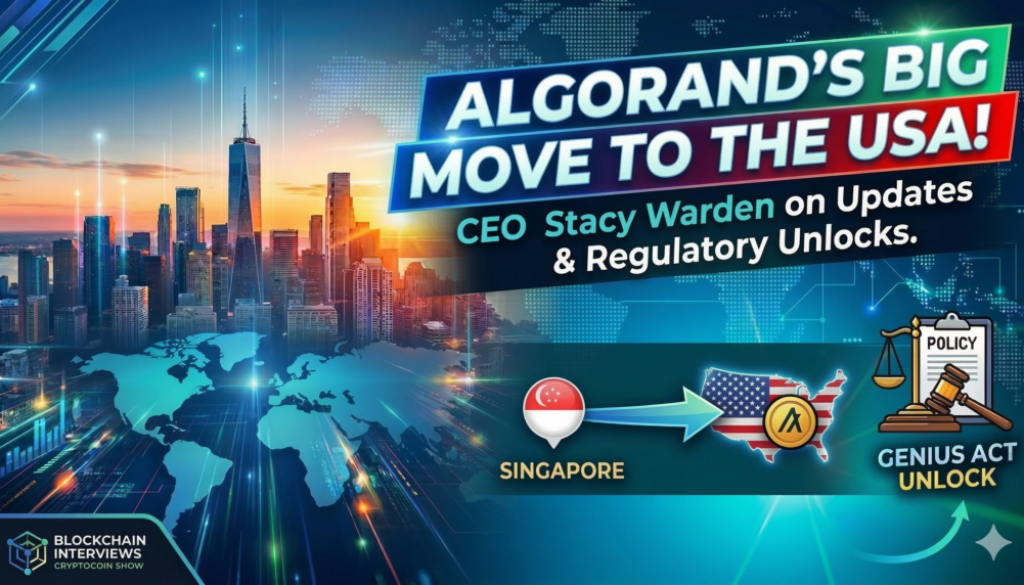
Algorand’s U.S. Return: CEO Staci Warden on Stablecoins, Humanitarian Aid, and the Future of Finance
After years of regulatory exile, the Algorand Foundation is coming home — and its CEO has a clear vision for how blockchain becomes invisible infrastructure.
After years of regulatory uncertainty forcing U.S. crypto companies to operate from Singapore and the Cayman Islands, Algorand Foundation is coming home. In this exclusive interview, CEO Staci Warden discusses the foundation’s return to the United States, how blockchain is transforming humanitarian aid in Afghanistan, and why instant finality makes Algorand uniquely positioned for the stablecoin economy.
I.Coming Home: Why Algorand Moved Back to the U.S.
For blockchain companies operating during the previous administration’s regulatory crackdown, staying clear of U.S. jurisdiction wasn’t just cautious — it was survival. Warden described the contortions Algorand Foundation had to perform:
I couldn’t even hold the token of the company I run. We’d immediately convert any algo compensation into dollars because we were so careful about not issuing algos to U.S. citizens. It’s a bad look for the CEO not to be holding the coin of the company.
The foundation relocated from Singapore to the United States, transitioned from nonprofit to for-profit status while maintaining its mission-driven reinvestment approach, and completely revamped its board with crypto, policy, regulatory, and payments heavyweights.
“We deserve to be here,” Warden explained. “We were founded out of MIT, one of the most prestigious universities in the United States, by one of the most important cryptographers in the country. The core chain was built in the U.S. We’re coming back where we belong.”
II.Blockchain Humanitarian Aid: The Afghanistan Model
One of the most compelling use cases Warden discussed was Algorand’s role in humanitarian payments in Afghanistan — a project that demonstrates blockchain’s ability to bring transparency, speed, and dignity to aid distribution.
When the Taliban returned to power and Afghanistan was sanctioned, traditional financial rails collapsed. International aid organizations still needed to support women and families they’d been helping, but banks wouldn’t touch transactions. Hassan Pay, an Algorand partner, built an Afghani stablecoin running on Algorand rails and created a transparency portal — a user-friendly overlay on the blockchain explorer that lets aid agencies track every payment.
You can see your list of recipients, match them to wallets, see where your aid has gone, and even track the next hop — what those wallets are doing with the payments. You might see lots of wallets sending to one place: turns out it’s a money changer, or the electric company. So they’re paying their bills.
The benefits extend beyond transparency:
- Instant payments — no waiting in lines
- Safety — recipients aren’t targets for theft when they don’t queue at distribution centers
- Dignity — electronic payments instead of public handouts
- Flexibility — usable via smartphone, basic phone, or card
“The Taliban is very aware of this. The central bank of Afghanistan understands that this is happening, but they appreciate the transparency, the speed, and of course the money that this enables,” Warden noted. The project has since been approached to expand into Syria for similar purposes.
III.Why Instant Finality Matters for Stablecoins
Algorand’s technical differentiator — instant finality — becomes critical in the stablecoin economy. Unlike chains where transactions can be reversed or require multiple confirmations, Algorand’s architecture ensures that once a transaction hits the ledger, it’s permanent.
When you’re promising to give $1 back for every $1 stablecoin that a customer redeems, you can’t have — even for a nanosecond, especially with bots running around — two versions of that world where you might have to redeem $2 for one stablecoin.
This becomes especially important for agentic payments — automated transactions where merchants accept payment from an AI agent, deliver merchandise immediately, but prefer settlement certainty before committing. Without instant finality, these workflows break down. Warden also addressed the coming proliferation of stablecoins, noting that as companies from Amazon to Exxon realize they can issue their own to manage supplier relationships, the ecosystem will fragment — then consolidate around quality and regulatory compliance.
IV.The GENIUS Act and Path to Regulatory Clarity
The GENIUS Act represents the biggest regulatory unlock for Algorand and the broader industry, allowing foundations to offer services to U.S. customers without fear of enforcement actions. When asked about the stalled CLARITY Act, Warden took a pragmatic stance:
I’m of the mind that you just get legislation enacted and you can always improve it. Legislation is not frozen once it’s enacted. You have an opportunity through rulemaking to improve things and fix things. We tend to act cautiously but opportunistically.
For Algorand, the current environment is already transformative. “We can now offer things to U.S. customers. The rest is a cherry on top,” Warden said. She acknowledged the industry’s debt to Coinbase CEO Brian Armstrong’s policy machine, while noting different stakeholders have different priorities — for Coinbase, the ability to pay interest on stablecoins is critical; for Algorand, it’s about being treated “appropriately and having a right to exist.”
V.When Blockchain Becomes Infrastructure: The 2030 Vision
Asked what needs to happen for blockchain to move from “approaching foundational” to “fully embedded in finance,” Warden pointed to wallet-based banking:
If I had to pick one thing, banks would have a wallet-based solution for their customers — with tokenized deposits from banks and the ability for banks to accept stablecoins. Then I think we’re here. We’ve finally arrived.
She contrasted traditional liability-based banking — where payments are reconciled in batch files at day’s end — with crypto’s wallet-based infrastructure where clearing is settlement. But the ultimate measure of success won’t be adoption metrics. It’ll be invisibility:
We’ll really be embedded when people stop talking about the blockchain. They’ll just know they’re making payments really easily, earning the reference rate on all their assets — they’ll know all these things. They might not know why.
Warden quoted Senator Tim Scott’s approach to advocacy: “If you’re trying to make somebody see the light, turn on the light switch for them. Don’t teach them how electricity works. What we need to do now is turn on some light switches for people.”
VI.Beyond Stablecoins: Tokenizing Capital Markets
Warden emphasized that stablecoins are just one example of tokenized financial assets. The real opportunity lies in on-chain capital markets — from money market funds to liquid stocks to private credit.
Her north star: paying for a Starbucks coffee with a sliver of a BlackRock money market fund, where you’re earning yield until the moment you hand it over to the merchant, who immediately starts earning yield on receipt.
“The challenges aren’t technical, they’re regulatory,” she noted. “That money market fund is a security. For me, it’s much more that the lawyers need to get busy making all of this possible than the engineers.” She also highlighted Lofty AI, built on Algorand, which lets investors buy into rental-earning real estate for as little as $50 — with full transparency on rental history, tax receipts, and property documentation.
VII.Six Years of Uptime, and Just Getting Started
Warden opened the conversation with a point of pride: Algorand hasn’t gone down for one nanosecond in over six years of operation. That reliability, combined with instant finality and energy efficiency, positions the chain as infrastructure-grade — not experimental tech.
With regulatory tailwinds, a U.S. domicile, and proven use cases from Afghan refugee payments to institutional stablecoin settlement, Algorand’s “future of finance” tagline looks less like startup hyperbole and more like a roadmap unfolding in real time.
CEO and board member of the Algorand Foundation, leading the energy-efficient, quantum-secure blockchain built for institutional-grade certainty and real-world scale. She serves on the board of the Global Blockchain Business Council (GBBC) and advises the U.S. Financial Technology Association. Before Algorand, Warden led the Global Market Development Practice at the Milken Institute for eight years, and has held senior roles at J.P. Morgan, Nasdaq, and as a senior economist for the U.S. Treasury Department, the Center for Global Development, and the Harvard Institute for International Development.
Founder and CEO of Crypto Coin Show (CCS), a blockchain media platform operating since 2014. CCS reaches 150,000+ YouTube subscribers and is the only blockchain media outlet syndicated on Reuters Insider/Refinitiv TV, delivering content to 600,000+ institutional subscribers via the London Stock Exchange. The platform distributes across 10+ podcast networks and publishes a weekly Substack newsletter. Ashton has conducted 1,500+ blockchain interviews and won the 2025 Web3 Influencer Award for “Best Interviews” (his second win after 2022). He previously raised $5M for EventChain SmartTickets and has served as advisor to Syscoin, Pundi X, and CoinPayments.