XRP Wins Major Regulatory Clarity As Commodity Status Emerges
Editorial Summary
The regulatory classification of XRP as a digital commodity rather than a security represents a watershed moment for institutional adoption of digital assets. This distinction—confirmed through joint SEC and CFTC guidance—removes years of legal uncertainty and signals coordinated federal policy toward the broader crypto market. For institutional investors, this clarity opens pathways for regulated trading, custody, and integration into traditional financial infrastructure.
XRP is entering a pivotal moment in its evolution as growing regulatory clarity is fundamentally reshaping its position within the global financial system. The recent developments suggest that XRP is increasingly being viewed through the lens of a commodity rather than a security—a distinction with profound implications for how the asset is traded, adopted, and integrated into institutional finance. This regulatory clarity arrives after years of legal uncertainty, particularly following enforcement actions that created ambiguity about XRP’s classification under U.S. federal law. The emerging consensus among regulators represents not merely a technical determination, but a signal that major cryptocurrencies may operate within a clearer, more predictable legal framework going forward. For institutional investors, market participants, and blockchain developers, this shift marks a potential inflection point in crypto’s journey toward mainstream financial integration.
The Regulatory Distinction: Commodity Classification Reshapes XRP’s Legal Status
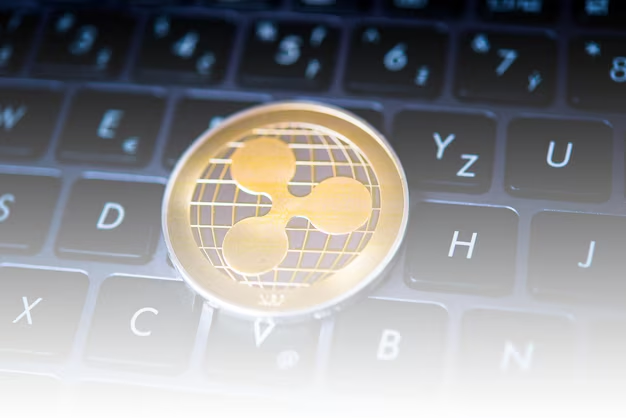
XRP has been formally designated a digital commodity by the SEC and CFTC, marking a watershed regulatory victory for the cryptocurrency sector. According to recent disclosures, the U.S. Securities and Exchange Commission and the Commodity Futures Trading Commission have released joint interpretive guidance that clarifies how federal securities laws apply to digital assets. Within this framework, XRP is cited as an exemplary digital commodity—defined as an asset whose value derives principally from the programmatic utility of a functional, decentralized system combined with market-driven supply and demand dynamics, rather than from expectations of profit through the efforts of others. This distinction is critical because it determines whether an asset must satisfy the Howey Test, the longstanding legal standard that classifies investments as securities under federal law. By positioning XRP outside the securities classification, regulators are effectively narrowing the scope of SEC oversight while expanding CFTC jurisdiction over spot and secondary market trading.
This regulatory clarity resolves the long-standing uncertainty that has shadowed XRP since its inception. The joint guidance represents a formal Commission-level interpretation rather than merely informal staff guidance, which significantly strengthens its legal weight and durability. The implication is profound: developers, exchanges, and custodians can now operate with greater confidence that their involvement with XRP trading and infrastructure does not trigger securities law compliance requirements. This shift also reflects a broader regulatory consensus that many major non-stablecoin cryptocurrencies may not qualify as securities when they possess sufficient decentralization and utility characteristics. The SEC and CFTC coordination itself signals a maturing regulatory approach, one designed to reduce jurisdictional overlap and create coherent policy across federal agencies. For institutional market participants accustomed to operating within clearly defined regulatory perimeters, this clarity eliminates a significant risk vector that had previously deterred participation.
The commodity classification carries immediate practical consequences for market infrastructure. Oversight of XRP in spot and secondary markets will shift primarily toward the CFTC, an agency with established expertise in commodity derivatives, position limits, and market manipulation oversight. This transition aligns with existing regulatory frameworks for physical commodities and commodity futures, creating familiar compliance pathways for institutional investors. The CFTC’s regulatory approach, while rigorous, tends to be more accommodating of derivative products and leveraged trading than the SEC’s securities-focused regime. Consequently, institutional investors may expect broader availability of XRP-denominated futures contracts, options, and structured products. Additionally, the commodity classification may facilitate easier integration of XRP into regulated custodial services, as the asset no longer faces the heightened compliance burdens associated with securities holding.
Fundamental Network Growth Accelerates Amid Regulatory Momentum
The regulatory clarity arrives at a moment when XRP’s network fundamentals are demonstrating accelerating growth trajectories. According to on-chain data, XRP has surpassed 7.7 million non-empty wallets for the first time in its thirteen-year history, indicating sustained network expansion and user adoption. Active addresses reached a five-week high of 46,767 on March 16, signaling renewed engagement and transaction activity across the network. These metrics matter for institutional investors because network growth directly correlates with utility adoption, developer participation, and ecosystem resilience. The expansion of the wallet base and active address count suggests that regulatory clarity is coinciding with organic growth in XRP’s practical use cases rather than speculation-driven volatility. This confluence of regulatory support and network expansion strengthens the fundamental case for institutional adoption.
Tokenized commodity activity on the XRP ledger has surged dramatically, growing from $111 million to $1.14 billion over the course of 2025 and into 2026. This represents explosive growth in a critical use case: the issuance and trading of commodities in tokenized form on a decentralized ledger. XRP’s share of the global tokenized commodities market has reached over 15 percent, establishing the network as a material venue for commodity tokenization. This metric is particularly significant for institutional participants because it demonstrates XRP’s utility in regulated, asset-backed applications—precisely the type of use case that appeals to traditional financial institutions seeking blockchain infrastructure. Commodity tokenization aligns with institutional risk management practices and regulatory frameworks, as tokenized commodities are backed by tangible underlying assets. The rapid growth in this sector indicates that XRP’s regulatory clarity is not merely theoretical; it is translating into concrete business activity and real-world adoption.
Network utilization metrics further underscore the acceleration in fundamental activity. XRP daily transactions have increased to nearly 3 million over the past week, reflecting sustained demand for on-ledger activity. Automated market maker pools have expanded to approximately 27,000, indicating robust liquidity infrastructure and decentralized exchange activity. These operational metrics demonstrate that XRP’s network is handling material transaction volumes and supporting sophisticated financial applications. For institutional investors evaluating whether XRP possesses sufficient liquidity and infrastructure maturity for large-scale adoption, these metrics provide tangible evidence of network capacity. The AMM ecosystem expansion is particularly noteworthy because it indicates developer and merchant participation in building financial products on XRP, a prerequisite for enterprise adoption. These fundamentals persist independent of macroeconomic conditions, suggesting that XRP’s growth trajectory reflects genuine adoption rather than cyclical interest rate dynamics.
Institutional Integration and Market Outlook: The Path Forward
The convergence of regulatory clarity and network growth creates a favorable environment for institutional adoption of XRP. Institutional investors have historically demanded clear regulatory status before committing capital to digital assets, viewing legal uncertainty as an unpriced risk. The SEC and CFTC joint guidance removes this barrier by establishing XRP’s commodity classification through formal regulatory interpretation. Consequently, institutional asset managers can now incorporate XRP into portfolios with greater confidence in regulatory treatment. Additionally, regulated custodians, including those under the supervision of the Office of the Comptroller of the Currency and banking regulators, may find it easier to offer XRP custody and trading services. The regulatory clarity may also accelerate the adoption of XRP in institutional payment and settlement applications, as the commodity classification suggests regulatory acceptance of XRP’s use in commerce and financial transactions.
The broader market implications extend beyond XRP itself to the entire digital asset ecosystem. The SEC and CFTC guidance establishes a precedent for how regulators evaluate digital assets and may signal a shift toward commodity classification for other major cryptocurrencies. This development potentially creates a bifurcated regulatory landscape where assets meeting specific decentralization and utility criteria receive commodity classification, while other assets may remain subject to securities law. This framework offers clarity not only for existing market participants but also for future digital asset launches and innovation. Developers considering new blockchain projects can now reference the regulatory standards articulated in the joint guidance, reducing uncertainty and encouraging capital formation in the digital asset sector. For institutional investors, this regulatory evolution suggests that digital assets are transitioning from speculative instruments toward recognized asset classes with established legal frameworks.
Looking forward, XRP’s regulatory clarity and network fundamentals position the asset for potential expansion in institutional use cases. The tokenized commodities boom demonstrates immediate commercial applications with institutional relevance, particularly in commodity trading and settlement. Payment and remittance applications may accelerate as institutional payment networks recognize XRP’s utility for cross-border transactions. Additionally, central banks and financial institutions exploring digital asset infrastructure may increasingly evaluate XRP as a potential settlement mechanism. For institutional investors, the combination of regulatory certainty, network growth, and expanding use cases suggests XRP has transitioned from a speculative asset into a recognized commodity with maturing institutional infrastructure. While macroeconomic factors will continue to influence digital asset valuations, XRP’s regulatory status and network metrics indicate that the asset is developing structural characteristics necessary for long-term institutional adoption and
Original reporting: newsbtc.com