
Winter Won’t Last — Bitcoin’s Next Season Is Near, Michael Saylor Says
Whether Bitcoin can sustain institutional momentum through current market weakness depends largely on whether the structural advantages cited by major market participants prove durable. MicroStrategy chairman Michael Saylor recently articulated a bullish case for Bitcoin’s near-term recovery, arguing that today’s pullback differs meaningfully from historical bear cycles—a position bolstered by his firm’s substantial on-chain Bitcoin holdings but viewed with skepticism by other market analysts.
Saylor’s Recovery Thesis
Saylor framed the current Bitcoin correction as relatively mild compared to previous downturns, positioning a rapid rebound as the probable outcome. His optimism rests on a fundamental claim: institutional participation in cryptocurrency markets has matured substantially since earlier cycles.
Banks and large financial institutions now operate within purpose-built infrastructure designed to facilitate digital asset custody, lending, and trading. This institutional scaffolding—largely absent during prior bear markets—represents genuine structural change in how capital flows into Bitcoin and related assets.
The deepening of institutional engagement with digital assets occurs within a framework of regulated banking infrastructure and credit facilities specifically engineered for the cryptocurrency sector.
— Crypto Coin Show Analysis
Saylor’s thesis hinges on the idea that institutional capital, once committed, exhibits greater staying power than retail-driven speculative flows. Whether that assumption holds during sustained downside pressure remains an open empirical question.
MicroStrategy’s Bitcoin Position
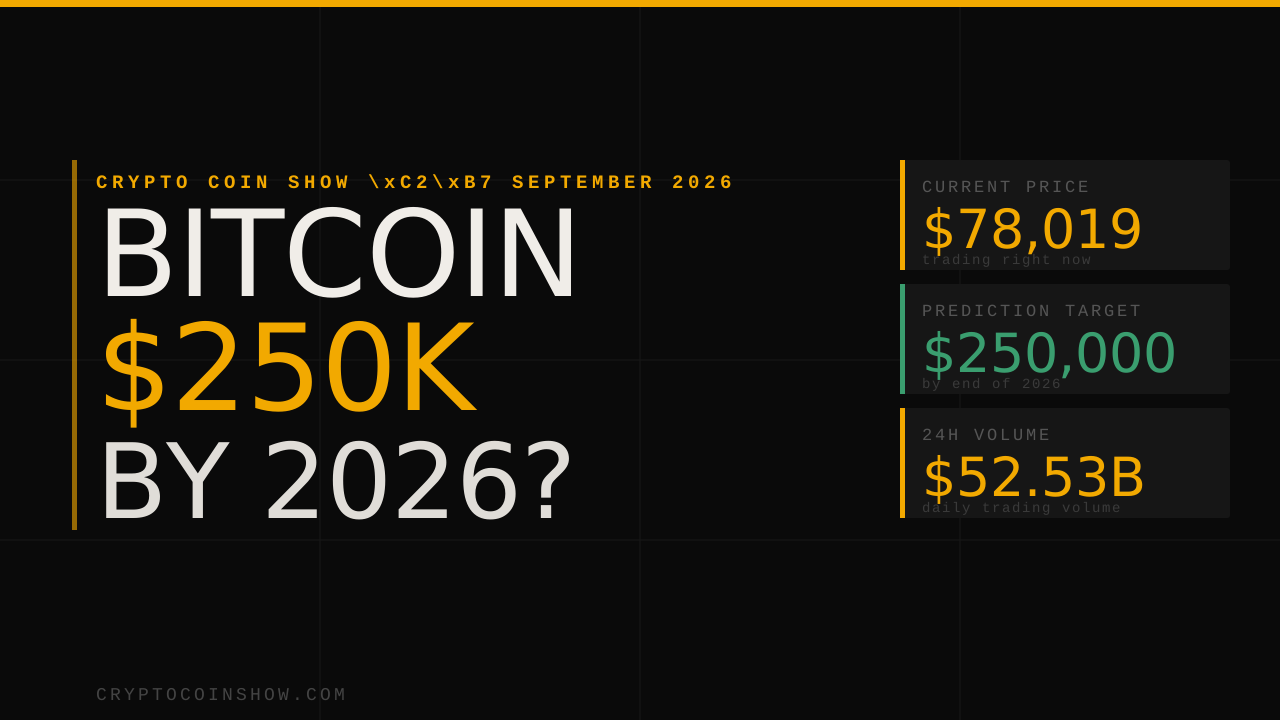
MicroStrategy maintains approximately 714,644 Bitcoin acquired at an average cost of roughly $76,056 per coin. At current spot prices near $67,900, this portfolio represents approximately $49 billion in value—a figure that exceeds MicroStrategy’s own market capitalization of roughly $42.8 billion.
MicroStrategy’s Bitcoin holdings now exceed the company’s total market capitalization, creating an inverted balance sheet structure where a single asset class drives enterprise valuation.
This concentration presents both opportunity and risk. The company has stressed that even a hypothetical decline to $8,000 per Bitcoin would maintain sufficient collateral backing for debt service obligations. That reassurance, however, carries limited weight if sustained volatility compounds operational pressures.
MicroStrategy has outlined plans to convert outstanding convertible debt instruments into equity over a three- to six-year horizon while maintaining a quarterly Bitcoin acquisition schedule. These capital decisions remain contingent on market conditions, available financing terms, and execution timing. The debt conversion strategy potentially reduces near-term pressure on share price dynamics but locks in exposure to continued Bitcoin volatility.
Institutional Participation and Market Structure
The claim that current conditions differ materially from historical cycles warrants careful scrutiny. Saylor’s argument rests on measurable institutional adoption, yet evidence of sustained, broad-based inflows remains mixed across on-chain transaction data and lending market indicators.
Comparative analysis requires examination of several concrete data points: transaction flow patterns on major exchanges, central bank liquidity conditions affecting traditional finance, banking sector credit extension to digital asset firms, and regulatory posture toward cryptocurrency market infrastructure.
Some market observers note that institutional participation has indeed expanded. Regulated spot Bitcoin Bitcoin exposure vehicles, custody infrastructure, and derivative markets now accommodate substantial capital deployment. Yet the persistence of institutional capital during periods of steep price declines—when leverage unwinds and volatility spikes—remains untested in the current cycle.
Institutional adoption metrics improved materially over the past 18 months, but whether this capital proves “sticky” during sustained corrections differs from whether it drives consistent price appreciation.
On-chain analysis provides partial clarity. Wallet concentration, exchange inflows and outflows, and long-term holder behavior offer signals about institutional versus retail positioning. Current data shows elevated volatility across these metrics, consistent with periods of uncertainty about medium-term direction.
The Evolving Cryptocurrency Market Landscape
Understanding Saylor’s positioning requires context about the broader cryptocurrency industry transformation over the past five years. The emergence of spot Bitcoin exchange-traded funds in the United States, Canadian regulatory approval of similar instruments, and growing recognition from traditional asset managers represents a fundamental shift in how institutional capital accesses digital assets.
Major financial institutions including BlackRock, Fidelity, and Charles Schwab have expanded cryptocurrency services offerings substantially. This institutional embrace reflects both market demand and recognition that digital assets represent a legitimate alternative asset class requiring infrastructure equivalent to equities or fixed income markets.
However, institutional adoption does not necessarily stabilize Bitcoin during cyclical downturns. Historical precedent from other alternative asset classes suggests that institutional participation can amplify volatility during periods of systematic deleveraging, particularly if institutions face redemption pressures or margin calls across multiple asset categories simultaneously.
The cryptocurrency lending sector—which expanded dramatically from 2020 through 2022—experienced severe disruption following the collapse of FTX and related market stress. Major institutional lending platforms either ceased operations or substantially curtailed service offerings. This contraction potentially constrains leverage availability during the next institutional capital inflow cycle, an outcome that could either reduce volatility or prevent capital deployment entirely depending on market conditions.
MicroStrategy’s Corporate Strategy and Market Implications
Beyond Bitcoin holdings, MicroStrategy operates a legacy business analytics software division generating approximately $500 million in annual recurring revenue. The company’s strategic pivot toward Bitcoin accumulation, funded through debt issuance and equity offerings, represents an unconventional corporate capital allocation strategy that concentrates shareholder returns entirely on Bitcoin price appreciation.
This approach creates a leveraged play on institutional cryptocurrency adoption. If Saylor’s thesis proves correct—that institutional participation drives sustainable Bitcoin demand—MicroStrategy shares could outperform the underlying Bitcoin asset substantially. Conversely, if institutional participation proves cyclical rather than structural, the company faces pressure to justify its balance sheet composition to debt holders and equity investors.
MicroStrategy’s strategy has attracted both significant investment from Bitcoin enthusiasts and criticism from traditional corporate governance advocates who view the concentrated Bitcoin exposure as excessive and speculative. The company’s quarterly earnings calls have emphasized management’s conviction in the Bitcoin thesis, but execution risk remains substantial if capital markets restrict the company’s access to financing or if debt covenant negotiations become more restrictive.
Catalysts and Uncertainty Ahead
Multiple potential catalysts could reshape market narrative over coming quarters. Central bank monetary policy decisions—particularly regarding interest rate trajectories and quantitative easing programs—directly influence capital allocation decisions across risk assets including Bitcoin and other digital assets.
Regulatory announcements from U.S. and international authorities regarding cryptocurrency market oversight, custody standards, and financial institution exposure limits could either validate institutional participation or impose constraints. Banking sector stress, should it materialize, might paradoxically strengthen Bitcoin’s appeal as a non-correlated asset or trigger forced liquidations across leveraged positions.
The cryptocurrency sector’s regulatory trajectory remains heavily contested. Proposed legislation addressing stablecoin issuance, exchanges, and custody requirements could accelerate institutional adoption by clarifying operational frameworks, or it could impose compliance costs that disadvantage smaller participants and consolidate market power among large incumbents.
Macroeconomic conditions—inflation trajectories, employment data, geopolitical tensions affecting energy markets—indirectly influence institutional appetite for alternative assets. Saylor’s confidence in rapid recovery depends partly on the assumption that macroeconomic conditions stabilize rather than deteriorate further.
The technical picture remains contested. Recent price action has oscillated within defined ranges, neither confirming a decisive break downward nor establishing clear upside momentum. Investors should monitor these levels carefully as they may signal the directional bias for institutional positioning over coming weeks.
Evaluating the Thesis Critically
Saylor’s public positioning—bullish on Bitcoin, confident in institutional participation, and aggressive in capital deployment—naturally reflects his firm’s material financial interests. That alignment of message with incentive structures does not invalidate the underlying analysis, but it does warrant independent verification of the empirical claims about institutional adoption and cycle dynamics.
Market participants evaluating Saylor’s thesis should examine whether institutional capital genuinely exhibits different risk tolerance profiles than retail capital, whether current regulatory clarity truly reduces systemic vulnerabilities, and whether banking sector engagement with cryptocurrency creates durable infrastructure or merely cyclical participation tied to asset price momentum.
The distinction between structural adoption and cyclical participation remains the central question animating current market debate. If institutional participants view Bitcoin as comparable to traditional alternative assets like commodities or real estate, sustained demand could emerge independent of speculative cycles. If instead institutions view cryptocurrency as tactical positioning tied to macroeconomic themes or relative value opportunities, capital flows could reverse sharply if underlying conditions shift.
Evidence will accumulate gradually through transaction data, regulatory developments, and institutional capital commitments. Bitcoin’s price discovery mechanism will reflect market participants’ evolving assessment of these fundamental questions over coming months and years.
Get weekly blockchain insights via the CCS Insider newsletter.