DAOs are forcing crypto protocols to choose between code and emergency brakes
Compound’s near-passage of a $24 million treasury transfer in July 2024 exposed a structural vulnerability in decentralized autonomous organizations: the same governance rules designed to empower token holders can be weaponized by coordinated voters to extract value before safeguards activate. Institutional investors now face a critical choice between protocol security and decentralization, and most DAOs lack adequate defenses.
- Compound Proposal 289 nearly transferred 499,000 COMP ($24 million) in final 34 minutes via 563,591 votes cast as 82% of total support.
- Max Planck and Vrije Universiteit research tracked voting-power concentration and governance-rule attacks across 48 large Ethereum DAOs.
- Emergency pause mechanisms and veto powers, the primary defense, shift control away from pure token-holder democracy toward centralized gatekeepers.
- $24M Amount of COMP tokens proposed for transfer in controversial Compound governance vote
- 82% Proportion of final proposal support concentrated in last 34 minutes before voting deadline
- 48 Large Ethereum DAOs analyzed for voting-power concentration and attack vectors
On July 29, 2024, Compound’s token holders came within eight minutes of approving a governance proposal that would have transferred 499,000 COMP, then valued at approximately $24 million, into a yield-bearing vehicle controlled by a small group of voters.
Proposal 289 had failed twice before, but on its third iteration, a coordinated bloc of addresses delegated their voting power and cast 563,591 votes in the final 34-minute window, accounting for 82 percent of all votes supporting the measure.
The proposal passed 682,191 to 633,636, a narrow margin that exposed a critical gap in Compound’s governance architecture: the protocol possessed no emergency authority to pause execution, even as community members flagged the concentration of voting power and questioned the transaction’s legitimacy.
Compound’s leadership later negotiated a settlement that canceled the allocation entirely and added a veto mechanism to future governance cycles.
The incident became emblematic of a tension now forcing decentralized protocols to confront a uncomfortable trade-off: the code worked flawlessly, executing exactly as programmed, yet the system failed to prevent what many participants viewed as a raid on the treasury.
That failure has prompted researchers and institutional stakeholders to examine whether DAOs have built sufficient safeguards into their governance layers, or whether the rush to eliminate human gatekeepers has simply created new vulnerabilities.
Max Planck Research Maps Voting-Power Concentration Across 48 Ethereum DAOs
Two separate 2026 studies from the Max Planck Institute for Software Systems and Vrije Universiteit Amsterdam examined governance vulnerabilities in 48 large Ethereum DAOs, revealing systemic patterns in how voting power concentrates and how attackers exploit valid governance rules.
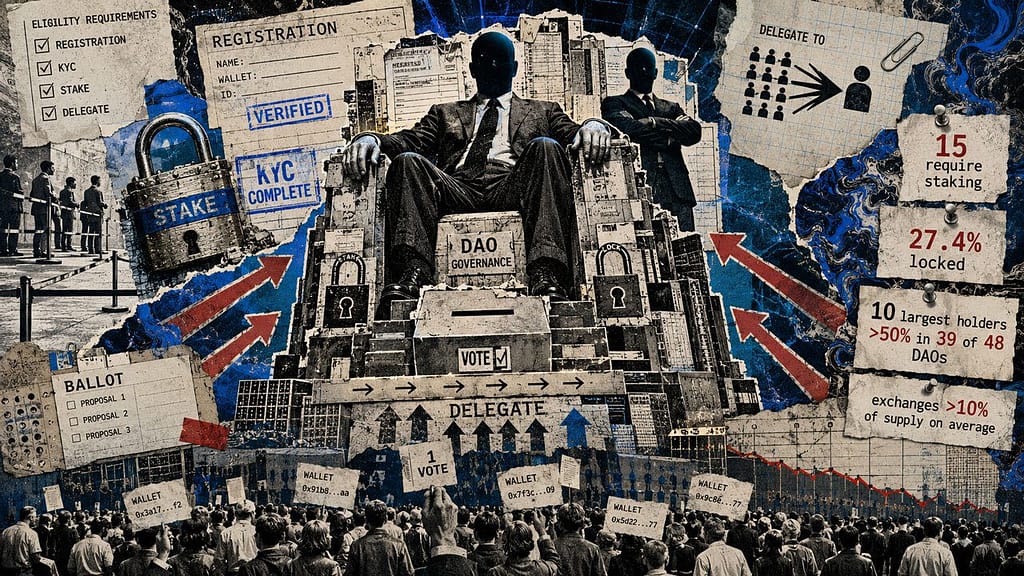
The first study traced the mechanics of registration, staking, delegation, and minimum-balance requirements, each designed to prevent spam and ensure skin-in-the-game participation, yet each creating bottlenecks that favor large holders and established delegates.
The second mapped specific attack vectors that operate within those rules, showing how coordinated actors can time proposals, accumulate delegated power, and move assets during windows when no pause mechanism exists.
Compound’s July incident exemplifies the second category: the attackers used only valid governance mechanics, registered wallets, delegated tokens, and cast votes within the deadline. No smart contract was exploited, no private keys compromised, no rules violated. The system functioned as designed and produced an outcome that a narrow majority of voters on-chain supported.
Yet institutional participants and security researchers argue that the speed and concentration of late-stage voting created conditions indistinguishable from a flash-loan attack or a sybil-coordinated raid.
This distinction matters for institutional investors evaluating DAO governance as a risk category. When a protocol failure stems from code, patches and audits can address it. When it stems from incentive design or the temporal dynamics of voting, the remedies inevitably involve adding human judgment, whether through a timelock, a veto council, a multisignature check, or an emergency pause.
Each such brake introduces the very centralization that DAOs were meant to eliminate.
Registration, Delegation, and Transaction Costs Create Tiered Access to Voting
The path from holding a governance token to casting a binding vote is longer than most participants realize.
Depending on the DAO’s architecture, a holder may need to register a wallet on-chain, lock tokens for a minimum period, explicitly delegate voting power to themselves or a proxy, maintain a minimum balance at the moment voting closes, and pay transaction fees, often significant during periods of network congestion.
Proposals face parallel barriers: someone must hold sufficient tokens or command enough delegated support to introduce a proposal, and the idea typically passes through a forum discussion and informal off-chain poll before reaching a binding blockchain vote or a snapshot poll conducted on a service such as Snapshot.
Proposal thresholds exist to prevent spam and protect the network from malicious code deployments, but they also reserve authorship for wealthy token holders and established delegates with enough capital to broadcast transactions. On-chain voting makes results enforceable and verifiable, but transaction costs, paid by individual voters, create a wealth tax that excludes smaller participants.
Off-chain polls on services like Snapshot cost nothing to participate in and attract a broad audience, yet they depend on a smaller technical group to execute the result, centralizing the final step in fewer hands.
The cumulative effect is a governance apparatus with multiple gates, each solving a legitimate problem while introducing a hidden bias. Registration requirements curb artificial participation but delay legitimate voters. Delegation thresholds reduce quorum failure but concentrate power among delegates who have actively claimed it.
On-chain voting ensures immutability but prices out smaller holders. Free off-chain voting widens participation but narrows execution.
Veto Mechanisms and Emergency Brakes Force Protocols to Accept Centralized Gatekeepers
Compound’s solution to the July incident, adding a veto role that could cancel proposals, is the most common institutional defense against governance attacks. Other DAOs employ timelocks that delay execution by days or weeks, allowing the broader community to mobilize if suspicious activity occurs.
Some use multisignature wallets held by core contributors, giving a small group the ability to reject or pause on-chain results. Others create separate committees tasked with reviewing proposals before they reach binding votes.
Each mechanism trades decentralization for security. A veto authority must be trusted not to abuse it; a timelock merely delays the attack window rather than eliminating it; a multisig concentrates power in known individuals who may face regulatory or legal pressure; a committee reintroduces the gatekeeping that blockchain governance was supposed to eliminate.
Institutional investors must evaluate whether they view these defenses as reasonable safeguards or as evidence that pure token-holder governance cannot scale without reverting to centralized control.
The Compound case offers no clean resolution to that debate. The protocol fixed the immediate vulnerability by adding a veto power, but doing so contradicts the governance model that attracted token holders in the first place. Holders buy COMP partly for the right to shape the protocol’s future; a veto council, no matter how well-intentioned, claims some of that right back.
Institutional Risk Assessment Now Hinges on Governance Resilience and Transparency
For institutional investors evaluating DAO-governed protocols, the Max Planck research and Compound’s experience suggest that governance security should rank alongside smart contract audits and custody solutions.
Protocols that lack emergency pause mechanisms, clear documentation of attack vectors, and transparent communication about voting-power concentration present material risk, particularly if they control significant assets or plan to scale to major market infrastructure roles.
The choice between code and emergency brakes is not binary; most protocols will adopt some combination of both. The question is which combination, and whether the trade-offs are disclosed clearly to participants.
A protocol that acknowledges the Compound-style vulnerability and implements graduated defenses, timelock plus multisig plus active community monitoring, may inspire more confidence than one that insists pure token-holder voting is sufficient.
The resolution will likely emerge from two parallel tracks: regulatory bodies may eventually impose minimum governance standards on protocols that touch regulated assets or custody services, while leading DAOs themselves will adopt best practices through voluntary competitive pressure. Compound’s post