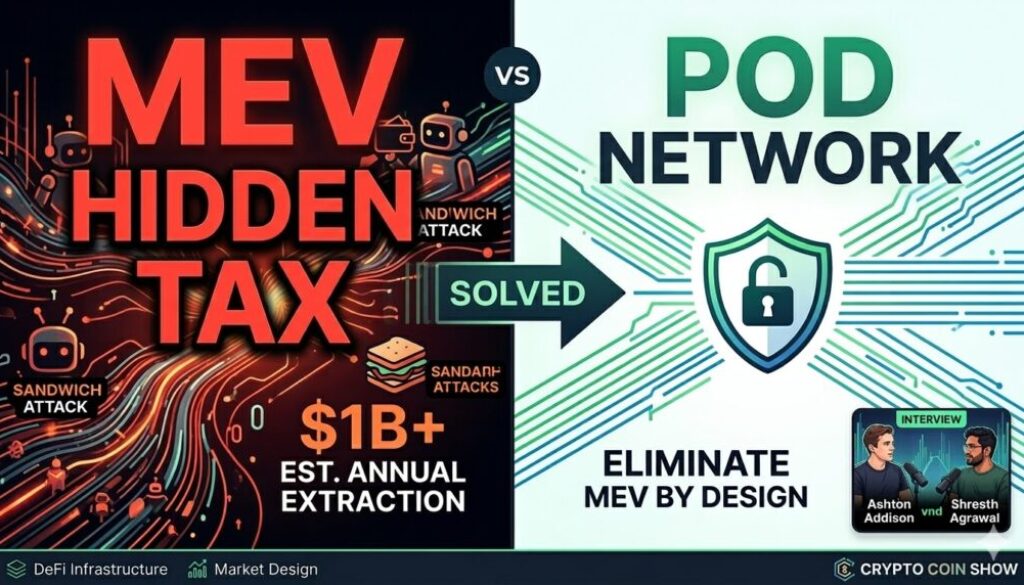
The Hidden Tax on Every Crypto Trade: MEV, Unfair Markets, and the Protocol Built to Fix Them
Every time you swap tokens on a DEX, an invisible force may be extracting value from your trade before it even settles. Here’s why MEV is the most consequential unsolved problem in decentralized markets — and how Pod Network is building a new architecture to eliminate it by design.
Imagine walking into a brokerage, placing a market order, and watching someone inside the building sprint ahead of you to buy the same asset a millisecond before your order fills — then immediately sell it back to you at a higher price. In traditional finance, that’s illegal. In decentralized finance, it happens millions of times a day. It has a name: Maximal Extractable Value, or MEV — and it represents one of the most structurally corrosive forces in the crypto market stack.
Understanding MEV is no longer optional for anyone building or trading in Web3. It is the reason why decentralized markets feel unfair even when the code is open source. It is the reason institutional capital remains cautious. And it is the problem that a small group of infrastructure builders — including Shresth Agrawal and his team at Pod Network — have made their life’s work to solve.
What Is MEV, and Why Should You Care?
MEV stands for Maximal Extractable Value — the profit that can be extracted from a blockchain by controlling or influencing which transactions get included in a block, and in what order. It was originally called “Miner Extractable Value” when proof-of-work dominated, but the mechanism persists in proof-of-stake chains and across every major L2.
Every transaction you broadcast to a blockchain network passes through a gatekeeper: a block proposer (or validator, or sequencer on an L2). This entity decides which transactions enter the next block and in what sequence. That ordering power is economically valuable — and it is routinely exploited.
Front-running: A bot sees your pending swap, inserts its own identical trade just before yours, then sells back into your order at the now-worse price. Sandwich attacks: Your trade is wrapped between a buy and a sell from the same attacker. Liquidation sniping: Bots race to liquidate undercollateralized positions the moment they become eligible.
The value extracted isn’t hypothetical. Research from various MEV tracking firms has estimated that hundreds of millions of dollars are siphoned from users annually through these mechanics — and that number grows with trading volume.
The deeper irony is that decentralization hasn’t solved this problem — in many cases, it has simply transferred the privilege. On a centralized exchange, a server operator has full visibility into the order book and incoming flow. On a “decentralized” exchange, the block proposer or sequencer occupies the same asymmetric vantage point. The power doesn’t disappear; it migrates.
On-chain markets today end up being that there is one party who controls what goes into the block and has an unfair advantage over the markets. Products can be quote-unquote decentralized, but they cannot really open the box.
— Shresth Agrawal, CEO & Co-founder, Pod NetworkThe Sequencer Problem: Decentralization’s Hidden Flaw
To understand why MEV has proven so difficult to eradicate, you need to understand the architecture of modern blockchains — and especially L2s. Layer 2 networks were built to solve Ethereum’s scalability problem: they process transactions off-chain and periodically settle on Ethereum, delivering dramatically higher throughput and lower fees.
But most L2 designs rely on a sequencer — a single entity (or small set of entities) responsible for ordering transactions before they’re batched and submitted to L1. The sequencer sees every incoming transaction before it’s finalized. It knows what you’re trading, at what size, and when. That information advantage is worth money, and anyone running or collocating with the sequencer can exploit it.
Even on L1 chains like Ethereum, the validator selected to propose the next block has the same structural advantage. Solutions like Flashbots’ Proposer-Builder Separation (PBS) have made MEV extraction more transparent and competitive — which does democratize some of the extracted value to validators — but retail users still bear the cost. The pie gets split differently; it doesn’t shrink.
This is not a bug that can be patched with a software update. It is a consequence of centralized ordering authority. As long as one party controls sequencing, that party has an extractable information advantage. Building fair markets on top of this foundation is like building a level playing field on a hillside.
Why Prediction Markets Are Especially Vulnerable
Prediction markets — platforms like Polymarket and Kalshi — have exploded in popularity over the past two years, drawing mainstream attention from media, politicians, and retail investors who have never touched a DEX. But beneath the intuitive UI lies a matching engine with serious fairness problems.
Both Polymarket and Kalshi perform their matching entirely off-chain, despite settling outcomes on a blockchain. The matching engines are hosted on servers — and high-frequency trading firms are well aware of this. The same colocation strategies that HFTs use to gain microsecond advantages on NASDAQ are deployed against prediction market retail flow. Physical proximity to the server is worth real money.
Polymarket briefly had a speed bump mechanism to blunt this advantage — a mandatory delay that reduced the HFT edge against slower retail participants. When it was removed, the consequences for retail were immediate and measurable. The episode illustrated that the problem isn’t being engineered away; it’s being managed around, imperfectly.
The fundamental issue is that prediction markets deal in exotic, illiquid assets: binary outcomes, one-of-a-kind events, long-tail scenarios with no historical price discovery. In thin markets, the advantage of seeing order flow early is amplified. A front-runner in a liquid ETH/USDC pool extracts a few basis points. A front-runner in a thinly-traded “Will X win the election?” market can move the needle dramatically, at the retail trader’s direct expense.
Pod Network: Fair Markets as a Protocol Primitive
Pod Network began not as a prediction market or exchange product, but as an infrastructure project: a protocol for decentralizing auction mechanisms used by Flashbots and CoW Swap in their order flow systems. The problem Shresth Agrawal and his co-founders set out to solve was specifically: how do you run an auction in a globally distributed setting without any single party controlling the result?
The answer they arrived at became Pod — a purpose-built Layer 1 blockchain designed from first principles around the concept of fair matching. The core insight is architectural: if the problem is centralized ordering authority, the solution isn’t better regulation of that authority — it’s eliminating the authority itself from the critical path.
Batch Auctions: An Old Idea, a New Implementation
The mechanism Pod uses is the batch auction — a model with deep roots in market microstructure theory and one that Gnosis recognized early in Ethereum’s history as particularly well-suited to illiquid assets. In a batch auction, orders are collected over a short window and cleared simultaneously at a single uniform price. There is no concept of “earlier” or “later” within a batch — all orders receive the same execution price.
This simple property eliminates the incentive for front-running within a batch. There’s nothing to gain by inserting your transaction before another in the same clearing window, because both will clear at identical prices. Any surplus generated by the batch — excess value beyond what participants demanded — is distributed back to users rather than extracted by an intermediary.
Streaming Finality Without Consensus Rounds
One of the more counterintuitive aspects of Pod’s architecture is how it handles finality. Traditional blockchains work in rounds: transactions accumulate in a mempool, a block proposer selects and orders them, a block is built, and then consensus validators ratify the block. Each step adds latency. For users, confirmation times of seconds to tens of seconds are the norm.
Pod rethinks this from the ground up. Transactions are streamed directly to all validators in parallel — there is no public mempool, no single proposer who sees transactions first. Validators locally validate each transaction and immediately return attestations. Once enough attestations accumulate, the transaction is finalized. The latency is bounded by the user’s own network ping to the validators, not by the overhead of consensus rounds.
In practice, this means sub-200ms finality for typical users — comparable to a web API call. For market applications where stale pricing compounds losses, this is not a cosmetic improvement; it changes the economics of what markets can safely exist on-chain.
Asset-Agnostic, Composable Architecture
Pod is designed to function as a matching layer, not just a closed exchange. Liquidity doesn’t need to be bridged onto Pod to be used for matching — assets can sit on other chains and have their orders matched via Pod’s infrastructure, settling wherever the underlying liquidity lives. This dramatically lowers the barrier to integrating with existing DeFi ecosystems.
For native markets on Pod, the benefits extend further: composability. When liquidity is native to the network, builders can create financial primitives that compose across markets — complex instruments, conditional orders, structured products — with the same permissionless building experience that Ethereum introduced to smart contract development. Any developer will eventually be able to call a contract function on Pod to launch a new market, on any asset class.
The Path to Institutional Adoption
For institutions — hedge funds, asset managers, corporate treasuries — the barriers to participating in on-chain markets have never been purely regulatory or custodial. The subtler barrier is market structure trust. Institutions have compliance teams, risk managers, and fiduciary obligations. Deploying capital into a venue where front-running is systemic and order execution is unpredictable is not an acceptable risk profile, regardless of yield.
Pod’s launch strategy reflects an awareness of this. The initial markets will be in US equities and real-world assets — gold, silver, and comparable instruments — rather than the speculative altcoin pairs that characterize most DEX activity. This is a deliberate signal: the infrastructure is being positioned as serious financial market architecture, not another crypto-native product for crypto-native users.
The UX framing matters equally. As Agrawal put it in our conversation: “The UX has to feel like you don’t have to know you’re using web3. You use it because you like the product, not because it’s decentralized.” That statement captures exactly the shift required for mainstream and institutional adoption — decentralization as infrastructure, invisible and trustless, rather than decentralization as identity and marketing.
What happens when markets that are currently settling globally with T+1 or T+2 latency can settle in 150 milliseconds, 24 hours a day, 7 days a week, with verifiable fairness guarantees? For precious metals, for equity derivatives, for prediction markets on geopolitical outcomes — the addressable market is not measured in DeFi TVL. It’s measured against the entire global financial system.
We want to launch with more real-world assets than crypto. We believe it’s a superior asset with superior infrastructure. Globally, 24/7 — the UX has to feel seamless.
— Shresth Agrawal, CEO & Co-founder, Pod NetworkWhat to Watch For
Pod Network is moving from testnet components toward a full end-to-end public release where users can trade, experience the execution quality firsthand, and evaluate what genuine fairness feels like in a live market. Initial native markets in US equities and real-world assets will follow, with a developer pathway for permissionless market creation coming as the system stabilizes.
For those building in DeFi infrastructure, prediction markets, or institutional on-chain products, Pod represents one of the more technically grounded attempts to solve MEV at the protocol layer rather than manage it at the application layer. The distinction matters: application-layer MEV mitigations are always one protocol upgrade away from being circumvented. Protocol-layer solutions, if sound, are structural.
The full conversation with Shresth Agrawal — covering MEV mechanics, Pod’s consensus model, the prediction market landscape, and the roadmap to NASDAQ-scale on-chain markets — is available in the video above. It’s worth an hour of any serious DeFi builder’s time.
Follow Pod Network: @poddotnetwork · Follow Shresth: @shresth3103 · Website: pod.network